Part 1: The Fast-Paced Landscape of Modern Warehousing
With Vietnam’s e-commerce (E-Com) sector projected to grow by 20–25% annually, the pressure on warehousing and logistics systems has never been greater. Customers now expect “instant delivery”, which means Distribution Centers (DCs) must operate with maximum speed and accuracy.
Is your warehouse facing these challenges?
Rising operational costs: Skilled forklift operators are increasingly scarce and expensive.
Human errors: Mis-picking SKUs or placing pallets in the wrong location can cause losses, rework, and reduced customer trust.
Space inefficiency: Traditional forklifts require wide aisles, wasting valuable storage capacity.
Slow processing speed: Manual workflows can’t keep up with seasonal or promotional peaks (e.g. 3/8, 9/9, Tet holidays).
To overcome these challenges, automation is no longer a luxury – it’s a necessity.
At the heart of this transformation lies the Smart Reach Truck – the “mobile brain” that optimizes both storage density and workflow automation in high-density warehouses.
Part 2: Decoding the Smart Reach Truck
What Is a Traditional Reach Truck?
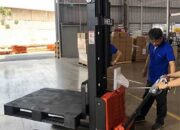
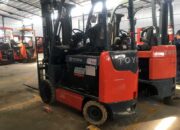
A Reach Truck (also known as a high-reach forklift) is an essential piece of equipment for high-rack, narrow-aisle warehouses. Its ability to “reach” deep into racking systems allows vertical space to be utilized efficiently.
At Samcovina, we import premium Reach Truck models from Japan (Komatsu, Toyota, Mitsubishi), Europe (Linde, Jungheinrich), and the U.S., offering both brand-new and reconditioned units with superior performance.
What Makes a Reach Truck “Smart”?
A Smart Reach Truck (also known as AMR – Autonomous Mobile Robot or AGV – Automated Guided Vehicle) is an upgraded, driverless version that operates autonomously through a suite of Industry 4.0 technologies:
Navigation Technologies:
LiDAR (Light Detection and Ranging): 360° laser scanning to map and “see” the warehouse environment.
Laser-Guided Navigation: Uses reflective targets installed in the warehouse for precise positioning.
Vision-Based (3D Cameras): Combines cameras with AI to perceive surroundings, similar to self-driving vehicles.
IoT Connectivity & WMS Integration:
Smart Reach Trucks communicate directly with your Warehouse Management System (WMS). When an order is created, the WMS automatically commands the nearest truck:
“Go to A-05-3, pick pallet code XYZ, and deliver it to Packing Zone B.”Artificial Intelligence (AI):
AI enables fleet coordination, optimizing travel routes, avoiding obstacles (e.g. pedestrians, other trucks), and automatically returning to charging stations when battery levels are low.Precision Automation:
Equipped with height and depth sensors, the forks automatically adjust with millimeter accuracy to pick or place pallets—completely eliminating rack collision risks.
Part 3: Five Key Advantages of Automating with Smart Reach Trucks
Maximum Storage Density
Smart trucks operate with pinpoint accuracy, enabling narrower aisles and up to 30% higher storage capacity on the same floor area.24/7 Productivity
Autonomous Reach Trucks can work three shifts non-stop, requiring only automatic charging downtime. They don’t tire or lose focus—ensuring consistently high throughput.Safety and Zero Errors
Advanced safety sensors instantly stop the vehicle when obstacles are detected. Integrated WMS communication ensures 100% accuracy – right product, right location, every time.Solving Labor Shortages
The shortage of certified, experienced Reach Truck operators is an ongoing challenge. Automation allows you to redeploy human resources into higher-value supervisory or analytical roles.Data-Driven Operations
Every movement, task duration, and battery cycle is recorded in real time. Managers gain actionable data for performance optimization and predictive maintenance.
Part 4: Implementation Challenges and Roadmap in Vietnam – A Practical Perspective
As industry experts, Samcovina recognizes that full automation is a journey, not an overnight transformation.
Vietnamese businesses typically face three main barriers:
High Capital Expenditure (CapEx): Initial investment in autonomous trucks and WMS software can be significant.
Infrastructure Requirements: Automated trucks require ultra-flat floors and stable industrial Wi-Fi coverage.
System Integration: Ensuring seamless communication between WMS, ERP, and the autonomous fleet remains a major challenge.
Recommended Phased Automation Roadmap
Phase 1 – Standardization & Optimization:
Before automation, ensure your warehouse operations are standardized. Begin by investing in high-quality semi-automatic or manual Reach Trucks, maximizing efficiency and safety.
(Samcovina offers top-tier new and pre-owned models from Japan, Europe, and the U.S., balancing performance with cost-effectiveness.)Phase 2 – Semi-Automation:
Deploy operator-assist technologies (e.g., auto-stop at programmed rack heights) or basic AGVs for fixed transport routes (e.g., from storage to dispatch zones).Phase 3 – Full Automation:
Once your infrastructure and WMS are ready, implement a fully autonomous Smart Reach Truck fleet deeply integrated with your logistics ecosystem.
Part 5: Samcovina – Your Partner in the Journey Toward Modernization
Automation is inevitable—but the right solution is what determines success.
At Samcovina, we don’t just sell forklifts; we deliver complete, flexible automation solutions tailored to every stage of your business growth.
We Understand What You Need:
Consulting & Foundational Solutions:
For businesses in early automation phases, Samcovina provides a full range of Reach Trucks, Forklifts, and Pallet Trucks (new or reconditioned) from the world’s leading brands—laying a strong foundation for your future automated warehouse.Flexible Rental Services:
Want to test-drive new Reach Truck technologies before a major investment? Samcovina’s short- and long-term forklift rental services in Vietnam and neighboring countries help you minimize Opex while deferring Capex.Reliable After-Sales Support (Maintenance, Repair & Parts):
Whether traditional or automated, every machine needs maintenance. Our experienced technicians and genuine spare parts inventory ensure maximum uptime and sustained performance for your fleet.