Processing and manufacturing service for crossbeam handrails
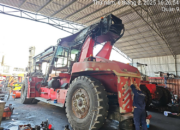
With Reach Stackers over 10 years old, crossbeam handrails often experience cracking or breakage. In such cases, you need to address this issue by manufacturing a crossbeam handrail box. It is recommended to seek specialized companies that provide crossbeam handrail manufacturing services to ensure quality. You can consider the services offered by Samco Vina Joint Stock Company.
What is a crossbeam handrail?
A crossbeam handrail is an important component of the Reach Stacker forklift. It is used to lift and transport containers at ports and warehouses. The crossbeam handrail consists of the following parts:
Sturdy beams: Designed to withstand the heavy load of containers and ensure stability during forklift movement. Multiple beams are connected together and attached to the forklift frame to form a crossbeam handrail.
Joints: Enable the crossbeam handrail to adjust height and width according to the size of the containers.
Clamping system: Used to securely grip the containers for lifting and transportation. The clamping system consists of mechanical mechanisms controlled manually or electrically to clamp the containers.
Control components: The crossbeam handrail is equipped with various control components that facilitate easy operation and adjustment during operation.
Causes of crossbeam handrail breakage and damage
The crossbeam handrail is designed to lift and lower 20-foot and 40-foot containers. Along with heavy loads, the crossbeam handrail operates frequently, sometimes even under overload conditions. Below are some reasons that can cause crossbeam handrail breakage and damage:
2.1. Heavy load capacity
When the crossbeam handrail bears heavy loads from heavy containers over a long period, it can experience reduced efficiency and wear. If the equipment is not regularly maintained and replaced, the crossbeam handrail may be damaged or broken due to excessive load capacity.
2.2. Improper usage
Incorrect usage or failure to comply with safety regulations during container transportation can lead to crossbeam handrail damage. Some instances of improper usage include misaligned clamping system control, incorrect adjustment of joints, excessive impacts on the crossbeam handrail, and more.
2.3. Technical failures
In rare cases, crossbeam handrails can experience breakage or failure due to technical errors. This typically occurs during production, assembly, or maintenance processes.
2.4. Lack of maintenance and servicing
Over time, forklifts show signs of decreased performance and wear. To detect early signs of damage and carry out necessary repairs, regular maintenance and servicing are essential. If a company neglects regular maintenance and servicing of forklifts, the crossbeam handrails are prone to cracking, breaking, or wearing out.
Guide to inspecting the condition of crossbeam handrails
How can you preliminarily assess the condition of crossbeam handrails before deciding on crossbeam handrail manufacturing? Here is a guide on inspecting the condition of crossbeam handrails before proceeding with manufacturing:
Check for scratches, impacts, cracks, or fractures on the crossbeam handrails.
Inspect for any bending or deformation in specific areas of the crossbeam handrails.
Examine the screws, joints, and clamping system for any signs of cracks.
Test the load-bearing capacity of the crossbeam handrails by lifting and lowering containers according to regulations.Spreader Beam Box Manufacturing Process at Samco Vina
To ensure the reliable completion of spreader beam boxes, they are manufactured following standardized processes. At Samco Vina, we manufacture spreader beam boxes according to the following procedure:
Step 1: Inspect the condition of the spreader beam to identify areas of damage and determine the best course of action.
Step 2: Prepare materials including steel plates, machining tools, connecting joints, etc.
Step 3: Design a mold based on the dimensions of the existing or required spreader beam box.
Step 4: Cut the steel plates according to the dimensions of the designed mold.
Step 5: Machine the steel plates using specialized tools such as grinders, cutters, drills, etc.
Step 6: Weld the steel plates together to form the spreader beam box, weld the connecting joints, apply anti-rust paint, and complete the surface details of the spreader beam box. Finally, install the spreader beam box onto the forklift.
Step 7: Perform quality inspections on the spreader beam box and test its operation.
Spreader Beam Box Manufacturing Service
If you have a need for spreader beam box manufacturing but haven’t found a suitable provider, consider Samco Vina – a reputable and quality-focused company specializing in spreader beam box manufacturing.
Here are the reasons why you should choose our spreader beam box manufacturing service:
4.1. Reputation and years of experience
With over 8 years of experience in the field of spreader beam box manufacturing, having served 18 equipment units and over 30 spreader beams, Samco Vina has become a trusted partner for all customers. Additionally, spreader beam box manufacturing is one of our core services, ensuring that we deliver the highest quality products and services.
4.2. Professional technical team and dedicated support
We have a professional technical team with extensive experience in repairing and manufacturing spreader beam boxes. With their enthusiasm and dedication, our technical team is always ready to provide 24/7 support to customers.
4.3. Competitive pricing
To meet the needs of customers for our services, we offer competitive pricing compared to the market. Therefore, customers can have peace of mind when using our products and services.
Spreader beam boxes are crucial components of Reach Stacker forklifts. Therefore, it is important to choose reputable and quality-focused companies for spreader beam box manufacturing.
These are the details about our spreader beam box manufacturing service. We hope that through this article, you have gained a better understanding of the signs, processes, and services related to spreader beam box manufacturing. If you have any further questions or require our services, please contact our hotline at 0931 431 599 for assistance.