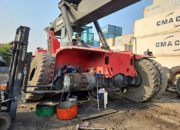
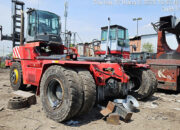
Container Handler Requires Hydraulic Pump Replacement
In the operating system of a container handler (Reachstacker) or a heavy-duty forklift, the hydraulic system functions like a circulatory network, with the hydraulic pump serving as the heart. When this “heart” weakens, the machine’s ability to lift and handle tens of tons of cargo can be severely compromised, potentially disrupting the entire logistics chain at ports or yards.
At Samcovina, backed by years of experience in importing and maintaining equipment from Europe, the United States, and Japan, we understand that early detection of hydraulic pump issues can help businesses avoid major repair costs and minimize unplanned downtime.
- Why Is the Hydraulic Pump So Critical?
The hydraulic pump converts mechanical energy from the engine into hydraulic energy (oil flow and pressure). This hydraulic pressure is transmitted through control valves to hydraulic cylinders, enabling heavy-duty operations such as:
- Boom lifting and lowering
- Telescopic extension and retraction
- Spreader opening and closing
For premium brands like Kalmar, Konecranes, Linde, and Hyster, hydraulic systems are engineered with high precision to withstand loads ranging from 10 to 45 tons. Even minor pump deficiencies can lead to serious safety risks and performance losses.
- Five Key Warning Signs of Hydraulic Pump Failure
Routine inspections can help identify these common symptoms:
2.1. Abnormally Slow Lifting Speed
Despite high engine RPM, lifting operations become noticeably slower or lack normal power. This typically indicates insufficient hydraulic flow due to internal wear of components such as pistons or the swash plate, causing internal leakage.
2.2. Unusual Noise and Cavitation
A high-pitched whine or rattling noise near the pump area signals trouble. These sounds often result from:
- Air entering the hydraulic circuit
- Loose internal components
- Cavitation (formation and collapse of vapor bubbles)
Prolonged cavitation can rapidly erode internal metal surfaces.
2.3. Excessive Hydraulic Oil Temperature
A worn pump forces oil through narrow clearances under high pressure, generating excessive heat. If the hydraulic tank or lines feel excessively hot (commonly exceeding 80°C), the pump may be operating inefficiently or under overload conditions.
2.4. Jerky or Delayed Hydraulic Response
When joystick inputs fail to produce immediate movement, or lifting becomes jerky and unstable, this suggests fluctuating hydraulic pressure from the pump. This directly impacts stacking precision and operational safety.
2.5. Metal Particles in the Hydraulic Filter
During scheduled maintenance, the presence of metallic debris in the hydraulic filter element is a serious warning. It indicates advanced wear of internal pump components such as pistons, cylinder blocks, or gears. Immediate corrective action is necessary to prevent contamination damage to expensive valves and actuators.
- Common Causes of Premature Pump Failure
- Contaminated hydraulic oil – responsible for up to 70% of pump failures
- Incorrect oil specification – improper viscosity reduces lubrication efficiency
- Overloading operations – frequent lifting beyond rated capacity
- Harsh working environments – salt-laden port air accelerates corrosion and seal degradation
- Samcovina’s Recommendation: Overhaul or Replace?
Our technical team advises based on cost-efficiency and operational safety:
- Pump Overhaul (Repair)
Suitable when the pump housing remains intact and damage is limited to seals or minor surface wear. This option is economical but requires precise calibration after repair. - Pump Replacement
Necessary when there is structural damage (cracked housing, broken shaft) or severe internal wear (>60%). For European-imported equipment, we recommend replacement with reputable pump brands such as Parker, Rexroth, Danfoss, or Casappa to maintain original performance standards.
- Why Choose Samcovina for Service and Parts?
As a direct importer, Samcovina delivers reliability and peace of mind:
- Extensive inventory – hydraulic pumps for Kalmar, Konecranes, SMV, Hyster, and more
- International quality standards – genuine and OEM-certified components
- On-site technical support – rapid inspection and replacement at ports and yards
- Comprehensive warranty – manufacturer-standard coverage for all replacement units