Container Reachstacker Repair Services at Ports – 5 Key Criteria for Choosing a Reliable Provider

Container Reachstacker Repair Services at Ports – 5 Key Criteria for Choosing a Reliable Provider

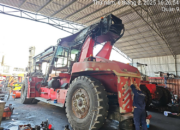
In the logistics supply chain, if seaports are considered the lifeline, then container handling equipment such as reachstackers and empty container handlers are the most critical assets. Even a minor fault that causes equipment downtime can disrupt the entire yard operation, resulting in losses of thousands of dollars per hour for businesses.

Finding a repair service provider is not difficult; however, selecting a technically competent partner capable of accurate fault diagnosis and delivering permanent solutions for these multi-ton machines is a major challenge for technical managers.

1. Why Is Choosing the Right Container Handler Repair Service So Critical?

Unlike standard warehouse forklifts, container handlers are highly complex systems integrating heavy-duty mechanical structures, high-pressure hydraulics, and advanced electronic control systems.

High asset value: A reachstacker can cost from hundreds of thousands to millions of USD. Entrusting such equipment to an unqualified service provider is a high-risk gamble.
Safety is paramount: With lifting capacities ranging from 10 to 45 tons, any mistake in repairing braking systems, hydraulic cylinders, or lifting structures can lead to catastrophic accidents at the port.
Time pressure at ports/ICDs: In container yards, time is money. Delayed repairs can result in demurrage charges, missed vessel schedules, and damage to the operator’s reputation.
2. Five Key Criteria for Selecting a Professional Repair Service Provider

To properly evaluate a service provider, technical managers should consider the following qualitative and quantitative criteria:

2.1. Technical Expertise and Industry Experience

This is the most critical factor. A reputable provider must have technicians with in-depth knowledge of EU/G7 equipment brands such as Kalmar, Konecranes, Linde, and Ferrari.

Diagnostic capability: Beyond mechanical repairs, technicians must be able to read and analyze CAN-bus systems, troubleshoot complex fault codes from transmissions (Dana, ZF), and engines (Volvo Penta, Cummins).
Hands-on experience: Priority should be given to providers experienced in major overhauls such as engine rebuilding, hydraulic system refurbishment, and control software troubleshooting.
2.2. Availability of Genuine Spare Parts

“Waiting for spare parts” is every fleet owner’s nightmare. A professional service provider should maintain a well-stocked parts inventory.

Traceable origin: Spare parts must have clear documentation (Genuine, OEM, or high-quality aftermarket replacements).
Stock availability: Fast-moving items such as filters, seals, and critical components like load sensors or hydraulic solenoid valves should be readily available for immediate replacement.
2.3. Modern Equipment and Specialized Tools

The era of relying on manual inspection and experience alone is over. Leading service providers must be equipped with:

Dedicated diagnostic tools: For ECU access, fault code clearing, and parameter calibration.
Specialized equipment: Hydraulic presses, pressure testing devices, and heavy-duty service tools to ensure proper handling without damaging components.
2.4. Professional and Transparent Workflow

A service provider’s professionalism is reflected in its operational process:

Inspection & assessment: Rapid on-site response to evaluate equipment condition.
Detailed quotation: Clear breakdown of repair scope, replacement items, costs, and estimated timeline.
Execution: Repair processes are documented with photos/videos, allowing remote monitoring by clients.
Commissioning & handover: Load testing and detailed acceptance reports upon completion.
2.5. After-Sales Support and Warranty Policies

A confident service provider will always offer strong after-sales support:

Warranty coverage: Clear warranty terms for overhauled systems and replaced components.
24/7 technical support: Immediate assistance in case of post-repair issues.
3. Samcovina – Your Trusted Technical Partner for Container Handling Equipment

In Vietnam, Samcovina Joint Stock Company meets the most stringent standards in container handler technical services.

Importer advantage: We directly import equipment and spare parts from Europe, the USA, and Japan. This ensures our customers receive genuine parts at competitive prices without intermediaries.
Expert technical team: Our technicians are not only repair specialists but also highly skilled diagnosticians for both legacy reachstackers and modern high-tech equipment.
Comprehensive solutions: In addition to repair services, Samcovina offers rental equipment solutions. If your machine requires extended downtime for repairs, we provide replacement units to ensure uninterrupted port operations.

Leave a Reply

Your email address will not be published. Required fields are marked *

Related posts

  • toyota-xe-nang Common Errors in Electric Forklifts

    I. Common errors in electric forklifts Maintaining and repairing electric forklifts is crucial to ensure their performance and lifespan. During usage, electric forklifts may encounter common errors, including electrical system failures, mechanical issues, and battery problems. These errors can be caused by improper usage, lack of regular maintenance, and the impact of weather conditions. To effectively handle and maintain electric forklifts, regular inspections and maintenance should be conducted, users should be trained properly, and genuine spare parts should be used. Additionally, preventive measures such as safety instructions during usage, proposing basic repair training for managers, and enhancing maintenance awareness among users should be implemented. 1. Electrical system failures in forklifts Electrical system failures are one of the common errors in electric forklifts. Power loss is a common issue that can be caused by weak or faulty batteries. To address this problem, batteries should be checked and replaced if necessary. Controller malfunctions can also occur due to damaged or improperly functioning components. To resolve this issue, components should be inspected and repaired or replaced if necessary. 2. Mechanical issues in forklifts Mechanical issues are another problem that electric forklifts may encounter. The steering system can experience malfunctions due to damaged or improperly functioning components. To address this problem, components should be checked and replaced if necessary. The lifting system can also experience malfunctions due to damaged or improperly functioning parts. To resolve this issue, parts should be inspected and repaired or replaced. 3. Battery-related issues in forklifts Battery problems are also crucial factors affecting the performance of electric forklifts. Battery lifespan can be affected by various factors such as battery age, usage conditions, and maintenance procedures. To maintain battery lifespan, proper maintenance and charging procedures should be followed. Decreased battery performance is another issue that can be caused by battery age, overloading, or incomplete charging. To address this problem, batteries should be checked and charged according to proper procedures. II. Causes of errors in electric forklifts – Causes of errors in electric forklifts can be attributed to improper usage, lack of regular maintenance, and the impact of weather conditions. Improper usage can lead to errors such as overloading the forklift or using incorrect procedures. To avoid these errors, adherence to usage procedures and limiting forklift overload is necessary. – Lack of regular maintenance is also a common cause of errors. Failure to conduct regular maintenance can affect the performance and lifespan of the forklift. To keep the forklift operating well, regular maintenance should be performed following manufacturer instructions. – Weather conditions can also impact the operation of electric forklifts. Factors such as high temperatures, cold weather, or dampness can cause issues for the forklift. To minimize the impact of weather conditions, proper protection and storage practices should be implemented. III. Handling and maintaining electric forklifts – To effectively handle and maintain electric forklifts, regular inspections and maintenance are necessary. Regular inspection and maintenance procedures help maintain the performance of the forklift and detect potential issues early on. – Proper training of users is also crucial, providing users with instructions on safe and efficient usage of electric forklifts. The use of genuine spare parts is another essential factor that cannot be overlooked as it ensures quality and longevity. – Additionally, preventive measures should be implemented to avoid errors from occurring. Safety instructions during usage are one important measure, providing safety guidelines to users of electric forklifts. – Proposing basic repair training for managers is another suggestion; training managers on basic knowledge about repairing electric forklifts enables them to handle minor issues without having to call technical staff. – Enhancing maintenance awareness among users is also an important measure, strengthening maintenance and management awareness of electric forklifts from the users. This can be achieved through providing usage instructions, reminders about regular maintenance, and creating a safe and professional working environment. In conclusion, maintaining and repairing electric forklifts is crucial to ensure their performance and lifespan. Addressing common errors such as electrical system failures, mechanical issues, and battery problems should be done meticulously and accurately. Regular inspections and maintenance, proper user training, and the use of genuine spare parts are important measures to handle and maintain electric forklifts effectively. Preventive measures such as safety instructions during usage, proposing basic repair training for managers, and enhancing maintenance awareness among users are also crucial to prevent errors from occurring.

  • xe nang container the he moi Trends in New Technology Applications in the Forklift Industry

    Trends in New Technology Applications in the Forklift Industry As logistics and warehouse management continue to evolve, the forklift industry is experiencing a breakthrough thanks to technological advancements. From Automated Guided Vehicles (AGVs) to Artificial Intelligence (AI) and lithium-ion battery-powered electric forklifts, these trends not only improve operational efficiency but also shape the future of […]

  • Thao-lap-xe-nang-fantuzzi Forklift dismantling and moving service

    Forklift dismantling and moving service Service of dismantling and transporting all models of forklift trucks of Samco Vina JSC Service of dismantling and transporting all models of forklifts is provided by many companies in the market. However, if you are interested in the service provided by Samcovina Joint Stock Company, here are some background information […]

  • xe nang container dau -dien Diesel or Electric Container Reachstackers?

    Advantages and Disadvantages of Each Option As the global and Vietnamese logistics industries rapidly transition toward the “Green Port” model, selecting material handling equipment is no longer just a purchasing decision—it is a long-term capital investment strategy. When comparing two major options—traditional diesel-powered container reachstackers and next-generation electric reachstackers—which solution is truly optimal for your […]

  • ban va cho thue xe nang The Most Reputable Forklift Brands Today

    The Most Reputable Forklift Brands Today Forklifts are essential equipment in industries, logistics, and warehousing. Choosing a reputable forklift brand not only ensures operational efficiency but also optimizes costs and enhances safety. In this article, we introduce the top 5 most trusted forklift brands today—Toyota, Linde, Kalmar, Komatsu, and Cat—along with their strengths and standout […]