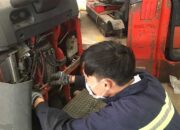
5 Warning Signs Your Reachstacker Brake System is Failing

5 Warning Signs Your Reachstacker Brake System is Failing — And When to Replace Brake Pads

Meta Description: Don’t wait until brake failure becomes a disaster. Learn the 5 critical warning signs of brake issues on reachstackers and when to replace brake pads for maximum safety and uptime.

Brake Failure = Disaster for Safety and OPEX

What happens if a 60–80 ton reachstacker — currently carrying a 40ft container — suddenly loses braking capability?

This is not a theory. This is real-life risk at ports, ICDs and yard operations.

Brake system integrity on heavy lift equipment (wet disc brakes or hydraulic / pneumatic drum brakes) is one of the most safety-critical systems. They handle extreme load and are directly responsible for safely decelerating multi-million-dollar assets.

Early detection of brake deterioration prevents expensive downtime and protects personnel.

Samcovina — as a leading service and parts solution provider for heavy lift trucks from EU/US/Japan — understands how critical brake system control is.

5 Red Flag Symptoms Your Reachstacker Brakes Are Calling for Help

Never ignore these 5 technical symptoms. They indicate serious brake system failure in progress.

1) Abnormal Noise When Braking (Squealing, Grinding, Scratching)

Description: Extremely loud metallic friction (squeal/grind), or “gravel-like” rubbing noise when brake pedal is applied.

Technical root causes:

Worst case: Brake pads are worn down to backing plate, metal-to-metal contact with rotor

Wet disc brakes: low level, dirty oil, oil contaminated with metal chips → dry friction

Scored / warped rotors or foreign debris (stones) trapped inside brake pack
Impact: destroys rotors / brake pack → extremely high replacement cost; sudden loss of brake torque

2) Brake Pedal Feel Changes (Too Soft, Too Hard, or Vibration)

Soft pedal (“spongy”): pedal travel goes deep before braking torque builds

Hard pedal: requires excessive force to decelerate

Vibrating pedal / steering wheel vibration during braking

Technical root causes:

Soft pedal: hydraulic fluid leak / air in brake line

Hard pedal: seized caliper pistons, clogged line, brake booster (pneumatic) failure

Vibration: warped rotors (typically overheating problem)
Impact: unpredictable stopping distance — no emergency stop capability

3) Truck Pulls to One Side When Braking

Description: When braking (especially hard braking), the unit drifts/pulls to left or right, operator must counter-steer strongly.

Root cause:

Unequal brake torque per axle/wheel

Usually: seized piston on one side, one brake pad wearing faster than the other, or one hydraulic/pneumatic circuit restricted
Impact: extremely dangerous under speed OR when carrying heavy load — high risk of skid or overturn

4) Fluid Leaks (Brake Fluid or Axle / Hub Oil)

Description: Wet/oily stains near wheels, brake calipers or along hose lines.

Technical identification:

Brake fluid (light color): leak from hose or caliper → hydraulic pressure loss

Axle / hub oil (dark, strong smell) — on wet disc brakes, this is the cooling oil → loss causes overheating and burning of brake pack
Impact: sudden brake loss; total destruction of wet disc brake assembly

5) Brake Warning Light on Dash

Description: Brake warning lamp (“(!)” or “BRAKE”) or general fault lamp.

Root cause (ECU reports):

Hydraulic reservoir low level

Brake pad wear sensor reached limit (modern machines)

Hydraulic / pneumatic pressure alarm
Impact: ignoring this is extremely high risk — stop operation immediately

When Is the Correct Timing to Replace Reachstacker Brake Pads?

Many fleets replace brakes “after failure”. Professional fleets replace before failure.

1) Replace Immediately (No Delay)

If any of the above 5 symptoms appear — especially #1 (metal noise), #2 (soft pedal) and #4 (fluid leak) → stop machine.

2) Replace Based on Preventive Maintenance Schedule

This is the optimum method.

Based on operating hours (OEM recommendation, e.g. 5,000h / 10,000h)

Depends on operation condition (marine corrosion, aggressive braking cycles)
Pro tip: Do not only count hours — always combine with visual inspection during PM service (oil / filters service interval)

3) Replace When Visual Inspection Confirms

During PM service technicians check:

Remaining friction material thickness (<20–25% = replace)

Pad condition: cracked, glazed (overheat), uneven wear (caliper piston sticking)

The Cost of Delay: “Saving” Becomes “Burning Money”

Trying to “save cost” by delaying pad replacement is a major financial mistake.

Rotor / wet disc pack replacement = 10x–20x the cost of pads

Downtime cost: emergency shutdown disrupts port/ICD logistics

Safety & liability risk: even minor collision → huge legal exposure
Leave a Reply

Your email address will not be published. Required fields are marked *

Related posts

  • Types of Forklift Trucks

    Learn about forklifts There are many different types of forklifts and each type of forklift has different functions, capacities, advantages and disadvantages. Let’s take a look at some of the problems that are particularly common with each type of forklift: Hand pallet truck Hand pallet truck is a forklift with compact size, simple design and […]

  • dong-co-xe-nang-dien Maintenance of electrical systems for forklifts

    Electric systems for forklifts The forklift’s electrical system is the main part of the forklift, a minor failure can cause the entire vehicle to malfunction or cause an accident. Therefore, the maintenance and maintenance of various components in the forklift’s electrical system is extremely important for the safe use of the forklift. The power supply […]

  • mua-xe-nang-qua-ngan-hang Buying and selling forklifts with installment payments through a loan bank

    Buy and sell forklifts with installment payments through the bank You want to buy a forklift through the bank? Not sure what this should include? The article below will help you understand the basics. Some information when buying a forklift through a bank in the form of installment payment Today, with the rapid development of […]

  • xe-cho-thue What information do forklift hirers need to know?

    What information do you need to know when renting a forklift? When buying or renting a forklift, knowing how to choose the right forklift for the job requires you to have in-depth knowledge if you want to find the most efficient forklift for the job you need while also saving money. most cost effective. In […]

  • hoi-dap-xe-nang-toyota Frequently Asked Questions about Common Issues with Toyota Forklifts

    Frequently Asked Questions about Common Issues with Toyota Forklifts 1. What are the causes and solutions for hydraulic oil leaks in Toyota forklifts? – The causes can be worn or damaged hydraulic oil lines, loose or damaged seals and gaskets, stuck or faulty hydraulic control valves, or leaking lift cylinders. – The solutions include checking and replacing damaged parts, regularly cleaning and maintaining the hydraulic system, and ensuring that the hydraulic oil is clean and at the required level. 2. What are the causes and solutions for difficult or failed engine starting in Toyota forklifts? – Common causes include weak or faulty batteries, malfunctioning starter systems, fuel injection/fuel system issues, or fouled spark plugs. – Solutions involve checking, charging, or replacing the battery; inspecting the starter system; cleaning or replacing fuel injection/fuel system components; and cleaning or replacing spark plugs if necessary. 3. How should you handle an overheating engine in a Toyota forklift? – Causes may include low engine coolant levels, a faulty cooling fan, clogged coolant lines, or a leaking water pump. – Solutions involve immediately stopping the operation of the forklift, checking the cooling system, adding coolant if needed, replacing the cooling fan or water pump if necessary, and cleaning and repairing any clogged coolant lines. 4. What are the causes and solutions for weak or loss of lifting power in Toyota forklifts? – Causes can include decreased hydraulic pressure in the system, inefficient hydraulic pumps, or leaking or damaged lift cylinders. – Solutions involve checking and addressing any factors that reduce hydraulic pressure, replacing the hydraulic pump if needed, and repairing or replacing faulty lift cylinders. 5. What should you do when the steering system of a Toyota forklift becomes stiff or too heavy? Firstly, check the hydraulic fluid level for the steering system and top it up if it’s low. Then inspect the hydraulic lines and control valves for the steering system, replacing them if damaged. If the issue persists, it may be due to worn steering worm gears or a faulty steering shaft that needs replacement. 6. How should you handle ineffective braking in a Toyota forklift? Firstly, check the brake fluid, replacing it if contaminated or low. Then inspect the friction surface of the brake discs, replacing them if worn. If the issue continues, check the brake cylinders, brake lines, and brake pump for any faults, repairing or replacing any damaged components. 7. What are the causes and solutions for non-functioning turn signals and lights in Toyota forklifts? – Causes can include blown fuses, broken wires, burnt-out bulbs, or faulty light switches. – Solutions involve checking and replacing blown fuses, repairing or replacing broken wires, installing new bulbs, and replacing faulty light switches if necessary. 8. How should you handle a malfunctioning battery charger in a Toyota forklift? Firstly, check the battery itself; replace it if corroded or too old. Then inspect the wiring from the charger to the battery; replace any broken wires or shorts. Next, check the charger; replace it if not functioning properly. Finally, adjust the charger settings to match the type of battery being used. 9. What should you do when there is hydraulic system leakage or loss of pressure in a Toyota forklift? Firstly, check the hydraulic fluid level; top it up to the required level if low. Then inspect the entire hydraulic system to identify any leaks or loss of pressure. Causes can include faulty hydraulic cylinders, hoses, valves, or seals/gaskets. Replace any damaged parts to restore pressure and ensure a tight seal in the system. 10. What are the causes and solutions for worn or damaged wheels on Toyota forklifts? – The main causes are overloading, driving on rough terrain, sudden changes in direction leading to increased tire wear. Additionally, wheels can be damaged due to rough handling. – Solutions involve ensuring proper loading during operation, driving cautiously on flat surfaces, and being careful when changing directions. Replace worn or damaged wheels with new ones. 11. How should you address transmission issues in a Toyota forklift? Firstly, check the transmission fluid level; top it up if low. Then inspect the components of the transmission system such as the clutch, drive shaft, couplings, and belts; replace any damaged parts if necessary. Finally, check the gearbox and gearbox oil pump; replace them if faulty. Regularly maintain and clean the entire transmission system. 12. What are the causes and solutions for a stuck parking brake in a Toyota forklift? – Common causes include a jammed or broken parking brake cable, deteriorated rubber grommets causing cable sticking, or a stuck or rusted brake drum. – Solutions involve removing and cleaning the parking brake cable, replacing it if broken, replacing deteriorated rubber grommets, lubricating the brake drum with grease if necessary, and replacing heavily rusted brake drums. 13. How should you handle a malfunctioning stability control system in a Toyota forklift? Firstly, check the hydraulic fluid level for the stability control system; top it up to the required level if low. Then inspect the hydraulic control valve and hydraulic cylinders to ensure there are no leaks. Replace valves or cylinders as needed.