How to Select the Right Warehouse Forklift Based on Facility Size to Optimize Cost and Space

How to Select the Right Warehouse Forklift Based on Facility Size to Optimize Cost and Space

Optimizing warehouse space is not only about racking layout—it is also closely tied to material handling equipment. Choosing the wrong type of forklift can lead to wasted space, increased collision risks, and reduced operational efficiency. With years of experience importing forklifts from Europe and the United States, Samcovina helps businesses solve the challenge of selecting the right equipment based on actual warehouse specifications.


  1. Understanding the “Key Parameters” When Selecting a Forklift

Before investing in or renting a forklift, business owners must clearly understand three critical technical parameters that directly impact warehouse operations:

  • Aisle Width:
    The clear distance between two rows of racking or between racks and walls. The aisle must be wide enough to allow the forklift to turn and place pallets safely into storage positions.
  • Turning Radius:
    The minimum space required for the forklift to complete a 180-degree turn. A smaller turning radius means better maneuverability in confined spaces.
  • Maximum Lifting Height:
    This must match the highest rack level. Especially for European-imported forklifts, mast systems are typically engineered with high rigidity to ensure safety at elevated heights.


  1. Forklift Classification Based on Warehouse Size and Characteristics

Depending on warehouse scale and layout, Samcovina recommends the following optimized forklift solutions:

2.1. Large Warehouses with Wide Aisles

For spacious warehouses or outdoor yards, sit-down forklifts (diesel or electric) are the top choice.

  • Key Features:
    High load capacity (from 2.5 tons up to 10 tons or more), fast travel speed, and exceptional durability.
  • Samcovina Advantage:
    Both new and used forklifts imported from Japan (Toyota, Komatsu) and the U.S. (Hyster, Yale) offer powerful engines and excellent stability.


2.2. Medium Warehouses with Narrow Aisles (2.7m – 3.2m)

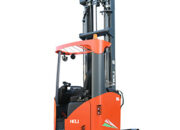
To increase storage density, many businesses narrow aisle widths and extend rack heights. In this case, Reach Trucks are the ideal solution.

  • Operating Mechanism:
    Extendable mast (reach in/out), allowing a shorter overall truck length compared to conventional forklifts.
  • Benefits:
    Capable of operating at heights up to 12 meters, making them ideal for logistics distribution centers and food-grade warehouses.


2.3. Very Narrow Warehouses or Short-Distance Handling (< 2.5m)

For compact storage areas or short-distance transport (e.g., from containers to production lines), compact electric pallet handling equipment is the most cost-effective option.

  • Equipment Types:
    • Pallet Truck (Low-level pallet mover)
    • Pallet Stacker (High-lift pallet stacker)
  • Advantages:
    Rear tiller steering, extremely small turning radius, quiet electric operation, and zero emissions.


  1. Comparison Table: Space Requirements by Forklift Type
Forklift TypeMinimum Aisle WidthTypical Lift HeightSuitable Environment
Sit-down Forklift3.8m – 4.5m3m – 6mLarge warehouses, outdoor
Reach Truck2.7m – 3.2m6m – 12mHigh racking, narrow aisles
Pallet Stacker2.2m – 2.6m1.6m – 4.5mSmall warehouses, tight aisles


  1. Step-by-Step Guide to Selecting the Right Forklift

To avoid costly mistakes, Samcovina recommends following this 4-step process:

  • Conduct On-site Measurements:
    Do not rely solely on technical drawings. Measure the actual clear distances between rack legs after installation.
  • Determine Pallet Dimensions:
    Pallet size (e.g., 1000 × 1200 mm) affects fork length and the forklift’s real turning radius.
  • Choose the Right Power Source:
    • Enclosed environments (pharmaceuticals, electronics): Electric forklifts are mandatory.
    • Outdoor or heavy-duty environments: Diesel forklifts offer higher performance.
  • Evaluate Investment Strategy:
    If budget is limited, choosing high-quality used forklifts imported from Europe or the U.S. is a smart option. These machines typically meet stricter standards and offer superior durability compared to low-cost new units.


  1. Why Choose Forklift Solutions from Samcovina?

Samcovina doesn’t just sell forklifts—we provide comprehensive operational solutions tailored to your warehouse:

  • Official Imports:
    Fully certified equipment from strict markets such as the EU, U.S., and Japan.
  • Flexible Services:
    Both sales and short-/long-term rental options to help businesses optimize cash flow.
  • Spare Parts Ecosystem:
    Readily available spare parts inventory and an experienced technical team ensure fast maintenance and repair, minimizing supply chain disruptions.

Leave a Reply

Your email address will not be published. Required fields are marked *

Related posts

  • loi thuong gap o xe nang kho Common Reach Truck Issues and Quick Fixes

    Common Reach Truck Issues and Quick Fixes In today’s fast-paced warehouse environment, a Reach Truck is not just equipment but a critical link determining the efficiency of the entire supply chain. A smoothly operating Reach Truck ensures seamless goods flow, while a sudden breakdown can trigger a domino effect: workflow disruptions, wasted labor, delayed orders, […]

  • chon xe nang hang Guide to Buying a Forklift

    Guide to Buying a Forklift: Understanding the Most Important Technical Specifications Are you facing the decision of investing in a forklift for your business? Amidst countless options, how do you ensure you choose the right forklift that suits your needs, optimizes work efficiency, and delivers the best return on investment (ROI)? The answer lies in […]

  • dong-co-xe-nang-dien Maintenance of electrical systems for forklifts

    Electric systems for forklifts The forklift’s electrical system is the main part of the forklift, a minor failure can cause the entire vehicle to malfunction or cause an accident. Therefore, the maintenance and maintenance of various components in the forklift’s electrical system is extremely important for the safe use of the forklift. The power supply […]

  • Repair services for boards and control units of forklifts

    Samco Vina provides repair services for boards and control units of forklifts Samco Vina is a specialized company offering repair and installation services for control units and circuit boards of forklifts—critical components that manage all forklift operations, including starting, moving, and lifting. A malfunctioning control unit can disrupt operations, reduce productivity, and pose safety risks. […]

  • xe-chup-kalma Frequently Asked Questions about Kalmar Container Reach Stackers

    Frequently Asked Questions about Kalmar Container Reach Stackers 1. What is the maximum lifting capacity of a Kalmar Reach stacker? A Kalmar Reach stacker has a maximum lifting capacity ranging from 45 to 50 tons, depending on the specific model. For example, the DRG450-65S5X model can lift up to 45 tons in the first row, while some higher-end models like the DRG500-75S5X can lift up to 50 tons. 2. is the average lifespan of a Kalmar Container Reach stacker? With proper maintenance, a Kalmar Container Reach stacker can operate efficiently for around 15-20 years. However, the exact lifespan depends on various factors such as usage frequency, working conditions, and maintenance quality. Some of our customers have reported that their machines are still running well after more than 25 years of use. 3. How much is the annual maintenance cost for a Kalmar Reach stacker? The annual maintenance cost for a Kalmar Reach stacker typically ranges from 3% to 5% of the initial value of the machine. This means that for a machine priced at around $500,000, the annual maintenance cost could be between $15,000 and $25,000. However, this figure may vary depending on usage intensity and operating conditions. 4. What are some special safety features of Kalmar Reach stackers? Kalmar Reach stackers are equipped with advanced safety features including: – Anti-Tipping System – Load weight sensors and overload warning – 360-degree cameras for comprehensive visibility – Regenerative braking system – ROPS (Roll-Over Protective Structure) compliant cabin design – Obstacle detection and warning system – Safety lockout system when operator is absent 5. What is the average fuel consumption of a Kalmar Reach stacker? The average fuel consumption of a Kalmar Reach stacker typically ranges from 12 to 18 liters of diesel per hour of operation, depending on the model and working conditions. Our latest models come with fuel-saving Eco Drive Mode technology that can reduce consumption to as low as 10-15 liters per hour under normal operating conditions. 6. Which Kalmar Reach stacker models are suitable for small and medium-sized ports? Kalmar offers several Reach stacker models suitable for small and medium-sized ports: – DRG420-60S5: This model can lift 42 tons, suitable for ports with moderate container traffic. – DRG450-65S5: With a lifting capacity of 45 tons, this is a flexible choice for various types of ports. – Gloria DRG100-54S6: This compact model is ideal for ports with limited space. These models have smaller dimensions, lower fuel consumption, but still ensure high performance. 7. How to optimize the performance of a Kalmar Reach stacker in a port environment? To optimize performance, it is important to: – Provide thorough training for operators on efficient driving techniques and stacking operations. – Use Kalmar’s fleet management software to monitor and analyze performance. – Implement preventive maintenance to minimize downtime. – Optimize traffic flow and workspace layout within the port. – Use Eco Drive mode whenever possible to save fuel. – Update software regularly to take advantage of the latest improvements. 8. What are the key advantages of Kalmar Reach stackers compared to other brands? Kalmar Reach stackers stand out with: – Stable operation, high reliability and long lifespan. – Advanced technology such as SmartWheel intelligent control system. – Low fuel consumption thanks to Eco Drive technology. – Ergonomic cabin design with good visibility for operator comfort. – Global support network and service offerings from the brand. – Many integration options with automation systems in warehouses and ports. 9. How long does training for operating a Kalmar Reach stacker typically last? Training usually lasts from 2 to 4 weeks including: – One week theoretical training on safety, operational mechanisms and basic maintenance. – One-two weeks practical training on simulator machines. – One week practical training on real machines under supervision. After training completion, operators need an additional 100–200 hours of practice to become proficient. Kalmar also provides advanced training courses and regular updates. 10. How to troubleshoot common issues on a Kalmar Reach stacker? Common troubleshooting steps for issues on a Kalmar Container reach Stacker include: – Use onboard diagnostic systems to identify faults. – Refer to user manuals for basic troubleshooting procedures. – For engine issues check fuel levels, air filters and electrical connections. – For hydraulic issues check oil levels and leaks. – For electrical issues check fuses and connections. 11. What automation features are available on the latest models of Kalmar Reach Stackers? The latest models of Kalmar reach Stackers come equipped with advanced automation features such as: […]