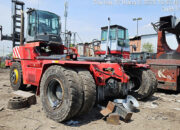
Comparison between Buying and Renting Container Forklifts

Comparison between Buying and Renting Container Forklifts

1. Benefits of Buying a Container Forklift compared to Renting

– Lower initial cost: When buying a container forklift, the initial cost will be lower compared to renting. Users only need to make a one-time payment and own the container forklift.

– No time limitation on usage: When buying a forklift, users are not limited by time. They can use the container forklift for as long as necessary without worrying about returning it after a certain period.

– Decision-making power for upgrades and repairs: When buying a forklift, users have the freedom to decide on upgrades or repairs according to their needs and preferences.

– Depreciation of assets for tax reduction: Buying a container forklift allows users to depreciate the asset for tax reduction, helping save costs in business operations.

2. Benefits of Renting a Container Forklift compared to Buying

– No large upfront investment: When renting a container forklift, users do not need to make a large upfront investment like when buying. Instead, they only need to pay monthly or yearly rental fees.

– Reduced risk when business models change: Renting a container forklift helps reduce risks when business models change. If there is a need to change scale or type of business, users can easily switch to using the appropriate type of forklift without financial difficulties.

– Reduced regular maintenance costs: When renting, users do not have to worry about regular maintenance and servicing of the forklift. These costs will be covered by the rental company.

– Always using the latest forklift technology: When renting, users always have access to the latest and most advanced container forklifts in the market. This helps increase work efficiency and reduces the risk of breakdowns.

3. Comparison of cost factors between both options

– Initial purchase/rental cost: When buying, users have to pay a large upfront amount to own the container forklift, while renting only requires a small rental fee or deposit.

– Fuel costs: Both options have fuel costs for operating the container forklift. However, these costs may vary depending on the type of forklift and level of usage.

– Regular maintenance costs: When owning a forklift, users have to bear the regular maintenance and servicing costs. On the other hand, when renting, these costs are covered by the rental company.

– Insurance costs: When owning a forklift, users need to purchase insurance for the vehicle and driver. When renting, the rental company already has insurance coverage for their fleet.

– Replacement parts costs: When owning a forklift, users have to provide and pay for replacement parts when necessary. When renting, the rental company takes responsibility for this.

4. Analysis of factors when making a decision to buy or rent a container forklift

– Usage needs: Users need to consider their long-term or short-term usage needs of the container forklift to decide whether to buy or rent.

– Available budget: Users need to consider their current budget to decide whether they have enough funds to buy or only rent a forklift.

– Long/short-term business strategy: Users need to consider their long-term or short-term business strategy to decide whether buying or renting is more suitable for their container forklift needs.

Trusted Sales and Rental Address of Container Forklifts in Binh Duong

Are you in need of renting or buying a container forklift in Binh Duong but unsure of any reputable and quality addresses? Let Samcovina Joint Stock Company help you!

Samcovina currently has a diverse range of container forklifts in various types and models. Customers can choose from electric-powered, diesel-powered, or pneumatic-powered forklifts that suit their job requirements. Our experienced team of technicians is always ready to advise and support customers in the selection process.

In addition, Samcovina provides competitive rental services for container forklifts. Customers can rent on a daily, weekly, or monthly basis, offering flexibility and cost savings. We guarantee the quality and safety of the container forklifts for each customer.

Moreover, Samcovina offers maintenance and repair services for container forklifts. Our professional team of technicians is ready to assist with any related issues. We use genuine replacement parts and adhere to strict inspection procedures to ensure the quality of our work.

With the goal of customer satisfaction, Samcovina not only provides sales and rental services for container forklifts but also supports customers in choosing the most suitable type of forklift.

Contact Samcovina today for consultation and detailed pricing.
SAMCOVINA JOINT STOCK COMPANY
Tax Code: 0313121108
Address: No. 3 Street 1, Song Than Industrial Zone, Di An Ward, Di An City, Binh Duong Province, Vietnam
Email: info@samcovina.com

Leave a Reply

Your email address will not be published. Required fields are marked *

Related posts

  • hoi-dap-xe--nang FAQs about Forklift Battery and Electrical System

    FAQs about Forklift Battery and Electrical System 1. What is the average lifespan of a forklift battery? The average lifespan of a forklift battery is typically between 4-6 years for lead-acid batteries, depending on usage, working conditions, and maintenance. Gel batteries have a shorter lifespan, around 3-5 years. 2. How should I maintain my forklift battery? To maintain your forklift battery, you should regularly check and top up the water level, clean the charging terminals and battery poles, ensure full charging without overcharging, regularly check electrolyte density and cell voltage. 3. How can I maximize the lifespan of my forklift battery? To maximize the lifespan of your forklift battery, you should use the correct capacity battery, follow proper installation procedures, maintain full charging, avoid deep discharging, perform regular maintenance, adjust electrolyte density as needed, and keep it clean. 4. What factors affect the lifespan of a forklift battery? The main factors that affect the lifespan of a forklift battery include initial battery quality, using the correct capacity battery, charging and discharging methods, operating temperature conditions, maintenance and storage practices, and working conditions (vibration, humidity, dust). 5. When should I replace my forklift battery? Typically, you should replace your forklift battery after 4-6 years of use depending on the quality of the battery, usage level, and maintenance conditions. If the battery experiences severe performance degradation before that time frame, it should be replaced earlier. Monitoring electrolyte density can help evaluate remaining battery life. 6. When and how should I charge my forklift battery? You should charge your forklift battery after each work shift. The best method is to use an automatic three-stage controlled charger (bulk-float-equal) with periodic water replenishment for lead-acid batteries. The charger should provide the appropriate current and voltage according to the battery’s requirements. 7. What causes and how to fix a swollen forklift battery? Causes: Excessive heat generated during charging, resulting in hydrogen and oxygen gas buildup. Heat causes expansion of the welding circuit, leading to battery case rupture. Solutions: Check and clean the charger, ventilation system. Replace the damaged battery case. Follow proper charging procedures. Purchase batteries with good quality. 8. How to prevent battery gassing in forklifts? To prevent battery gassing, avoid discharging below 80% of rated capacity, avoid hot charging at high temperatures, maintain proper electrolyte density, perform regular equalizing charges, and use an automatic three-stage controlled charger. 9. Which type of battery is suitable for different types of forklifts? The choice of battery depends on the motor power requirement, lifting capacity, continuous usage time, and working environment conditions. Lead-acid batteries are suitable for high-power forklifts with long working hours. Gel batteries are suitable for small-capacity forklifts used internally. 10. Evaluate the advantages and disadvantages of gel batteries compared to lead-acid batteries. Advantages of gel batteries: No acid spillage, low maintenance, no fumes emission, safer and environmentally friendly. Disadvantages: Shorter lifespan, higher cost, cannot replenish water levels, prone to overheating. Advantages of lead-acid batteries: Lower cost, longer lifespan; however, they require more maintenance and have a risk of acid leakage. 11. How often should I replace distilled water in lead-acid batteries? Distilled water in lead-acid batteries should be replaced every 6-12 months depending on evaporation levels. The replacement frequency may be shorter if the forklift operates in hot and dusty environments. Regularly check water levels to determine when it needs replacement. 12. What are the standards for distilled water used in forklift batteries? Distilled water used in forklift batteries must meet high purity standards (≥99.5%), be free from large impurities, and have a resistivity of ≥5 MΩ.cm. Water that does not meet these standards can corrode battery components, create deposits, and reduce performance. 13. What causes and how to fix a short-circuited forklift battery? Causes: Damaged or corroded wires causing ground contact and short circuits. Dirt and high humidity inside the battery can also cause shorts. Solutions: Check and repair damaged wires. Clean the battery to remove dirt. Maintain proper humidity levels. Replace the battery if it is too old. 14. How should I maintain electrical components on a forklift? Electrical components should be regularly maintained, including checking and cleaning the charger, control circuitry, motor, conductors, and tightening all electrical connections. Ensure effective cooling ventilation systems. Check and replace any faulty components to ensure electrical safety. 15. What are the signs of electrical system issues in a forklift? Signs of electrical system issues in a forklift include slow movement or failure to reach desired speed, underperforming motor power, abnormal battery heat or swelling, smoke smell from electrical devices, unusual noise from motor or drivetrain, malfunctioning warning lights or display screens. 16. What does regular maintenance of the forklift’s electrical system involve? Regular maintenance of the forklift’s electrical system includes checking and cleaning the battery, replenishing distilled water, measuring electrolyte density; checking and cleaning the charger; inspecting control circuits; motors; conductors; tightening all electrical connections; ensuring effective cooling ventilation systems; checking and replacing faulty components to ensure electrical safety.

  • xe nang van chuyen pallet A Professional Guide to Routine Pallet Truck Maintenance

    A Professional Guide to Routine Pallet Truck Maintenance   In any warehouse or workshop, the pallet truck is often considered the “unsung hero.” Day in and day out, these machines tirelessly move tons of goods with speed, efficiency, and reliability. However, precisely because of their simplicity and durability, many businesses inadvertently neglect their routine maintenance. […]

  • toyota-xe-nang Common Errors in Electric Forklifts

    I. Common errors in electric forklifts Maintaining and repairing electric forklifts is crucial to ensure their performance and lifespan. During usage, electric forklifts may encounter common errors, including electrical system failures, mechanical issues, and battery problems. These errors can be caused by improper usage, lack of regular maintenance, and the impact of weather conditions. To effectively handle and maintain electric forklifts, regular inspections and maintenance should be conducted, users should be trained properly, and genuine spare parts should be used. Additionally, preventive measures such as safety instructions during usage, proposing basic repair training for managers, and enhancing maintenance awareness among users should be implemented. 1. Electrical system failures in forklifts Electrical system failures are one of the common errors in electric forklifts. Power loss is a common issue that can be caused by weak or faulty batteries. To address this problem, batteries should be checked and replaced if necessary. Controller malfunctions can also occur due to damaged or improperly functioning components. To resolve this issue, components should be inspected and repaired or replaced if necessary. 2. Mechanical issues in forklifts Mechanical issues are another problem that electric forklifts may encounter. The steering system can experience malfunctions due to damaged or improperly functioning components. To address this problem, components should be checked and replaced if necessary. The lifting system can also experience malfunctions due to damaged or improperly functioning parts. To resolve this issue, parts should be inspected and repaired or replaced. 3. Battery-related issues in forklifts Battery problems are also crucial factors affecting the performance of electric forklifts. Battery lifespan can be affected by various factors such as battery age, usage conditions, and maintenance procedures. To maintain battery lifespan, proper maintenance and charging procedures should be followed. Decreased battery performance is another issue that can be caused by battery age, overloading, or incomplete charging. To address this problem, batteries should be checked and charged according to proper procedures. II. Causes of errors in electric forklifts – Causes of errors in electric forklifts can be attributed to improper usage, lack of regular maintenance, and the impact of weather conditions. Improper usage can lead to errors such as overloading the forklift or using incorrect procedures. To avoid these errors, adherence to usage procedures and limiting forklift overload is necessary. – Lack of regular maintenance is also a common cause of errors. Failure to conduct regular maintenance can affect the performance and lifespan of the forklift. To keep the forklift operating well, regular maintenance should be performed following manufacturer instructions. – Weather conditions can also impact the operation of electric forklifts. Factors such as high temperatures, cold weather, or dampness can cause issues for the forklift. To minimize the impact of weather conditions, proper protection and storage practices should be implemented. III. Handling and maintaining electric forklifts – To effectively handle and maintain electric forklifts, regular inspections and maintenance are necessary. Regular inspection and maintenance procedures help maintain the performance of the forklift and detect potential issues early on. – Proper training of users is also crucial, providing users with instructions on safe and efficient usage of electric forklifts. The use of genuine spare parts is another essential factor that cannot be overlooked as it ensures quality and longevity. – Additionally, preventive measures should be implemented to avoid errors from occurring. Safety instructions during usage are one important measure, providing safety guidelines to users of electric forklifts. – Proposing basic repair training for managers is another suggestion; training managers on basic knowledge about repairing electric forklifts enables them to handle minor issues without having to call technical staff. – Enhancing maintenance awareness among users is also an important measure, strengthening maintenance and management awareness of electric forklifts from the users. This can be achieved through providing usage instructions, reminders about regular maintenance, and creating a safe and professional working environment. In conclusion, maintaining and repairing electric forklifts is crucial to ensure their performance and lifespan. Addressing common errors such as electrical system failures, mechanical issues, and battery problems should be done meticulously and accurately. Regular inspections and maintenance, proper user training, and the use of genuine spare parts are important measures to handle and maintain electric forklifts effectively. Preventive measures such as safety instructions during usage, proposing basic repair training for managers, and enhancing maintenance awareness among users are also crucial to prevent errors from occurring.

  • bom-thuy-luc The principle of hydraulic system of forklift truck

    Forklift hydraulic system 1. Principle of forklift hydraulic system. The hydraulic system of the forklift is an important part of the forklift. The working equipment accessories and the steering system of the forklift are all driven by the hydraulic system. Therefore, the advantages and disadvantages of the forklift hydraulic system directly affect the forklift’s ability […]

  • nha-phan-phoi-xe-nang Trends in the Container Forklift Industry

    Introduction to the current container forklift market   In recent years, the forklift industry has experienced significant growth. With the increase in international trade and the growing trend of containerized cargo transportation, the use of container forklifts has become an important factor in the loading and unloading process and transportation of goods. The current container […]