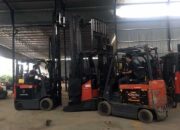
Hyundai forklift for sale and rental

Forklift Hyundai

Hyundai is a famous Korean forklift brand that is not only famous and won the trust of most users for its long life but also famous for its good product quality, diverse models and extended warranty period. up to 3000 hours through authorized Hyundai dealers. This is one of the plus points that Hyundai gives customers complete peace of mind in their products.

When you choose to buy or rent a Hyundai forklift, you can be assured of the quality Hyundai Forklift is specially designed to meet the requirements of handling, loading and unloading goods and materials. In particular, hyundai forklifts have a long life, little damage and great value when reselling when old.

Most new Hyundai Electric, Diesel and LPG forklifts come with a standard 2-year or 3000-hour manufacturing warranty (or 4000 hours on the B-7A series).

Samcovina is the official dealer of Hyundai forklifts in Vietnam. We have more than 14 years of experience operating in the field of selling and renting forklifts, of which Hyundai branded forklift is one of our key brands. Samcovina company sells and leases all lines of Hyundai forklifts such as hand trucks, electric forklifts, diesel forklifts from 2 tons (2 tons, 2.5 tons, 3 tons…) to 35 tons. Especially, we are the official dealer and directly import 100% genuine new complete Hyundai forklift trucks, so the price is reasonable, competitive, high quality and warranty – maintenance up to 2 years (3000 hours). .

On the other hand, we import 100% new, original Hyundai forklifts regularly and continuously and display a large number of Hyundai forklifts at our main facility of more than 3000 square meters at Binh Duong Boulevard, Binh Duong province. and two large branch yards of our company in District 9, TP. Ho Chi Minh City and Dong Nai in order to create favorable conditions for customers in Binh Duong, Dong Nai, City. Ho Chi Minh City and neighboring provinces come to choose forklifts that are suitable for the actual needs of businesses.

How do we deliver higher quality, more durable, more reliable forklifts at a lower cost? Our company Samcovina is constantly trying to find and promote cooperation with famous forklift brands in the world in order to find stable and quality import sources with reasonable prices. At the same time, we are constantly looking for skilled engineers, technicians and professionals to improve the qualifications of the technical team for the purpose of maintaining, checking or fixing any errors in time. the fastest. From there, helping customers save costs is the first basis for a lower cost of ownership. When you choose Samcovina, you can feel confident that you’re getting the best value in the industry.

Our motto is that we don’t just want to sell you or rent a forklift, we want to build a partnership with you, with your business. We understand your revenue is tied to the productivity and efficiency of your lifting equipment. So we have a great responsibility to stand behind our products, make sure the best warranty, maintain or fix the problem in the fastest way, the best consulting service and become a one of the best companies in the industry.

 ,

Leave a Reply

Your email address will not be published. Required fields are marked *

Related posts

  • kho-xe-nang-dien FAQs – Frequently Asked Questions about Toyota Electric Forklifts

    1. What are the main benefits of using a Toyota electric forklift compared to a gasoline forklift? The main benefits of using a Toyota electric forklift compared to a gasoline forklift are: – Environmentally friendly, with no harmful emissions – Lower operating costs and fuel savings – Quieter operation, significantly less noise than gasoline forklifts – Simpler maintenance and lower costs – Increased productivity in warehouses and storage facilities 2. What is the average lifespan of a battery on a Toyota electric forklift? The average lifespan of a battery on a Toyota electric forklift is typically 4-5 years, depending on usage and maintenance conditions. 3. How can I optimize the lifespan of the battery on my Toyota electric forklift? To optimize the lifespan of the battery on your Toyota forklift, you should: – Fully charge the battery after each work shift – Avoid overfilling or completely draining the battery – Properly maintain the battery, including regular electrolyte level checks – Operate the forklift within its recommended load limits – Replace the battery when it becomes too old and worn out 4. What types of batteries does Toyota use for their electric forklifts? Toyota uses lead-acid batteries, lithium-ion batteries, and alkaline batteries for their electric forklifts depending on the specific model. 5. How long does it take to fully charge the battery on a Toyota electric forklift? The charging time for a Toyota electric forklift battery depends on its capacity but averages around 6-8 hours with standard chargers. 6. When should I replace the battery on my Toyota electric forklift? You should replace the battery on your Toyota electric forklift when: – The recommended lifespan has been exceeded (typically 4-5 years) – The continuous usage time on a single charge has significantly decreased – The battery is swollen, leaking, or severely damaged – The battery’s performance has deteriorated beyond acceptable levels 7. How do I replace the battery on a Toyota electric forklift? The process of replacing the battery on a Toyota forklift is as follows: – Check and identify the specific model of the replacement battery – Remove the vehicle casing and disconnect the electrical circuit to access the old battery – Disconnect and remove the old battery by disconnecting terminals and cables – Install the new battery of the same type and make proper connections – Restart the forklift, fully charge the new battery, and test its operation – Reassemble the vehicle casing and complete the process 8. What is the average operating cost of a Toyota electric forklift compared to a gasoline forklift? The average operating cost of a Toyota electric forklift is 60-70% lower than that of a gasoline forklift with similar load capacities. 9. Can Toyota electric forklifts be used outdoors? Toyota electric forklifts can be used outdoors but certain conditions must be met: – Batteries must be fully charged and properly maintained […]

  • Tips to Reduce Warehouse Forklift Spare Parts Costs for Businesses

    Tips to Reduce Warehouse Forklift Spare Parts Costs for Businesses In the context of constantly fluctuating logistics and warehouse operating costs, effective fleet management of forklifts (Reach Trucks, Pallet Trucks, Forklifts, etc.) has become a mission-critical challenge for businesses. In practice, spare parts replacement costs typically account for 15% to 25% of total forklift operating […]

  • kho-xe-nang-cu Advice on Choosing Used Container Forklifts

    Definition of Used Container Forklifts Used container forklifts are specialized vehicles used for transporting and stacking containers. These forklifts have been previously used for a certain period of time before being resold on the market. Used container forklifts are typically 2-10 years old, have been operating reliably, and can continue to be effectively used for many more years. The Importance of Choosing the Right Type of Used Container Forklift Choosing the right type of used container forklift is crucial as it determines work efficiency, operating costs, and even safety for both the operator and the cargo and surrounding equipment. Key factors to consider include load capacity, size, container lifting speed, durability, reliability, maintenance costs, and availability of spare parts. Each type of forklift is suitable for specific tasks and operating environments. Therefore, businesses need careful guidance and selection when purchasing and using used container forklifts. I. Benefits of Choosing Used Container Forklifts 1. Cost savings compared to new vehicles The biggest advantage of used container forklifts is their significantly lower price compared to new vehicles, usually only 30-60% of the original value. This affordable price range is suitable for many small and medium-sized businesses. Purchasing used container forklifts helps businesses save considerable initial investment costs as well as operating expenses while still achieving profitability. 2. Environmental protection and recycling Using used container forklifts helps extend the lifespan of equipment, reduce industrial waste, and save resources and energy consumed in producing new vehicles. This approach promotes circular economy practices and environmental protection that many countries are adopting. 3. Work efficiency and stability of used forklifts After a period of use, container forklifts often reach a stable operational state with main components having passed their “childhood” stage, resulting in fewer breakdowns. Many models, when properly and regularly maintained, can be used continuously for 20 years or more without a decrease in performance. Furthermore, experience in operating and repairing familiar models is often higher compared to newly introduced forklifts. II. Important Factors to Consider When Choosing Used Container Forklifts When selecting used container forklifts, buyers need to carefully evaluate technical condition, structure, and operational history to ensure quality and reliability during use. 1. Check technical condition and maintenance – Engine and transmission system – Check cylinder compression pressure, oil/grease leaks – Starting capability, abnormal engine noise – Smoothness of power transmission system – Steering and braking system – Smooth steering, effective braking – No brake fluid leaks – Check tire condition and suspension system – Tires meet wear standards – Check shock absorber condition, lifting cylinder 2. Inspect structure and frame of the forklift – Check welding and frame durability: no deformation or cracks – Condition of other important components: gearbox, driver’s cabin… 3. Examine the usage history and maintenance records of the forklift – Operating hours – the lower the better – Complete maintenance records according to manufacturer’s requirements – Proper storage and operation conditions (non-harsh environments) III. Well-known and Reliable Brands Some reliable and well-known used container forklift brands on the market include: 1. Famous manufacturers: – Kalmar – Konecranes – Hyster – Linde – Toyota -Crown These are leading global brands in container forklifts with proven reliability and quality over time. 2. Highly rated used container forklift models: -Kalmar DRF 400-450: efficient electric plug-in empty container handler -Hyster H22XM: smooth-operating diesel container loader/unloader -Toyota 02-8FD: durable diesel forklift with stable power […]

  • xe-chup-kalma Frequently Asked Questions about Kalmar Container Reach Stackers

    Frequently Asked Questions about Kalmar Container Reach Stackers 1. What is the maximum lifting capacity of a Kalmar Reach stacker? A Kalmar Reach stacker has a maximum lifting capacity ranging from 45 to 50 tons, depending on the specific model. For example, the DRG450-65S5X model can lift up to 45 tons in the first row, while some higher-end models like the DRG500-75S5X can lift up to 50 tons. 2. is the average lifespan of a Kalmar Container Reach stacker? With proper maintenance, a Kalmar Container Reach stacker can operate efficiently for around 15-20 years. However, the exact lifespan depends on various factors such as usage frequency, working conditions, and maintenance quality. Some of our customers have reported that their machines are still running well after more than 25 years of use. 3. How much is the annual maintenance cost for a Kalmar Reach stacker? The annual maintenance cost for a Kalmar Reach stacker typically ranges from 3% to 5% of the initial value of the machine. This means that for a machine priced at around $500,000, the annual maintenance cost could be between $15,000 and $25,000. However, this figure may vary depending on usage intensity and operating conditions. 4. What are some special safety features of Kalmar Reach stackers? Kalmar Reach stackers are equipped with advanced safety features including: – Anti-Tipping System – Load weight sensors and overload warning – 360-degree cameras for comprehensive visibility – Regenerative braking system – ROPS (Roll-Over Protective Structure) compliant cabin design – Obstacle detection and warning system – Safety lockout system when operator is absent 5. What is the average fuel consumption of a Kalmar Reach stacker? The average fuel consumption of a Kalmar Reach stacker typically ranges from 12 to 18 liters of diesel per hour of operation, depending on the model and working conditions. Our latest models come with fuel-saving Eco Drive Mode technology that can reduce consumption to as low as 10-15 liters per hour under normal operating conditions. 6. Which Kalmar Reach stacker models are suitable for small and medium-sized ports? Kalmar offers several Reach stacker models suitable for small and medium-sized ports: – DRG420-60S5: This model can lift 42 tons, suitable for ports with moderate container traffic. – DRG450-65S5: With a lifting capacity of 45 tons, this is a flexible choice for various types of ports. – Gloria DRG100-54S6: This compact model is ideal for ports with limited space. These models have smaller dimensions, lower fuel consumption, but still ensure high performance. 7. How to optimize the performance of a Kalmar Reach stacker in a port environment? To optimize performance, it is important to: – Provide thorough training for operators on efficient driving techniques and stacking operations. – Use Kalmar’s fleet management software to monitor and analyze performance. – Implement preventive maintenance to minimize downtime. – Optimize traffic flow and workspace layout within the port. – Use Eco Drive mode whenever possible to save fuel. – Update software regularly to take advantage of the latest improvements. 8. What are the key advantages of Kalmar Reach stackers compared to other brands? Kalmar Reach stackers stand out with: – Stable operation, high reliability and long lifespan. – Advanced technology such as SmartWheel intelligent control system. – Low fuel consumption thanks to Eco Drive technology. – Ergonomic cabin design with good visibility for operator comfort. – Global support network and service offerings from the brand. – Many integration options with automation systems in warehouses and ports. 9. How long does training for operating a Kalmar Reach stacker typically last? Training usually lasts from 2 to 4 weeks including: – One week theoretical training on safety, operational mechanisms and basic maintenance. – One-two weeks practical training on simulator machines. – One week practical training on real machines under supervision. After training completion, operators need an additional 100–200 hours of practice to become proficient. Kalmar also provides advanced training courses and regular updates. 10. How to troubleshoot common issues on a Kalmar Reach stacker? Common troubleshooting steps for issues on a Kalmar Container reach Stacker include: – Use onboard diagnostic systems to identify faults. – Refer to user manuals for basic troubleshooting procedures. – For engine issues check fuel levels, air filters and electrical connections. – For hydraulic issues check oil levels and leaks. – For electrical issues check fuses and connections. 11. What automation features are available on the latest models of Kalmar Reach Stackers? The latest models of Kalmar reach Stackers come equipped with advanced automation features such as: […]

  • xe-nang-rut-cong Forklift rental, container loading and unloading trucks

    Forklift rental and container loading and unloading service Container forklifts are one of the essential vehicles in the management and arrangement of goods in the warehouse. In order not to have to raise a large amount of money to buy a car, choosing a forklift truck rental service is the best option for businesses. And […]

Gọi ngay
Chat Zalo