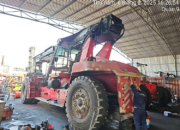
35-Ton Heavy Forklift vs. 40ft Container Reach Stacker

35-Ton Heavy Forklift vs. 40ft Container Reach Stacker: Which Equipment Should You Invest In?

Operations at seaports, Inland Container Depots (ICDs), or heavy industrial manufacturing plants always require rigorous calculations regarding material handling equipment. As cargo volume scales up, many enterprises face a tough strategic decision: Should they invest in a versatile 35-ton Heavy Forklift, or allocate their budget toward a dedicated 40ft Container Reach Stacker?

Making the wrong choice not only wastes billions of Dong in capital expenditure (CAPEX) but also creates operational bottlenecks that reduce overall yard throughput. The following article from material handling experts provides a detailed breakdown of the pros and cons of each equipment type to help you make the right investment decision.

  1. 35-Ton Heavy-Duty Forklift: A Versatile Solution for Heavy Industry

A 35-ton forklift falls into the heavy-duty forklift segment. At the core of this machine is a massive counterweight system and ultra-heavy-duty parallel forks, enabling it to lift and handle heavy loads up to a maximum capacity of 35 tons.

Key Advantages:

  • Unmatched Versatility: This is the biggest advantage of heavy forklifts. The machine is non-selective when it comes to cargo types. Whether handling precast concrete blocks, solid timber logs, heavy industrial machinery, or lifting containers directly from the bottom using forks, it handles the job with ease.
  • Flexible Attachment Upgrades: When necessary, users can easily replace the lifting forks with a top-lifting spreader attachment to handle containers from above.
  • Operational & Maintenance Costs: Thanks to its traditional vertical mast design, servicing and repairing the hydraulic systems of a 35-ton heavy forklift is generally simpler and more cost-effective compared to machines with complex telescopic booms.

Disadvantages:

  • Limited Reach: Mast forklifts can only access cargo positioned in the first row (Row 1).
  • Lower Stacking Capability: The height limit of the vertical mast restricts stacking performance, usually safe only up to 3 to 4 container tiers high.
  1. 40ft Container Reach Stacker: Dedicated Container-Handling Power

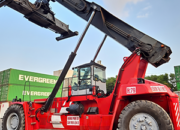
If the 35-ton heavy forklift is a “multi-purpose operator,” the 40ft Container Reach Stacker is a true “specialist.” Equipped with a heavy-duty telescopic boom and a versatile spreader, this machine is purpose-built to handle fully loaded standard containers (20ft, 40ft, and 45ft).

Key Advantages:

  • Extended Outreach Capability: This is an invaluable feature in space-constrained container yards. A Reach Stacker can easily reach over the first row to pick containers located in Row 2, or even Row 3.
  • Yard Space Optimization: Thanks to its wide-angle telescopic boom, the machine can stack containers up to 5–6 tiers high, allowing businesses to maximize vertical storage density.
  • Stability and Safety: When lifting fully loaded 40ft containers weighing tens of tons, the twistlock locking mechanism on the spreader combined with an electronic load-moment system ensures exceptional stability and effective anti-tilt safety during transit.

Disadvantages:

  • Highly Specialized Application: The machine is optimized almost exclusively for container handling. Using a Reach Stacker to handle other cargo types is highly restrictive and lacks operational flexibility.
  • Capital Investment & Space Requirements: It demands higher initial capital investment (CAPEX) and requires relatively wide operational aisles for the telescopic boom to operate at maximum efficiency.
  1. Comparison Table
Criteria35-Ton Heavy ForkliftContainer Reach Stacker
Primary ApplicationMulti-purpose (Steel, timber, machinery, containers)Dedicated container handling
Handling MechanismForks / Vertical MastTelescopic Boom / Top Spreader
Outreach CapabilityNone (Row 1 handling only)Excellent (Row 2 and Row 3 access)
Max Stacking Height3 – 4 Tiers5 – 6 Tiers
Maintenance & ServicingSimple, moderate maintenance costRequires higher technical expertise, more complex
  1. Expert Recommendations: Which Equipment Should You Invest In?

There is no “best” machine—only the machine that is “most suitable” for your business model.

Choose a 35-Ton Heavy Forklift if:

You operate a building materials manufacturing plant, a heavy mechanical engineering facility, or a general cargo warehouse. Your daily operational requirements are highly diverse: lifting machinery today, handling steel coils tomorrow, and only occasionally handling containers. Its high versatility will ensure continuous equipment utilization and maximize your ROI (Return on Investment).

Allocate Your Budget to a Reach Stacker if:

You manage a seaport, ICD, or container depot with high-volume, continuous 40ft container throughput every day. In this scenario, rapid throughput cycles, the ability to selectively retrieve containers from second or third rows, and high-density stacking (5–6 tiers high) are vital factors for maintaining seamless port operations.

  1. Samcovina – Comprehensive Material Handling Solutions

Investing in heavy-duty material handling equipment requires a capable partner with deep technical expertise. Samcovina Joint Stock Company is proud to be a leading provider of warehouse and port handling solutions, serving hundreds of logistics, shipping, and industrial enterprises across Vietnam and neighboring regions.

We don’t just sell equipment; we deliver a sustainable operational ecosystem:

  • Diverse, International-Standard Product Lineup: Samcovina specializes in importing Reach Stackers and heavy-duty forklifts (including Reach Trucks and Pallet Trucks) directly from top engineering markets such as Europe, the US, Japan, and South Korea.
  • Flexible Financial Solutions: Whether your business requires brand-new machines, high-quality pre-owned equipment to optimize CAPEX, or equipment rental services, Samcovina offers tailored solutions to meet your needs.
  • Professional After-Sales Service – Eliminating Downtime Risks: A breakdown of a 35-ton forklift or Reach Stacker can cause severe operational delays across the supply chain. Understanding this, Samcovina provides genuine OEM spare parts along with a team of skilled field engineers ready for rapid maintenance and repair services, ensuring your fleet remains fully operational at all times.

Leave a Reply

Your email address will not be published. Required fields are marked *

Related posts

  • forklift-cat FAQs about Forklift

    Frequently Asked Questions about Forklifts 1. What is a forklift? Answer: A forklift is a specialized vehicle designed to lift, lower, and move goods and materials in warehouses and factories easily and safely. It is equipped with front lifting forks and an engine for movement. 2. What are the most common types of forklifts? Answer: Some common types of forklifts include counterbalance forklifts, electric forklifts, pneumatic forklifts, and manual pallet jacks. Among them, electric forklifts are the most popular due to their flexibility, ease of use, and environmental friendliness. 3. What is the typical lifting range of a forklift? Answer: The standard lifting range of a forklift is usually between 2m – 5.5m depending on the type and capacity. For high-rise warehouses, taller lifting ranges up to 7-12 meters can be used. 4. What is the maximum safe load capacity of regular forklifts? Answer: The safe load capacity of regular forklifts ranges from 1 – 5 tons depending on the capacity and size of the vehicle. For heavy-duty forklifts, the load capacity can go up to 10-15 tons. Always follow the manufacturer’s recommended load limits to ensure safety. 5. What are the common fuel options for forklifts? Answer: Forklifts commonly run on electricity (battery) or diesel/gasoline fuel. Electric forklifts are preferred in indoor warehouses due to their clean operation, quietness, and ease of use. 6. How should a forklift be regularly maintained? Answer: To ensure proper operation and safety, a forklift should undergo regular maintenance every month or after a certain number of operating hours. Maintenance tasks typically include checking oil levels, replacing oil/fuel filters, inspecting brakes/tires, charging/replacing batteries (for electric forklifts), etc. 7. How much does it cost to operate and maintain a forklift annually? Answer: The annual operating and maintenance cost for a regular forklift is around 15 – 30 million VND, including fuel costs (diesel, gasoline, electricity), regular maintenance, and small component replacements. For higher-end forklifts, the cost can go up to 50-70 million VND per year. 8. How to safely lift and lower palletized loads with a forklift? Answer: When lifting loads, tilt the forks forward by 15 degrees to ensure stability, move slowly, and maintain a safe distance from the surroundings. Lift the load slowly according to the driver’s visibility. Lower the load slowly in a tilted direction. Avoid sudden lifting or lowering that may cause load spills. 9. What qualifications or certifications are required to operate a forklift? Answer: Forklift operators need to have certification in safe operation and handling of forklifts. They also need to possess a Forklift Driver’s License issued by the authorized agency to legally operate the vehicle. 10. What are the standard dimensions of different types of forklifts? Answer: The dimensions of forklifts vary depending on their load capacity and type. Typically, length ranges from 1.5 – 3m; width ranges from 0.5 – 1m; height ranges from 1.5 – 4m. Some models have smaller dimensions to fit narrow aisles. 11. On what types of terrains can forklifts operate? Answer: Forklifts can operate well on most flat surfaces such as concrete, asphalt, tiled floors, etc. However, they should not be used on rough or uneven terrains or muddy areas. 12. What is the safe traveling speed of a forklift when carrying loads? Answer: The recommended safe traveling speed for a forklift carrying loads is 8-12 km/h. Speed should be reduced when going around corners or narrow paths. 13. How to stack loads on a forklift to ensure safety? Answer: Loads should be stacked evenly and within the allowed load capacity. Do not stack higher than the fork height. Maintain stability while moving. Stack in a way that does not obstruct the driver’s visibility. 14. What safety features do forklifts have? Answer: Forklifts are equipped with reverse alarms, turn signals, warning horns, anti-tip frames, and guardrails to protect the driver and cargo. 15. How long does it take to fully charge an electric forklift battery? Answer: The average charging time for an electric forklift battery is 6-8 hours. It should be fully charged before each shift. Some models can have fast charging options within 2-3 hours. 16. Which countries are the most common sources of imported forklifts? Answer: Forklifts are mostly imported from Japan, South Korea, China, and Taiwan. These countries are known for their quality and popular brands in Vietnam. 17. What are some popular forklift brands? Answer: Some popular forklift brands include Toyota, Mitsubishi, Komatsu, Nissan, TCM, Hangcha, Lonking… 18. Is it better to buy a new or used forklift? Why? Answer: It is recommended to buy a new forklift to ensure quality and longevity of the vehicle. New forklifts have high durability, fewer breakdowns, and lower maintenance costs. Used forklifts may be cheaper but come with higher risks of issues. 19. How much does it cost to insure a forklift annually? Answer: The insurance cost for a forklift is around 4-8% of the vehicle’s value. For example, for a 500 million VND forklift, the insurance fee would be approximately 20-40 million VND per year depending on the coverage. 20. What is the process for inspection and registration of a forklift? Answer: Forklifts need to undergo inspection and registration procedures according to local regulations. This typically involves submitting necessary documents, paying fees, and obtaining registration plates or stickers.

  • reach stacker What is a Reach Stacker? Classification and Detailed Applications in Logistics Operations

    What is a Reach Stacker? Classification and Detailed Applications in Logistics Operations In the era of global commerce, the speed of cargo turnover at seaports and intermodal logistics centers is vital for every business. To handle thousands of TEUs (Twenty-foot Equivalent Units) daily, relying on manual labor or basic lifting equipment is impossible. The most […]

  • kho-xe-nang-cu Advice on Choosing Used Container Forklifts

    Definition of Used Container Forklifts Used container forklifts are specialized vehicles used for transporting and stacking containers. These forklifts have been previously used for a certain period of time before being resold on the market. Used container forklifts are typically 2-10 years old, have been operating reliably, and can continue to be effectively used for many more years. The Importance of Choosing the Right Type of Used Container Forklift Choosing the right type of used container forklift is crucial as it determines work efficiency, operating costs, and even safety for both the operator and the cargo and surrounding equipment. Key factors to consider include load capacity, size, container lifting speed, durability, reliability, maintenance costs, and availability of spare parts. Each type of forklift is suitable for specific tasks and operating environments. Therefore, businesses need careful guidance and selection when purchasing and using used container forklifts. I. Benefits of Choosing Used Container Forklifts 1. Cost savings compared to new vehicles The biggest advantage of used container forklifts is their significantly lower price compared to new vehicles, usually only 30-60% of the original value. This affordable price range is suitable for many small and medium-sized businesses. Purchasing used container forklifts helps businesses save considerable initial investment costs as well as operating expenses while still achieving profitability. 2. Environmental protection and recycling Using used container forklifts helps extend the lifespan of equipment, reduce industrial waste, and save resources and energy consumed in producing new vehicles. This approach promotes circular economy practices and environmental protection that many countries are adopting. 3. Work efficiency and stability of used forklifts After a period of use, container forklifts often reach a stable operational state with main components having passed their “childhood” stage, resulting in fewer breakdowns. Many models, when properly and regularly maintained, can be used continuously for 20 years or more without a decrease in performance. Furthermore, experience in operating and repairing familiar models is often higher compared to newly introduced forklifts. II. Important Factors to Consider When Choosing Used Container Forklifts When selecting used container forklifts, buyers need to carefully evaluate technical condition, structure, and operational history to ensure quality and reliability during use. 1. Check technical condition and maintenance – Engine and transmission system – Check cylinder compression pressure, oil/grease leaks – Starting capability, abnormal engine noise – Smoothness of power transmission system – Steering and braking system – Smooth steering, effective braking – No brake fluid leaks – Check tire condition and suspension system – Tires meet wear standards – Check shock absorber condition, lifting cylinder 2. Inspect structure and frame of the forklift – Check welding and frame durability: no deformation or cracks – Condition of other important components: gearbox, driver’s cabin… 3. Examine the usage history and maintenance records of the forklift – Operating hours – the lower the better – Complete maintenance records according to manufacturer’s requirements – Proper storage and operation conditions (non-harsh environments) III. Well-known and Reliable Brands Some reliable and well-known used container forklift brands on the market include: 1. Famous manufacturers: – Kalmar – Konecranes – Hyster – Linde – Toyota -Crown These are leading global brands in container forklifts with proven reliability and quality over time. 2. Highly rated used container forklift models: -Kalmar DRF 400-450: efficient electric plug-in empty container handler -Hyster H22XM: smooth-operating diesel container loader/unloader -Toyota 02-8FD: durable diesel forklift with stable power […]

  • xe-nang-hang-cho-thue Forklift rental service in Binh Duong

    Forklift rental service Forklift leasing is the most flexible and cost-effective way to ensure every operation in your warehouse or factory is fully equipped with forklifts to handle large volumes of goods. materials need to be lifted and unloaded within a certain time (depending on rental period) without loss of productivity during peak months. On […]

  • thay dau thuy luc cho xe nang cont Warning Signs That a Container Handler Requires Hydraulic Pump Replacement

    Container Handler Requires Hydraulic Pump Replacement In the operating system of a container handler (Reachstacker) or a heavy-duty forklift, the hydraulic system functions like a circulatory network, with the hydraulic pump serving as the heart. When this “heart” weakens, the machine’s ability to lift and handle tens of tons of cargo can be severely compromised, […]

Gọi ngay
Chat Zalo