Top Global Reach Stacker Brands: Kalmar, Hyster, Konecranes, Linde – How to Choose Based on Your Needs?
There is no single “best” reach stacker brand for every scenario; each manufacturer excels in a specific category of needs. In short: Kalmar is ideal for high-volume ports and terminals requiring a broad equipment ecosystem; Konecranes (SMV, manufactured in Sweden) dominates in intermodal operations, rail handling, and special configurations; Hyster is suited for heavy-duty, multi-purpose operations (steel, wind power, barges) with a low total cost of ownership; Linde makes sense when your fleet is already standardized around the Linde brand.
A reach stacker is a major investment with a typical operational lifecycle of 10–15 years. Choosing the wrong brand not only wastes upfront capital but also leads to cascading costs in spare parts, component wait times, and downtime throughout the machine’s lifespan. Therefore, the right question is not “Which brand is number one?” but rather “Which brand aligns with my cargo type, operational frequency, budget, and the local parts and service availability in Vietnam?” This article analyzes the practical market positioning of each brand to help you make a technically sound decision.
What is a Reach Stacker and Why Choosing the Right Brand Matters
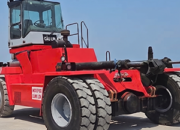
A reach stacker is a container handling lift truck equipped with a boom and a spreader attachment, used for lifting, stacking, and moving containers at ports, Inland Container Depots (ICDs), depots, and yards. Unlike an empty container handler (which only processes empty containers), a reach stacker can handle laden containers, stacking them multiple rows deep and several tiers high thanks to its boom.
The brand you choose impacts three critical factors that determine long-term operational efficiency:
Total Cost of Ownership (TCO): The initial investment is just the tip of the iceberg. Fuel, spare parts, maintenance intervals, and downtime account for the vast majority of lifecycle costs.
Parts Availability: No matter how good a machine is, if you have to wait months for components, it remains “dead in the yard.” This is a crucial point many Vietnamese companies overlook during procurement.
Service Network and Resale Value: Popular brands with widely used component configurations are generally easier to repair and resell.
Kalmar: The Choice for High-Volume Ports and Terminals
Kalmar is a Finnish manufacturer headquartered in Helsinki. Successfully spun off as an independent company from the Cargotec corporation, it was listed on Nasdaq Helsinki in mid-2024. It is one of the world’s dominant brands in container handling equipment for ports and terminals.
Strengths:
Wide range of reach stackers: Includes the DRF, DRG (Eco), DRT, and DRU series with typical lifting capacities around 45 tons (depending on the model and configuration).
Comprehensive equipment ecosystem: Beyond reach stackers, Kalmar provides empty container handlers, heavy-duty forklifts, terminal tractors (Ottawa), and straddle carriers—highly advantageous when standardizing an entire yard.
Early electrification: Kalmar has introduced fully electric reach stackers alongside a range of electric heavy forklifts and tractors, aligning with the trend of emission reductions at ports.
Manufacturing scale and global network: Features a factory in Shanghai serving the Asian market and a customer base that includes major ports like PSA and DP World.
Best Suited For:
Seaports, container terminals, and high-volume ICDs that require equipment standardized within a single ecosystem, prioritizing a vast parts and service network along with a clear electrification roadmap. For large-scale container fleets, Kalmar is often the “operationally safe” choice due to the widespread availability of its parts.
Konecranes (SMV): Strengths in Intermodal, Rail, and Custom Configurations
Konecranes’ lift truck division traces its roots to SMV Lifttrucks AB in Markaryd, Sweden—a company founded in 1947 and acquired by KCI Konecranes in 2004. These reach stackers carry the SMV designation (e.g., SMV 4531, SMV 4538, SMV 4632) and are manufactured in Sweden, China, and France.
Strengths:
Intermodal and rail specialization: Many SMV models are specifically designed for handling railcars, trailers, and swap bodies, boasting lifting capacities at the first and second rail tracks—a strength not every brand possesses.
High customization: Customers can order highly specific configurations for reach stackers, forklifts, and container handlers tailored to unique operational requirements.
Heavy technology heritage: Konecranes launched the world’s first hybrid reach stacker in 2013 and the world’s largest reach stacker in 2019, boasting a lifting capacity of 152 tons (special edition), showcasing their capability in handling extreme loads.
Swedish origin: For organizations prioritizing equipment and components of Nordic origin, this is a highly compelling factor regarding manufacturing standards.
Best Suited For:
ICDs and railway stations with intermodal operations, entities requiring specialized configurations (railcar stacking, extreme heavy lifting, heavy industrial applications), or customers prioritizing European sourcing and parts. Since SAMCO VINA imports equipment and parts from European manufacturers, particularly Sweden, the SMV/Konecranes lineup perfectly matches the company’s supply strengths.
Hyster: Versatile, Durable “Big Trucks” with Optimized TCO
Hyster, part of the Hyster-Yale Group (USA), positions its products as durable “big trucks” for ports and heavy industry.
Strengths:
Two primary series (RS45 and RS46): The RS45 offers a 45-ton lift capacity in the first row and 27/31 tons in the second row; the RS46 encompasses seven models capable of stacking first-row containers up to 6 tiers high and, utilizing an extended boom, reaching up to 3 rows deep. (Note: The RS45 is only distributed in select regions, including Asia-Pacific; specific models must be verified by market.)
Extreme versatility: Beyond containers, Hyster reach stackers are used for second-row rail handling, container tilting, wind turbine blade and tower lifting, steel handling, and barge stevedoring, supporting toolchangers for steel applications.
Common supplier components: Configurations frequently utilize Cummins engines, Kessler/AxleTech drive axles, Spicer Off-Highway TE-27 transmissions, and Danfoss hydraulics—making it much easier to source replacement parts.
Low TCO messaging: The brand heavily emphasizes fuel efficiency and extended maintenance intervals to drive down lifecycle costs.
Best Suited For:
Operations with heavy, multi-purpose needs—handling containers as well as steel, wind power components, and barges—that prioritize durability and low operating costs. The utilization of common commercial components is also a significant advantage for maintenance in Vietnam.
Linde: When Your Fleet is Already Standardized with Linde
Linde Material Handling (Germany, part of the KION Group) is strongest in the traditional forklift sector. For container handling, Linde offers the C-series reach stackers and laden container handlers, such as the C4230 to C4535 with typical capacities of 42,000–45,000 kg, alongside full container handlers (C360/C400) and empty container handlers (C80).
Strengths and Considerations:
Brand synchronization: If your yard already operates Linde forklifts, adding Linde reach stackers helps unify maintenance procedures, operator training, and portions of your parts supply chain.
Solid forklift foundation: Linde’s core strength lies in forklifts, making the brand more sensible for mixed operations (primarily forklift use with occasional container handling) rather than pure, large-scale container ports.
Important note: In the Vietnamese and international markets, the majority of Linde reach stackers currently traded are used machines (typically manufactured around 2005–2010). The availability of new models and specific part numbers must be carefully checked via serial numbers and verified directly before making a decision.
Best Suited For:
Facilities that have already standardized their fleet with Linde equipment, or operations with moderate container handling needs where standard forklift operations remain the primary focus.
Quick Comparison Table of 4 Reach Stacker Brands
| Criteria | Kalmar | Konecranes (SMV) | Hyster | Linde |
| Origin / Main Factories | Finland; Shanghai and European factories | Sweden (Markaryd), China, France | USA (Hyster-Yale) | Germany (KION) |
| Typical Reach Stacker Series | DRF, DRG (Eco), DRT, DRU | SMV 45xx/46xx | RS45, RS46 | C-Series (C4230–C4535) |
| Key Strengths | Comprehensive port ecosystem, electrification | Intermodal, rail, customization, extreme heavy lifting | Versatility (steel, wind, barge), low TCO | Synchronization with Linde forklift fleets |
| Best Suited For | High-volume ports/terminals | ICDs, rail stations, custom configurations | Heavy multi-purpose operations | Yards standardized on Linde |
| Parts / Service Notes | Widely available parts, extensive network | European/Swedish sourcing | Many standard commercial components | Primarily used machines; verify by serial number |