Advantages and Disadvantages of Each Option
As the global and Vietnamese logistics industries rapidly transition toward the “Green Port” model, selecting material handling equipment is no longer just a purchasing decision—it is a long-term capital investment strategy. When comparing two major options—traditional diesel-powered container reachstackers and next-generation electric reachstackers—which solution is truly optimal for your business?
Let Samcovina break down the details to help you make the right decision.
- Diesel-Powered Container Reachstackers
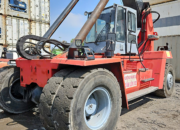
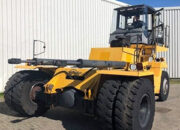
Diesel reachstackers from renowned manufacturers such as Kalmar, Konecranes, and Terex remain the operational backbone of major seaports and inland container depots (ICDs). Based on Samcovina’s hands-on experience, diesel units continue to be the most widely used due to their outstanding operational strength.
Advantages:
Continuous high-intensity operation
Unlike electric machines that require charging downtime, diesel reachstackers can be refueled in just a few minutes and immediately return to work—an absolute advantage for terminals operating 24/7.
Reasonable initial capital expenditure (CAPEX)
Compared to electric reachstackers of the same lifting capacity, diesel models are significantly more affordable. In particular, high-quality used units imported from Europe, available at Samcovina, allow operators to optimize capital investment while maintaining reliable performance.
Excellent adaptability to harsh environments
Internal combustion engines operate reliably in heavy rain, high humidity, and uneven terminal surfaces—conditions commonly encountered at Vietnamese ports.
Disadvantages:
High operating costs
Fluctuating diesel prices and high fuel consumption rates create a substantial long-term financial burden.
Complex maintenance requirements
Diesel engines consist of thousands of mechanical components (pistons, injectors, filters, belts, etc.), all of which require regular servicing and replacement to prevent major failures.
- Electric Container Reachstackers
Electric reachstackers are no longer a niche or luxury concept. Thanks to advances in lithium-ion battery technology, these machines are redefining perceptions of electric power in heavy-duty industrial applications.
Advantages:
Significantly lower operating expenses (OPEX)
Real-world calculations show that electricity costs are 60%–80% lower than diesel fuel costs for the same workload.
Reduced maintenance complexity
With no internal combustion engine and no complex hydraulic transmission, electric reachstackers can reduce periodic maintenance costs by up to 50%.
Quiet and zero-emission operation
No noise pollution and no carbon emissions—an important advantage for operators pursuing ISO environmental certifications, ESG goals, or operating in enclosed warehouses and urban areas.
Disadvantages:
High acquisition cost
The purchase price of a new electric reachstacker can be up to twice that of a diesel unit, requiring strong financial capacity.
Charging infrastructure requirements
Operators must invest in high-capacity charging stations and carefully plan fleet utilization to avoid downtime caused by battery charging.
- Side-by-Side Comparison for Decision Makers
To provide a clear overview, Samcovina summarizes the key technical and economic factors below:
| Criteria | Diesel Container Reachstacker | Electric Container Reachstacker |
| Initial Investment (CAPEX) | Low – Medium | Very High |
| Energy Cost | Very High (diesel price volatility) | Low (more stable) |
| Operating Availability | 24/7 (fast refueling) | Dependent on battery capacity & charging |
| Component Durability | Frequent mechanical replacements | Long lifespan of electrical components |
| Environmental Compliance | CO₂ emissions, high noise | Zero emissions, ultra-quiet |
- Samcovina’s Recommendation: Which Should You Choose?
The right choice depends entirely on your economic model and operational requirements:
Choose diesel reachstackers if:
You need rugged, heavy-duty equipment capable of continuous high-intensity operation, and you want faster return on investment by acquiring reliable used machines from Europe.
Choose electric reachstackers if:
Your company prioritizes long-term operating cost reduction, already has suitable electrical infrastructure, and is committed to sustainability and ESG objectives to strengthen brand positioning with international partners.
At Samcovina, we offer a comprehensive range of container reachstackers—from traditional diesel-powered units to the most advanced electric solutions—available as new and used machines imported from the USA, Japan, and Europe, tailored to meet diverse operational needs.