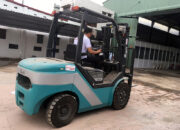
User manual for energy-saving electric forklifts.

Use energy-saving electric forklifts.

Conventional electric forklifts are built with small and medium lifting capacities, to be able to move flexibly and meet the requirements of handling different situations. An economical technology for power consumption.

Electric forklifts often operate for a long time, controlling the amount of power consumption can greatly reduce the cost of work. Electric forklifts of the same type have the same working conditions, different operating speeds, and different power consumption. Therefore power consumption will be lowest only when running at a certain speed. To save energy, electric forklifts should be driven in direct gear or high gear at medium speed, so the effect will be more obvious.

dien-nang-tiet-kiem

In addition, the power consumption of the equipment in an electric forklift is related to its engine temperature. If the temperature is too high or too low, the power consumption will increase, so maintaining the engine temperature is one of the main methods to save power consumption. Engine heating when used in low temperature conditions, if preheating is done, the power saving of electric forklifts is also very helpful.

Battery forklift is a forklift that uses a battery as power source to drive the relay motor and hydraulic system motor, and then completes the delivery and loading work. It has high durability, reliability and wide applicability used in many industries. There are mundane applications. So in the process of using a forklift we can easily ignore what problems, the following people are easy to get used to.

When using electric forklifts to load goods, it is necessary to carefully manage the load center, in the comments, the load center distance is the center of gravity of the electric forklift when the forklift is lifting goods. Usually refers to the center of the length of the cargo. Assuming the forklift’s fork length is 1.20 meters, the load center is 600mm. If your row is 3 meters long and the center of the row is 1.5m, it is definitely not possible to use a 1.20 meter forklift. Even if there will be an answer in the near future, it is very likely that dumping will occur, which is an extreme crisis.

When the forklift is moving forward, if the fork is raised too high, the height of the forklift’s overall center of gravity will increase, and the stability of the forklift will be affected. Therefore, when moving forward, the fork should not be raised too high, the height of the lower end above the ground should be kept at 300-400mm, the load should be in the lowest position without hindering the advance, the rig should be tilted. rearward and it should not be raised unless stowed or loaded. When going in and out of the assignment site or on the go, be careful if there are any obstacles in the sky. If you need to carry a large object, it will block the driver’s view, so turn the forklift upside down.

When the electric forklift is turning, if there are pedestrians or vehicles nearby, it is necessary to notify and take precautions to make sharp turns at high speed, otherwise the vehicle will lose stability and overturn. Stop flames and skids on downhill, under non-exclusive conditions, stopping the forklift brake when the forklift is moving forward. Do not brake unless the load is transitioning more than 7 degrees and when going up and downhill at a higher speed than the first gear. After unloading, the fork must be lowered to the normal forward address before forwarding.

When electric forklifts operate in the workshop area, they must also obey traffic laws, need to keep a certain safe distance from the vehicle in front. Because it is driven by the rear wheel, it is necessary to be careful with the rear swing to avoid the sudden rollover that often occurs when you first start driving. Block when turning on the road and cannot advance over the ramp. When the forklift loads downhill, back up, otherwise the load may tip over.

Leave a Reply

Your email address will not be published. Required fields are marked *

Related posts

  • xe nang van chuyen pallet A Professional Guide to Routine Pallet Truck Maintenance

    A Professional Guide to Routine Pallet Truck Maintenance   In any warehouse or workshop, the pallet truck is often considered the “unsung hero.” Day in and day out, these machines tirelessly move tons of goods with speed, efficiency, and reliability. However, precisely because of their simplicity and durability, many businesses inadvertently neglect their routine maintenance. […]

  • xe-nang-tay Overview of manual hydraulic forklifts

    Overview of manual hydraulic forklifts In recent years, manual hydraulic forklifts have gradually become popular in the domestic market. The hydraulic hand pallet truck with flexible, convenient operation and skillful transportation has played a role that other forklifts cannot perform during operation. Hydraulic hand pallet truck, also known as hand pallet truck, is a versatile […]

  • dong-co-xe-nang-dien Maintenance of electrical systems for forklifts

    Electric systems for forklifts The forklift’s electrical system is the main part of the forklift, a minor failure can cause the entire vehicle to malfunction or cause an accident. Therefore, the maintenance and maintenance of various components in the forklift’s electrical system is extremely important for the safe use of the forklift. The power supply […]

  • cach chon xe nang cho kho bai Optimizing Warehouse Space with Reach Trucks

    Optimizing warehouse space with Reach Trucks The explosion of e-commerce, supply chain development, and increased industrial output has led to a surge in demand for goods storage. Businesses face a challenging puzzle: how to optimize warehouse space and improve logistics efficiency without incurring excessive investment costs in expanding warehouse areas? Among countless solutions, Reach Trucks […]

  • hoi-dap-xe--nang FAQs about Forklift Battery and Electrical System

    FAQs about Forklift Battery and Electrical System 1. What is the average lifespan of a forklift battery? The average lifespan of a forklift battery is typically between 4-6 years for lead-acid batteries, depending on usage, working conditions, and maintenance. Gel batteries have a shorter lifespan, around 3-5 years. 2. How should I maintain my forklift battery? To maintain your forklift battery, you should regularly check and top up the water level, clean the charging terminals and battery poles, ensure full charging without overcharging, regularly check electrolyte density and cell voltage. 3. How can I maximize the lifespan of my forklift battery? To maximize the lifespan of your forklift battery, you should use the correct capacity battery, follow proper installation procedures, maintain full charging, avoid deep discharging, perform regular maintenance, adjust electrolyte density as needed, and keep it clean. 4. What factors affect the lifespan of a forklift battery? The main factors that affect the lifespan of a forklift battery include initial battery quality, using the correct capacity battery, charging and discharging methods, operating temperature conditions, maintenance and storage practices, and working conditions (vibration, humidity, dust). 5. When should I replace my forklift battery? Typically, you should replace your forklift battery after 4-6 years of use depending on the quality of the battery, usage level, and maintenance conditions. If the battery experiences severe performance degradation before that time frame, it should be replaced earlier. Monitoring electrolyte density can help evaluate remaining battery life. 6. When and how should I charge my forklift battery? You should charge your forklift battery after each work shift. The best method is to use an automatic three-stage controlled charger (bulk-float-equal) with periodic water replenishment for lead-acid batteries. The charger should provide the appropriate current and voltage according to the battery’s requirements. 7. What causes and how to fix a swollen forklift battery? Causes: Excessive heat generated during charging, resulting in hydrogen and oxygen gas buildup. Heat causes expansion of the welding circuit, leading to battery case rupture. Solutions: Check and clean the charger, ventilation system. Replace the damaged battery case. Follow proper charging procedures. Purchase batteries with good quality. 8. How to prevent battery gassing in forklifts? To prevent battery gassing, avoid discharging below 80% of rated capacity, avoid hot charging at high temperatures, maintain proper electrolyte density, perform regular equalizing charges, and use an automatic three-stage controlled charger. 9. Which type of battery is suitable for different types of forklifts? The choice of battery depends on the motor power requirement, lifting capacity, continuous usage time, and working environment conditions. Lead-acid batteries are suitable for high-power forklifts with long working hours. Gel batteries are suitable for small-capacity forklifts used internally. 10. Evaluate the advantages and disadvantages of gel batteries compared to lead-acid batteries. Advantages of gel batteries: No acid spillage, low maintenance, no fumes emission, safer and environmentally friendly. Disadvantages: Shorter lifespan, higher cost, cannot replenish water levels, prone to overheating. Advantages of lead-acid batteries: Lower cost, longer lifespan; however, they require more maintenance and have a risk of acid leakage. 11. How often should I replace distilled water in lead-acid batteries? Distilled water in lead-acid batteries should be replaced every 6-12 months depending on evaporation levels. The replacement frequency may be shorter if the forklift operates in hot and dusty environments. Regularly check water levels to determine when it needs replacement. 12. What are the standards for distilled water used in forklift batteries? Distilled water used in forklift batteries must meet high purity standards (≥99.5%), be free from large impurities, and have a resistivity of ≥5 MΩ.cm. Water that does not meet these standards can corrode battery components, create deposits, and reduce performance. 13. What causes and how to fix a short-circuited forklift battery? Causes: Damaged or corroded wires causing ground contact and short circuits. Dirt and high humidity inside the battery can also cause shorts. Solutions: Check and repair damaged wires. Clean the battery to remove dirt. Maintain proper humidity levels. Replace the battery if it is too old. 14. How should I maintain electrical components on a forklift? Electrical components should be regularly maintained, including checking and cleaning the charger, control circuitry, motor, conductors, and tightening all electrical connections. Ensure effective cooling ventilation systems. Check and replace any faulty components to ensure electrical safety. 15. What are the signs of electrical system issues in a forklift? Signs of electrical system issues in a forklift include slow movement or failure to reach desired speed, underperforming motor power, abnormal battery heat or swelling, smoke smell from electrical devices, unusual noise from motor or drivetrain, malfunctioning warning lights or display screens. 16. What does regular maintenance of the forklift’s electrical system involve? Regular maintenance of the forklift’s electrical system includes checking and cleaning the battery, replenishing distilled water, measuring electrolyte density; checking and cleaning the charger; inspecting control circuits; motors; conductors; tightening all electrical connections; ensuring effective cooling ventilation systems; checking and replacing faulty components to ensure electrical safety.