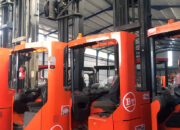
Optimizing Warehouse Space with Reach Trucks

Optimizing warehouse space with Reach Trucks

The explosion of e-commerce, supply chain development, and increased industrial output has led to a surge in demand for goods storage. Businesses face a challenging puzzle: how to optimize warehouse space and improve logistics efficiency without incurring excessive investment costs in expanding warehouse areas?

Among countless solutions, Reach Trucks have emerged as a “savior” for businesses. With their specialized design, ability to operate flexibly in narrow spaces, and outstanding performance, Reach Trucks are gradually replacing traditional forklifts, becoming the optimal choice for modern warehouses.

Reach Trucks: The optimal choice for warehouse space optimization

Reach Trucks are specifically designed to operate in narrow aisles, with the ability to lift and handle goods safely and efficiently at high elevations. So what makes Reach Trucks so special?

Ultra-compact design, optimized for every space:

The biggest difference between Reach Trucks and traditional counterbalance forklifts lies in their ultra-compact design. The minimized truck width allows for comfortable movement in narrow aisles, ranging from 2.5 to 3 meters. The extremely small turning radius enables flexible maneuvering, saving travel space.

Thanks to this design, Reach Trucks can operate effectively in warehouses with limited space, maximizing storage space without the need for warehouse expansion. Businesses can arrange more shelves, increase storage density, and enhance warehouse capacity.

Superior lifting and lowering capabilities conquer all heights:

Not only compact, Reach Trucks also possess outstanding lifting and lowering capabilities. The truck’s extending reach allows access to and handling of goods at high positions, making full use of vertical warehouse space. Some modern Reach Trucks can lift loads up to 12 meters, meeting the needs of high-rise warehouses.

This “tremendous” lifting capacity allows businesses to optimize the use of vertical space, increasing warehouse capacity without incurring additional investment costs in floor space.

Intelligent, safe, and efficient operating mechanism:

Reach Trucks are equipped with an intelligent operating mechanism that allows the lifting mast to move flexibly in multiple directions: extending, retracting, lifting, and lowering. This allows the truck to easily access goods in any position and perform complex handling operations in confined spaces safely and efficiently.

For example, a Reach Truck can easily retrieve goods from high-rise racks, place goods on deep pallets, and move goods through narrow aisles without any obstacles.

Outstanding benefits of applying Reach Trucks in warehouse management

The application of Reach Trucks brings many practical benefits to businesses, contributing to improving logistics efficiency and optimizing costs:

Increased operational productivity:

Fast travel speed and powerful lifting and lowering capabilities help shorten goods handling time and increase labor productivity.
Minimizes waiting time, accelerates import and export progress, and improves supply chain efficiency.
Cost savings for warehouse operations:

Reduces warehouse rental costs by optimizing storage space.
Saves labor costs by reducing the number of employees required for goods handling.
Minimizes goods damage, saving repair and replacement costs.
Ensuring occupational safety:

Equipped with modern safety systems: automatic braking system, overload warning, surveillance cameras… to help minimize the risk of occupational accidents.
Creates a safe and professional working environment, enhancing the image of the business.
Choosing a Reach Truck and factors to consider

To choose the right Reach Truck for your needs, businesses need to carefully consider the following factors:

Lifting capacity:

Clearly determine the weight of the goods to be lifted, the type of pallet used… to choose the type of forklift with a suitable load capacity for actual needs.
Calculate the excess lifting capacity to ensure safety and operational efficiency.
Lifting height:

Determine the height of the shelves in the warehouse and the height of the warehouse ceiling to choose a truck with a suitable lifting height.
Working environment:

Choose the type of vehicle suitable for the working environment: cold storage, normal warehouse, chemical warehouse…
Forklift brand and supplier:

Prioritize reputable and quality forklift brands with good warranty and maintenance regimes.
Choose an experienced and reputable supplier that provides attentive after-sales service.
In conclusion:

Reach Trucks are an effective solution for optimizing warehouse space, bringing many practical benefits to businesses. Choosing the right forklift for your needs and paying attention to important factors when purchasing will help businesses increase operational productivity, save costs, and ensure occupational safety.
Leave a Reply

Your email address will not be published. Required fields are marked *

Related posts

  • xe-nang-2-tan Forklift 1.5 tons, tons, 2.5 tons, 3 tons

    Forklift 1.5 tons, tons, 2.5 tons, 3 tons – Which one is suitable for your needs? Forklifts are widely used in various fields such as factories, warehouses, ports… for transporting and stacking goods. However, choosing a forklift with the right lifting capacity is not a simple task. Choosing a too small forklift will cause overload, danger and inefficiency. On the other hand, choosing a too large forklift will result in cost waste and space inefficiency. So in the segments of forklifts 1.5 tons, 2 tons, 2.5 tons and 3 tons, which one should you choose to best suit the actual conditions of your business? Factors determining the appropriate lifting capacity: Type and size of goods being transported The first important factor to consider is the type of goods and their weight, size. If most of the goods are in the range of 1-1.5 tons, forklifts with capacities of 1.5-2 tons will be suitable. If you frequently transport heavy materials as steel, wood… then you should choose a forklift from 2.5 tons onwards. In addition, the size of the goods affects the choice of forklift because each type of forklift has different lifting heights and dimensions. Operating environment of the forklift The operating environment is also an important factor to consider when choosing a forklift. In closed warehouses or workshops, lightweight forklifts like 1.5-2 tons can be used to move around easily. On the other hand, if operating outdoors, heavy-duty forklifts like 2.5-3 tons should be chosen to meet load-bearing requirements and operate on rough terrain. For narrow operating spaces, it is best to avoid large cumbersome forklifts. Load capacity and distribution capability of the forklift Each type of forklift has different load limits according to its design. Some types are designed to carry loads evenly across their floors while others are only suitable for concentrated loads. Therefore, you need to understand the load capacity of the forklift and consider how the actual will be distributed. Furthermore, it is necessary to consider production scale and future business expansion plans. If there are plans to expand in scale in the future, it is better to choose a higher load capacity forklift to meet future needs and avoid investing in new equipment. Comparing different segments of forklifts based on lifting capacity: 1.5-ton Forklift Advantages: Low cost, flexible movement in narrow spaces. Disadvantages: Only suitable for transporting light goods under 1 ton. Recommendation: Choose this type if operating space is limited and mainly transporting goods under 1 ton weight. 2-ton Forklift Advantages: Versatile; can transport various types of goods from light to heavy within a load range of 1-2 tons. Disadvantages: Higher cost than a 1.5-ton model; not suitable for loads over 2 tons. Recommendation: A popular choice among small and medium-sized warehouses and manufacturing facilities; suitable for various heavy goods weighing between 1-2 tons such as paper rolls, fabrics, food items… 2.5-ton Forklift Advantages: Superior load capacity compared to lower models; can lift heavy loads. Disadvantages: Requires larger operating space. Recommendation: Ideal choice for large-scale warehouses or manufacturing facilities requiring transportation of heavy goods such as crates or construction materials weighing between 2 – 2.5 tons; especially suitable near coastal areas or ports due to its strong load-bearing capabilities. 3-ton Forklift Advantages: High load capacity; efficient transportation of heavy items. Disadvantages: High cost; difficult maneuverability in small spaces. Based on an analysis of factors influencing choice and comparing advantages/disadvantages among different segments mentioned above: If mainly transporting light goods under 1 ton weight in limited operating spaces – opt for a 1.5-ton model but consider future business expansion plans before making a decision. For shops or small-medium manufacturing facilities needing transportation within a range from light (under) up-to medium-heavy (around) two tonnes – go with a two-ton model which offers cost savings while meeting requirements effectively. For large factories or warehouses frequently moving heavy items like steel beams or cement bags weighing between two-three tonnes – choose a two-and-a-half ton model ensuring productivity & safety standards are met efficiently. In cases where handling super-heavy materials over two-and-a-half tonnes becomes necessary – invest in three-ton models after careful consideration due to their higher load-bearing capabilities. Additionally recommended selecting models with slightly higher loading capacities (10-20%) than anticipated maximum loads prevent overloading ensuring safety measures are maintained properly while considering financial capabilities when making investment decisions possibly opting rental services if regular usage isn’t required saving costs effectively. Moreover once selecting an appropriate model ensure following correct operational procedures maintenance schedules recommended by manufacturers prolonging equipment lifespan significantly catering special transportation needs considering specialized models optimizing operations efficiently.

  • xe nang kho pallet dien A Comprehensive Guide to Selecting Electric Pallet Trucks for Small Warehouses Introduction

    For small-scale warehouses, supermarkets, or production workshops, optimizing space and operational efficiency presents a significant challenge. The reliance on traditional manual hand pallet jacks not only curtails labor productivity but also introduces potential safety risks. Conversely, investing in a full-sized counterbalance forklift is often not feasible due to spatial and financial constraints. In this context, […]

  • xe nang cu container Purchasing New, Used, and Long-Term Leasing of Container Forklifts

    Cost Comparison: Purchasing New, Used, and Long-Term Leasing of Container Forklifts 1. Introduction In the logistics industry, container forklifts are critical equipment for handling and transporting containers at ports, warehouses, or distribution centers. However, deciding between purchasing a new container forklift, acquiring a used one, or opting for long-term leasing poses a significant challenge for […]

  • reacchstacker cu nhap khau Experience in Selecting Container Handlers for Logistics Companies

    Experience in Selecting Container Handlers for Logistics Companies In the logistics supply chain, container handling equipment such as Reachstackers or Empty Container Handlers are often considered the “heart” of port terminals and container yards. Investing in a container handler is not merely purchasing equipment; it is a strategic decision that can impact a company’s operations […]

  • ban va cho thue xe nang The Most Reputable Forklift Brands Today

    The Most Reputable Forklift Brands Today Forklifts are essential equipment in industries, logistics, and warehousing. Choosing a reputable forklift brand not only ensures operational efficiency but also optimizes costs and enhances safety. In this article, we introduce the top 5 most trusted forklift brands today—Toyota, Linde, Kalmar, Komatsu, and Cat—along with their strengths and standout […]