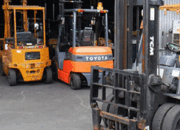
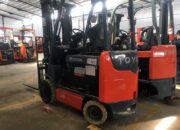
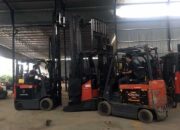
Toyota diesel and electric forklift for sale and rental

Toyota forklift for sale and rental

You are looking to buy or rent a new or used forklift for your convenience, but you are wondering which model or brand to choose? So have you thought about owning a Toyota forklift? Toyota is a Japanese brand that is said to be a giant in the forklift industry

Toyota forklifts are famous for their efficiency, resilience as well as good efficiency. Toyota forklifts are made with advanced manufacturing technology, built with high quality and reliable engines. All forklift components, accessories and spare parts are researched, designed, developed, tested by Toyota in a closed technological process in Japan before being put on the market.

Toyota forklifts are famous for their efficiency, resilience as well as good efficiency. Toyota forklifts are made with advanced manufacturing technology, built with high quality and reliable engines. All forklift components, accessories and spare parts are researched, designed, developed, tested by Toyota in a closed technological process in Japan before being put on the market.

For more than 20 years, Toyota has been the number 1 selling forklift brand in the world, proving that many customers trust the quality and safety of Toyota. There is a special feature that Toyota forklifts operate efficiently, creating immediate productivity but without the cost of maintenance and engine maintenance over a long period of time.

Toyota

Toyota forklifts are built with a powerful hydraulic system and a firmer frame to provide stability and safety when transporting, reducing the possibility of tilting the forklift when lifting, loading and unloading goods at a height. maximum. In addition, Toyota is about making their forklifts handy, paying attention to the toggle switch, the hanging seat creates a line of sight, good visibility of the forklift to increase satisfaction and create comfort for the occupants. operate smoothly.

Toyota forklifts are often used for businesses that move goods with large workloads, high working intensity for many years without having to replace them, but keep its status quo and its performance does not decrease over time. years even if it works continuously in outdoor working environment under inclement weather.

Toyota forklifts have the ability to lift strong, solid, durable and high safety. These capabilities make it possible to load and unload goods from high positions without causing an accident. Modern design with new functions makes them easy to use, easy to operate, operate quietly and is especially friendly to the environment.

To find or rent a forklift that’s right for your company’s needs, you have plenty of options. Samcovina currently has many models of Toyota forklifts, each with different characteristics. Electric forklifts, counterbalance forklifts, forklifts used in narrow aisles, hand jacks, Toyota hand pallet trucks…with a variety of lifting capacities from 1.5 tons, 2 tons, 2.5 tons… to forklifts. Large payload up to 45 tons. We’ll help you choose the model and model that’s right for your business and help you improve your productivity and business efficiency.

If you are looking to buy or rent a Toyota forklift or any other famous forklift brand in the world, do not hesitate or go far, please visit our company Samcovina immediately. We will listen to your needs and choose the best cars for you.
Leave a Reply

Your email address will not be published. Required fields are marked *

Related posts

  • hoi-dap-xe--nang FAQs about Forklift Battery and Electrical System

    FAQs about Forklift Battery and Electrical System 1. What is the average lifespan of a forklift battery? The average lifespan of a forklift battery is typically between 4-6 years for lead-acid batteries, depending on usage, working conditions, and maintenance. Gel batteries have a shorter lifespan, around 3-5 years. 2. How should I maintain my forklift battery? To maintain your forklift battery, you should regularly check and top up the water level, clean the charging terminals and battery poles, ensure full charging without overcharging, regularly check electrolyte density and cell voltage. 3. How can I maximize the lifespan of my forklift battery? To maximize the lifespan of your forklift battery, you should use the correct capacity battery, follow proper installation procedures, maintain full charging, avoid deep discharging, perform regular maintenance, adjust electrolyte density as needed, and keep it clean. 4. What factors affect the lifespan of a forklift battery? The main factors that affect the lifespan of a forklift battery include initial battery quality, using the correct capacity battery, charging and discharging methods, operating temperature conditions, maintenance and storage practices, and working conditions (vibration, humidity, dust). 5. When should I replace my forklift battery? Typically, you should replace your forklift battery after 4-6 years of use depending on the quality of the battery, usage level, and maintenance conditions. If the battery experiences severe performance degradation before that time frame, it should be replaced earlier. Monitoring electrolyte density can help evaluate remaining battery life. 6. When and how should I charge my forklift battery? You should charge your forklift battery after each work shift. The best method is to use an automatic three-stage controlled charger (bulk-float-equal) with periodic water replenishment for lead-acid batteries. The charger should provide the appropriate current and voltage according to the battery’s requirements. 7. What causes and how to fix a swollen forklift battery? Causes: Excessive heat generated during charging, resulting in hydrogen and oxygen gas buildup. Heat causes expansion of the welding circuit, leading to battery case rupture. Solutions: Check and clean the charger, ventilation system. Replace the damaged battery case. Follow proper charging procedures. Purchase batteries with good quality. 8. How to prevent battery gassing in forklifts? To prevent battery gassing, avoid discharging below 80% of rated capacity, avoid hot charging at high temperatures, maintain proper electrolyte density, perform regular equalizing charges, and use an automatic three-stage controlled charger. 9. Which type of battery is suitable for different types of forklifts? The choice of battery depends on the motor power requirement, lifting capacity, continuous usage time, and working environment conditions. Lead-acid batteries are suitable for high-power forklifts with long working hours. Gel batteries are suitable for small-capacity forklifts used internally. 10. Evaluate the advantages and disadvantages of gel batteries compared to lead-acid batteries. Advantages of gel batteries: No acid spillage, low maintenance, no fumes emission, safer and environmentally friendly. Disadvantages: Shorter lifespan, higher cost, cannot replenish water levels, prone to overheating. Advantages of lead-acid batteries: Lower cost, longer lifespan; however, they require more maintenance and have a risk of acid leakage. 11. How often should I replace distilled water in lead-acid batteries? Distilled water in lead-acid batteries should be replaced every 6-12 months depending on evaporation levels. The replacement frequency may be shorter if the forklift operates in hot and dusty environments. Regularly check water levels to determine when it needs replacement. 12. What are the standards for distilled water used in forklift batteries? Distilled water used in forklift batteries must meet high purity standards (≥99.5%), be free from large impurities, and have a resistivity of ≥5 MΩ.cm. Water that does not meet these standards can corrode battery components, create deposits, and reduce performance. 13. What causes and how to fix a short-circuited forklift battery? Causes: Damaged or corroded wires causing ground contact and short circuits. Dirt and high humidity inside the battery can also cause shorts. Solutions: Check and repair damaged wires. Clean the battery to remove dirt. Maintain proper humidity levels. Replace the battery if it is too old. 14. How should I maintain electrical components on a forklift? Electrical components should be regularly maintained, including checking and cleaning the charger, control circuitry, motor, conductors, and tightening all electrical connections. Ensure effective cooling ventilation systems. Check and replace any faulty components to ensure electrical safety. 15. What are the signs of electrical system issues in a forklift? Signs of electrical system issues in a forklift include slow movement or failure to reach desired speed, underperforming motor power, abnormal battery heat or swelling, smoke smell from electrical devices, unusual noise from motor or drivetrain, malfunctioning warning lights or display screens. 16. What does regular maintenance of the forklift’s electrical system involve? Regular maintenance of the forklift’s electrical system includes checking and cleaning the battery, replenishing distilled water, measuring electrolyte density; checking and cleaning the charger; inspecting control circuits; motors; conductors; tightening all electrical connections; ensuring effective cooling ventilation systems; checking and replacing faulty components to ensure electrical safety.

  • kho-xe-nang-dien FAQs – Frequently Asked Questions about Toyota Electric Forklifts

    1. What are the main benefits of using a Toyota electric forklift compared to a gasoline forklift? The main benefits of using a Toyota electric forklift compared to a gasoline forklift are: – Environmentally friendly, with no harmful emissions – Lower operating costs and fuel savings – Quieter operation, significantly less noise than gasoline forklifts – Simpler maintenance and lower costs – Increased productivity in warehouses and storage facilities 2. What is the average lifespan of a battery on a Toyota electric forklift? The average lifespan of a battery on a Toyota electric forklift is typically 4-5 years, depending on usage and maintenance conditions. 3. How can I optimize the lifespan of the battery on my Toyota electric forklift? To optimize the lifespan of the battery on your Toyota forklift, you should: – Fully charge the battery after each work shift – Avoid overfilling or completely draining the battery – Properly maintain the battery, including regular electrolyte level checks – Operate the forklift within its recommended load limits – Replace the battery when it becomes too old and worn out 4. What types of batteries does Toyota use for their electric forklifts? Toyota uses lead-acid batteries, lithium-ion batteries, and alkaline batteries for their electric forklifts depending on the specific model. 5. How long does it take to fully charge the battery on a Toyota electric forklift? The charging time for a Toyota electric forklift battery depends on its capacity but averages around 6-8 hours with standard chargers. 6. When should I replace the battery on my Toyota electric forklift? You should replace the battery on your Toyota electric forklift when: – The recommended lifespan has been exceeded (typically 4-5 years) – The continuous usage time on a single charge has significantly decreased – The battery is swollen, leaking, or severely damaged – The battery’s performance has deteriorated beyond acceptable levels 7. How do I replace the battery on a Toyota electric forklift? The process of replacing the battery on a Toyota forklift is as follows: – Check and identify the specific model of the replacement battery – Remove the vehicle casing and disconnect the electrical circuit to access the old battery – Disconnect and remove the old battery by disconnecting terminals and cables – Install the new battery of the same type and make proper connections – Restart the forklift, fully charge the new battery, and test its operation – Reassemble the vehicle casing and complete the process 8. What is the average operating cost of a Toyota electric forklift compared to a gasoline forklift? The average operating cost of a Toyota electric forklift is 60-70% lower than that of a gasoline forklift with similar load capacities. 9. Can Toyota electric forklifts be used outdoors? Toyota electric forklifts can be used outdoors but certain conditions must be met: – Batteries must be fully charged and properly maintained […]

  • phu tung cho xe nang Why Genuine Parts Can Reduce Forklift Operating Costs by Up to 30%

    Why Genuine Parts Can Reduce Forklift Operating Costs by Up to 30% In the management of container handling equipment and reach stacker fleets at ports, one common mistake many companies make is focusing too heavily on purchase price while overlooking the Total Cost of Ownership (TCO). Using non-genuine replacement parts may deliver a small short-term […]

  • xe-kalmar Hydraulic Oil for Forklifts

    Hydraulic Oil for Forklifts Hydraulic oil used for forklifts is a special type of oil designed to work in the hydraulic system of a forklift. This type of oil provides lubrication and power transmission to hydraulic components, ensuring smooth and efficient operation. When choosing hydraulic oil for a forklift, there are several important factors to […]

  • cho-thue-xe-nang hang Rental Electric Forklifts, Reach Trucks, Pallet Trucks & Reach Stackers

    Forklift Rental in Ho Chi Minh City: Electric Forklifts, Reach Trucks, Pallet Trucks & Reach Stackers   Forklift rental services in Ho Chi Minh City are primarily available in four categories: electric counterbalance forklifts, reach trucks, pallet trucks, and container handlers (reach stackers). Each type is designed for a specific application. Electric forklifts are widely […]

Gọi ngay
Chat Zalo