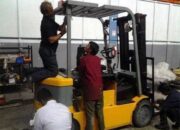
Trends in New Technology Applications in the Forklift Industry

Trends in New Technology Applications in the Forklift Industry

As logistics and warehouse management continue to evolve, the forklift industry is experiencing a breakthrough thanks to technological advancements. From Automated Guided Vehicles (AGVs) to Artificial Intelligence (AI) and lithium-ion battery-powered electric forklifts, these trends not only improve operational efficiency but also shape the future of the industry. Let’s explore how advanced technologies are transforming warehouse operations and supply chains.


Automated Guided Vehicles (AGVs): The Next Step in Automation

AGVs are becoming one of the most disruptive technologies in the logistics industry. These are forklifts that operate autonomously using navigation technologies such as lasers, cameras, or RFID (radio-frequency identification) to transport goods around warehouses without the need for a human driver.


Benefits of AGVs

Increased productivity: AGVs can operate 24/7, minimizing downtime and human error. This is particularly useful in large warehouses where speed and precision are essential.


Enhanced safety: Equipped with advanced sensors, AGVs can detect obstacles and stop immediately, reducing the risk of accidents in crowded work environments.


Flexibility and easy integration: AGVs can be easily programmed to perform various tasks and integrated with warehouse management systems (WMS) to optimize workflows.


Real-world Applications

AGVs are widely used across various industries. For example, in e-commerce, companies like JD.com have deployed AGVs to handle millions of orders per day, cutting delivery times and increasing accuracy. In manufacturing, automotive factories use AGVs to transport parts to assembly lines, ensuring uninterrupted operations.


Challenges of AGV Adoption

Despite the benefits, implementing AGVs comes with challenges. Initial investment costs for AGVs and the necessary infrastructure (such as navigation systems and management software) can be high, especially for small and medium-sized businesses. Additionally, maintenance and system upgrades require highly skilled technicians.


Artificial Intelligence (AI): The Future of Smart Warehouse Management

AI is revolutionizing how businesses manage warehouses. From demand forecasting to process optimization, AI helps warehouses operate more efficiently, reduce costs, and enhance customer experience.


The Role of AI in Warehouse Management

Demand forecasting: AI uses machine learning algorithms to analyze historical data, forecast product demand, and optimize inventory levels.


Process optimization: AI can plan optimal routes for AGVs, reducing travel time and improving efficiency. It also aids in scientifically organizing goods in the warehouse, saving space.


Increased accuracy: With machine vision technology, AI can quickly identify and classify goods, reducing errors in order processing.


Real-world Example

Amazon is a pioneer in applying AI to warehouse management. Its AI system has reduced inventory costs and increased order fulfillment rates by up to 30%. AI algorithms analyze data from millions of daily transactions to make optimal decisions on storage locations and delivery routes.


The Future of AI in Warehousing

The integration of AI and the Internet of Things (IoT) is expected to lead to fully automated warehouses. IoT sensors will collect real-time data, while AI will process that data to make immediate decisions. This will not only enhance efficiency but also allow businesses to quickly adapt to changing market demands.


Electric Forklifts with Lithium-ion Batteries: A Sustainable and Efficient Solution

Electric forklifts have long been considered an environmentally friendly alternative to diesel forklifts. However, the development of lithium-ion battery technology has taken electric forklifts to a new level, offering superior performance and sustainable operation.


Advantages of Electric Forklifts

Environmentally friendly: Electric forklifts produce zero CO2 emissions, making them ideal for indoor warehouses and compliant with increasingly strict environmental regulations.


Cost-saving: Compared to diesel forklifts, electric models have lower fuel and maintenance costs, offering long-term savings.


Quiet operation: Electric forklifts generate less noise, creating a more comfortable work environment for employees.


Lithium-ion Battery Technology

Lithium-ion batteries are gradually replacing traditional lead-acid batteries due to their outstanding benefits:


High performance: Lithium-ion batteries provide consistent power output, ensuring efficient forklift operation even during long shifts.


Fast charging: These batteries can be fully charged in just 1–2 hours, compared to 6–8 hours for lead-acid batteries. This allows for continuous operation with minimal downtime.


Long lifespan: Lithium-ion batteries can last 2,000–3,000 charge cycles—2–3 times longer than lead-acid batteries—reducing replacement costs.


Safety: Built-in Battery Management Systems (BMS) help prevent issues such as overcharging, overheating, or short circuits.


Comparing Lithium-ion Batteries and Lead-acid Batteries

(Let me know if you’d like to include a comparison table or chart here.)


The Rise of Electric Forklifts

The demand for electric forklifts is rapidly increasing, especially in green industries like food, pharmaceuticals, and e-commerce. Advances in lithium-ion batteries have enabled electric forklifts to compete in performance while supporting companies in achieving their sustainability goals.


The Impact of Technological Trends on the Forklift Industry

The convergence of AGVs, AI, and lithium-ion-powered electric forklifts is driving a significant transformation in the forklift industry:


Increased productivity and efficiency: Automation and AI reduce order processing times, optimize warehouse space, and improve order accuracy.


Reduced operating costs: AGVs and electric forklifts cut labor, fuel, and maintenance costs, boosting profitability.


Environmental protection: Electric forklifts and lithium-ion batteries help companies meet safety and environmental standards while building a green brand image.


Competitive edge in logistics: Businesses that quickly adopt these technologies will have a distinct advantage in the e-commerce and global supply chain markets.


These technological trends are not just a leap forward—they’re a major opportunity for logistics companies to redefine their operational strategies and meet the growing demands of the modern market.

Leave a Reply

Your email address will not be published. Required fields are marked *

Related posts

  • phu tung cho xe nang Genuine Container Forklift Spare Parts The Golden Key to Performance Optimization and Safety Assurance

    Genuine Container Forklift Spare Parts: The Golden Key to Performance Optimization and Safety Assurance Meta Description: Discover the pivotal role of genuine container forklift spare parts in boosting performance, extending lifespan, and ensuring safe operations. This in-depth article analyzes benefits and risks, helping you make smart, strategic investment decisions. Container Forklifts – The Backbone of […]

  • cac-loai-cang-nang Common Forklift Damage and Troubleshooting

    Common Forklift Damage and Troubleshooting 1. Fork damage: – Question: How to detect and handle fork damage? – Answer: To detect fork damage, you need to regularly check for bending, cracking, or deformation. If any abnormal signs are found, regular maintenance and replacement of the forks are necessary to ensure safety and work efficiency. 2. Uneven forks: – Question: What should we do when we notice uneven forks? – Answer: When the forks are not even, you need to check and adjust them to ensure proper alignment. This may require the intervention of an experienced technician or the use of specialized equipment for adjustment. 3. Hydraulic oil leakage: – Question: How does hydraulic oil leakage affect the forklift and what is the solution? – Answer: Hydraulic oil leakage can affect the operation of the forklift and workplace safety. The solution is to check hydraulic system connections, hoses, cylinders, and other components to find the cause of the leakage. Then proceed with repairing or replacing damaged components. 4. Loss of pressure: – Question: What causes loss of pressure in a forklift and how to troubleshoot it? – Answer: Loss of pressure can be caused by oil leakage, air in the system, or worn components. To fix this issue, you need to check the entire system from pump, valves to cylinders to determine the problem and repair or replace components as needed. 5. Stuck or damaged mechanical parts: – Question: How should we handle stuck or damaged mechanical parts in a forklift? – Answer: For issues related to mechanical parts such as wheels or rotating shafts, maintaining regular maintenance is crucial to prevent machine deterioration. If a jammed or damaged occurs, detailed inspection is needed to determine the cause followed by repair or replacement of components as required. 6. Broken cables or shaking: – Question: What should be done when forklift cables are broken or shaking? – Answer: If cables are broken or shaking, stop using the forklift immediately and conduct an inspection. Replace damaged cables with new ones according to manufacturer specifications by an experienced technician. 7. Loss of control or electrical system failure: – Question: When encountering problems with electrical systems, how do we restore control of a forklift? – Answer: Check electrical components such as fuses, relays, switches, and control circuits. Repair or replace faulty components while always following safety procedures when working with electrical systems. 8. Uneven shaking: – Question: How does uneven shaking during lifting affect operations and how can it be fixed? – Answer: Uneven shaking not only makes it difficult to control the forklift but can also damage goods and operators. Check forks, wheels, suspension components to determine causes of shaking then proceed with necessary repairs or adjustments. 9. Malfunctioning safety sensors: – Question: Why is maintaining safety sensors important and what should be done when they malfunction? – Answer: Safety sensors help prevent accidents and unwanted incidents. When a sensor malfunctions, use diagnostic equipment to identify issues then proceed with repairs or replacements. 10. Cooling system failure: – Question: What are consequences of cooling system failure and how can it be fixed? – Answer: Ineffective cooling can lead to overheating which affects performance and damages components. Check fans, radiators, hoses, coolant fluid flow blockages or leaks. 11.Brake system failure Question : When brake system fails what needs 2 b done Answer : First stop using d lift n inspect d brake sys . Check d master cylinder , brake fluid n connections 2 find d cause . If any signs f wear r damage r found , immediately replace those parts . Regular maintenance s important 2 prevent brake sys issues . 12.Poor mechanical response Question : How 2 fix poor mechanical response f d lift not moving smoothly r getting stuck ? Answer : This could b due 2 lack f lubrication r worn out parts . Clean n lubricate d mechanical parts , then apply lubricant as per manufacturer’s recommendations . If severe wear s found , replace those parts 2 ensure stable n safe operation . Remember that regular maintenance n inspections f d lift will not only extend its lifespan but also ensure safe operations .

  • lai xe nang reachstacker What Certifications Are Needed to Operate a Container Forklift

    What Certifications Are Needed to Operate a Container Forklift? Where to Learn? In Vietnam’s logistics and port industry, container forklifts (such as container reach stackers, container handlers, or container stackers) play a crucial role in handling and moving cargo containers. With the growing demand for skilled operators of container forklifts, possessing the appropriate operating certification […]

  • Repair services for boards and control units of forklifts

    Samco Vina provides repair services for boards and control units of forklifts Samco Vina is a specialized company offering repair and installation services for control units and circuit boards of forklifts—critical components that manage all forklift operations, including starting, moving, and lifting. A malfunctioning control unit can disrupt operations, reduce productivity, and pose safety risks. […]

  • phu tung cho xe nang cont 10 Essential Spare Parts Every Container Handler Warehouse Must Stock

    10 Essential Spare Parts Every Container Handler Warehouse Must Stock A multi-billion–dong container handler standing idle — halting the entire logistics chain and causing massive operational losses — simply because of one unavailable spare part. This painful yet all-too-familiar scenario occurs at many ports and depots. The cost of downtime per hour far exceeds the […]