Experience in Selecting Container Handlers for Logistics Companies
In the logistics supply chain, container handling equipment such as Reachstackers or Empty Container Handlers are often considered the “heart” of port terminals and container yards. Investing in a container handler is not merely purchasing equipment; it is a strategic decision that can impact a company’s operations for the next 10–15 years.
With years of experience importing container handling equipment from demanding markets such as Europe, the United States, and Japan, Samcovina shares practical insights to help businesses choose the most suitable machine.
1. Identify Your Actual Operational Needs: Laden Container or Empty Container Handling?
One of the most common mistakes made by new logistics companies is selecting the wrong type of container handler, which can result in excessive fuel consumption or equipment overloading.
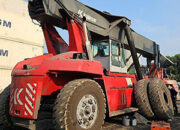
Loaded Container Handler (Reachstacker)
This machine is the “heavy lifter” of container yards, with a typical lifting capacity of up to 45 tons. Its major advantage is the ability to stack containers up to 5–6 high and reach deep into the yard (handling containers in the second or third row). It is ideal for seaports, ICDs, and high-density container terminals.
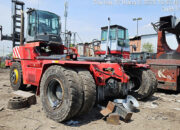
Empty Container Handler (ECH)
If your business focuses on empty container storage depots, this is the optimal choice. Empty container handlers offer faster travel and lifting speeds, enabling rapid yard turnover. However, they are designed for lighter loads, typically below 10 tons.
Professional Tip:
Never attempt to lift heavier loads with an empty container handler. The mast structure of this type of machine is not designed for heavy loads and can easily suffer structural deformation if overloaded.
2. Choosing Equipment Origin: Europe, America, or Japan?
The origin of the equipment significantly affects durability, performance, and spare parts availability in Vietnam.
European / American Brands (Kalmar, Konecranes, Hyster)
These brands are widely regarded as the industry leaders in container handling equipment. Their advantages include extremely robust chassis structures, high-precision hydraulic systems, and ergonomically designed operator cabins. Equipment from these markets also complies with some of the strictest safety and emission standards worldwide.
Japanese / Korean Brands (TCM, Toyota)
These machines are well-known for their reliability, ease of operation, and long service life. Another major advantage is the availability of spare parts in the Vietnamese market, often at a more competitive price compared to European and American brands.
3. Financial Strategy: Brand-New Equipment or Used Imports?
This is often the most challenging question for financial managers. At Samcovina, we usually advise customers based on the following comparison:
| Criteria | Brand-New Equipment | Used Imported Equipment |
|---|---|---|
| Initial Investment | Very high, longer ROI period | Saves 40–60% of investment budget |
| Technology | Latest technology, Stage V emission standard, fuel efficient | Older generation but mechanically reliable |
| Availability | Usually requires 6–12 months lead time | Available in stock, ready for immediate operation |
| Maintenance | OEM service, higher spare part cost | Easier repair, widely available parts |
Optimal Strategy:
For companies that are expanding operations or optimizing cash flow, purchasing well-maintained used equipment imported from developed markets can be a very smart investment.
4. Five Critical Technical Checks Before Purchase
Whether buying new or used equipment, ensure your technical team thoroughly inspects the following components:
Engine and Transmission System
Check reputable engine brands such as Volvo Penta, Cummins, or Scania. Listen to the engine sound, inspect exhaust emissions, and test the responsiveness of the transmission system (commonly ZF or Dana Spicer gearboxes).
Hydraulic System
This is the lifeline of the machine. Inspect the hydraulic cylinders for scratches, oil leaks, or seal damage. Hydraulic pressure must meet manufacturer specifications to guarantee rated lifting capacity.
Chassis and Spreader
Carefully inspect original weld points and structural integrity. The spreader should operate smoothly in both 20ft and 40ft container modes, and the twistlocks must not be excessively worn.
Electrical System and Sensors
Modern container handlers are equipped with numerous safety sensors, including load sensors and tilt sensors. Ensure the onboard display shows no active error codes.
Tyres
A complete set of container handler tyres can cost hundreds of millions of VND. If tyre wear exceeds 70%, negotiate for replacement or a price reduction.
5. Never Overlook After-Sales Service
A container handler that remains idle for repair for even one day can cause significant financial losses across the logistics chain.
Key factors to consider:
Spare Parts Availability
Does the supplier maintain stock of consumables (filters, seals, hydraulic oil) and critical spare parts (sensors, pumps, transmissions)?
Technical Capability
Does the service provider have specialized diagnostic tools and experienced technicians?
Preventive Maintenance Programs
A reputable company such as Samcovina typically offers preventive maintenance packages at 500-hour and 1,000-hour intervals, ensuring the machine remains operational and ready for heavy-duty work at all times.