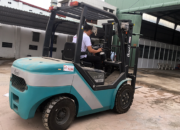
Why Modern Logistics Companies Choose Reach Stackers over Traditional Forklifts

Why Modern Logistics Companies Choose Reach Stackers over Traditional Forklifts

Reach Stacker: Driving Performance Breakthroughs for Modern Logistics

In today’s fiercely competitive global logistics landscape, every decision can make the difference between success and stagnation. The mounting pressure of delivery deadlines, warehouse space optimization, and operational cost control weighs heavily on logistics enterprises. Against this backdrop, choosing the right cargo-handling equipment—whether a heavy-duty forklift or a reach stacker—goes beyond simple operations and becomes a strategic decision. This article analyzes why leading logistics companies increasingly favor reach stackers as a comprehensive solution to replace traditional forklifts.


Comparing Reach Stackers vs. Traditional Container Forklifts

To better understand this shift, it is essential to distinguish between the two types of equipment:

  • Traditional Container Forklift (Heavy-duty Forklift): A well-known machine equipped with forks mounted on a vertical mast that lifts and lowers containers. All lifting, lowering, and moving operations rely on repositioning the entire truck.

  • Reach Stacker: A hybrid between a forklift and a mobile crane. It features a telescopic boom capable of extending, retracting, and adjusting lifting angles, allowing access to containers at greater heights and depths.

This fundamental difference in mechanism results in significant advantages for reach stackers in modern logistics operations. While forklifts are limited to stacking containers 3–4 tiers high in the first row, a reach stacker can effortlessly stack 5–6 tiers high and reach into the second or third row. This revolutionizes reach, speed, and operational flexibility.


5 Key Reasons Reach Stackers Dominate the Logistics Market

1. Maximizing Every Square Meter of Storage Space

Real estate costs are among the largest expenses for logistics companies. Reach stackers directly address this issue by enabling higher-density storage. With the ability to stack containers up to 6 tiers high and retrieve from the third row, businesses can maximize vertical space and minimize aisle requirements. Unlike forklifts that need wide aisles to access each container row, reach stackers significantly increase yard capacity within the same footprint, directly reducing land leasing or purchasing costs.

2. Lightning-fast Loading and Unloading – Reduced Waiting Time

In logistics, speed is critical. Reach stackers save valuable time thanks to superior handling speed. Instead of constantly repositioning the entire forklift truck, operators can simply park the reach stacker in one spot and extend the boom to pick or place containers. This drastically shortens cycle times, increases cargo throughput at ports and depots, and reduces waiting time for trucks and other equipment. This makes reach stackers the most efficient container handling solution in high-speed environments.

3. Exceptional Flexibility in Any Scenario

Container yards (CYs) and inland container depots (ICDs) often have limited space and dense traffic. Reach stackers excel in maneuverability thanks to a smaller turning radius and the ability to approach containers from multiple angles. They can reach over obstacles or extract containers sandwiched between rows without moving others—an advantage traditional forklifts cannot provide.

4. Enhanced Visibility for Maximum Operator Safety

Workplace safety is paramount. Reach stackers are designed with elevated, often sliding cabins that provide operators with a clear 360° field of view. By contrast, forklift operators’ vision is frequently obstructed by the mast and the container itself. Improved visibility reduces the risk of collisions with personnel, vehicles, and cargo, ensuring a safer and more efficient working environment.

5. More Than Just Containers – A Versatile Investment

The value of a reach stacker extends beyond container handling. Thanks to quick-change attachments, it can be adapted for a wide range of tasks. Companies can equip it with coil clamps, special forks for oversized cargo, or lifting hooks for handling concrete beams, large steel pipes, or industrial equipment. This versatility turns the reach stacker into a smart long-term investment, maximizing utilization and ROI.
Leave a Reply

Your email address will not be published. Required fields are marked *

Related posts

  • cac-loai-cang-nang Common Forklift Damage and Troubleshooting

    Common Forklift Damage and Troubleshooting 1. Fork damage: – Question: How to detect and handle fork damage? – Answer: To detect fork damage, you need to regularly check for bending, cracking, or deformation. If any abnormal signs are found, regular maintenance and replacement of the forks are necessary to ensure safety and work efficiency. 2. Uneven forks: – Question: What should we do when we notice uneven forks? – Answer: When the forks are not even, you need to check and adjust them to ensure proper alignment. This may require the intervention of an experienced technician or the use of specialized equipment for adjustment. 3. Hydraulic oil leakage: – Question: How does hydraulic oil leakage affect the forklift and what is the solution? – Answer: Hydraulic oil leakage can affect the operation of the forklift and workplace safety. The solution is to check hydraulic system connections, hoses, cylinders, and other components to find the cause of the leakage. Then proceed with repairing or replacing damaged components. 4. Loss of pressure: – Question: What causes loss of pressure in a forklift and how to troubleshoot it? – Answer: Loss of pressure can be caused by oil leakage, air in the system, or worn components. To fix this issue, you need to check the entire system from pump, valves to cylinders to determine the problem and repair or replace components as needed. 5. Stuck or damaged mechanical parts: – Question: How should we handle stuck or damaged mechanical parts in a forklift? – Answer: For issues related to mechanical parts such as wheels or rotating shafts, maintaining regular maintenance is crucial to prevent machine deterioration. If a jammed or damaged occurs, detailed inspection is needed to determine the cause followed by repair or replacement of components as required. 6. Broken cables or shaking: – Question: What should be done when forklift cables are broken or shaking? – Answer: If cables are broken or shaking, stop using the forklift immediately and conduct an inspection. Replace damaged cables with new ones according to manufacturer specifications by an experienced technician. 7. Loss of control or electrical system failure: – Question: When encountering problems with electrical systems, how do we restore control of a forklift? – Answer: Check electrical components such as fuses, relays, switches, and control circuits. Repair or replace faulty components while always following safety procedures when working with electrical systems. 8. Uneven shaking: – Question: How does uneven shaking during lifting affect operations and how can it be fixed? – Answer: Uneven shaking not only makes it difficult to control the forklift but can also damage goods and operators. Check forks, wheels, suspension components to determine causes of shaking then proceed with necessary repairs or adjustments. 9. Malfunctioning safety sensors: – Question: Why is maintaining safety sensors important and what should be done when they malfunction? – Answer: Safety sensors help prevent accidents and unwanted incidents. When a sensor malfunctions, use diagnostic equipment to identify issues then proceed with repairs or replacements. 10. Cooling system failure: – Question: What are consequences of cooling system failure and how can it be fixed? – Answer: Ineffective cooling can lead to overheating which affects performance and damages components. Check fans, radiators, hoses, coolant fluid flow blockages or leaks. 11.Brake system failure Question : When brake system fails what needs 2 b done Answer : First stop using d lift n inspect d brake sys . Check d master cylinder , brake fluid n connections 2 find d cause . If any signs f wear r damage r found , immediately replace those parts . Regular maintenance s important 2 prevent brake sys issues . 12.Poor mechanical response Question : How 2 fix poor mechanical response f d lift not moving smoothly r getting stuck ? Answer : This could b due 2 lack f lubrication r worn out parts . Clean n lubricate d mechanical parts , then apply lubricant as per manufacturer’s recommendations . If severe wear s found , replace those parts 2 ensure stable n safe operation . Remember that regular maintenance n inspections f d lift will not only extend its lifespan but also ensure safe operations .

  • hoi-dap-xe-nang-toyota Frequently Asked Questions about Common Issues with Toyota Forklifts

    Frequently Asked Questions about Common Issues with Toyota Forklifts 1. What are the causes and solutions for hydraulic oil leaks in Toyota forklifts? – The causes can be worn or damaged hydraulic oil lines, loose or damaged seals and gaskets, stuck or faulty hydraulic control valves, or leaking lift cylinders. – The solutions include checking and replacing damaged parts, regularly cleaning and maintaining the hydraulic system, and ensuring that the hydraulic oil is clean and at the required level. 2. What are the causes and solutions for difficult or failed engine starting in Toyota forklifts? – Common causes include weak or faulty batteries, malfunctioning starter systems, fuel injection/fuel system issues, or fouled spark plugs. – Solutions involve checking, charging, or replacing the battery; inspecting the starter system; cleaning or replacing fuel injection/fuel system components; and cleaning or replacing spark plugs if necessary. 3. How should you handle an overheating engine in a Toyota forklift? – Causes may include low engine coolant levels, a faulty cooling fan, clogged coolant lines, or a leaking water pump. – Solutions involve immediately stopping the operation of the forklift, checking the cooling system, adding coolant if needed, replacing the cooling fan or water pump if necessary, and cleaning and repairing any clogged coolant lines. 4. What are the causes and solutions for weak or loss of lifting power in Toyota forklifts? – Causes can include decreased hydraulic pressure in the system, inefficient hydraulic pumps, or leaking or damaged lift cylinders. – Solutions involve checking and addressing any factors that reduce hydraulic pressure, replacing the hydraulic pump if needed, and repairing or replacing faulty lift cylinders. 5. What should you do when the steering system of a Toyota forklift becomes stiff or too heavy? Firstly, check the hydraulic fluid level for the steering system and top it up if it’s low. Then inspect the hydraulic lines and control valves for the steering system, replacing them if damaged. If the issue persists, it may be due to worn steering worm gears or a faulty steering shaft that needs replacement. 6. How should you handle ineffective braking in a Toyota forklift? Firstly, check the brake fluid, replacing it if contaminated or low. Then inspect the friction surface of the brake discs, replacing them if worn. If the issue continues, check the brake cylinders, brake lines, and brake pump for any faults, repairing or replacing any damaged components. 7. What are the causes and solutions for non-functioning turn signals and lights in Toyota forklifts? – Causes can include blown fuses, broken wires, burnt-out bulbs, or faulty light switches. – Solutions involve checking and replacing blown fuses, repairing or replacing broken wires, installing new bulbs, and replacing faulty light switches if necessary. 8. How should you handle a malfunctioning battery charger in a Toyota forklift? Firstly, check the battery itself; replace it if corroded or too old. Then inspect the wiring from the charger to the battery; replace any broken wires or shorts. Next, check the charger; replace it if not functioning properly. Finally, adjust the charger settings to match the type of battery being used. 9. What should you do when there is hydraulic system leakage or loss of pressure in a Toyota forklift? Firstly, check the hydraulic fluid level; top it up to the required level if low. Then inspect the entire hydraulic system to identify any leaks or loss of pressure. Causes can include faulty hydraulic cylinders, hoses, valves, or seals/gaskets. Replace any damaged parts to restore pressure and ensure a tight seal in the system. 10. What are the causes and solutions for worn or damaged wheels on Toyota forklifts? – The main causes are overloading, driving on rough terrain, sudden changes in direction leading to increased tire wear. Additionally, wheels can be damaged due to rough handling. – Solutions involve ensuring proper loading during operation, driving cautiously on flat surfaces, and being careful when changing directions. Replace worn or damaged wheels with new ones. 11. How should you address transmission issues in a Toyota forklift? Firstly, check the transmission fluid level; top it up if low. Then inspect the components of the transmission system such as the clutch, drive shaft, couplings, and belts; replace any damaged parts if necessary. Finally, check the gearbox and gearbox oil pump; replace them if faulty. Regularly maintain and clean the entire transmission system. 12. What are the causes and solutions for a stuck parking brake in a Toyota forklift? – Common causes include a jammed or broken parking brake cable, deteriorated rubber grommets causing cable sticking, or a stuck or rusted brake drum. – Solutions involve removing and cleaning the parking brake cable, replacing it if broken, replacing deteriorated rubber grommets, lubricating the brake drum with grease if necessary, and replacing heavily rusted brake drums. 13. How should you handle a malfunctioning stability control system in a Toyota forklift? Firstly, check the hydraulic fluid level for the stability control system; top it up to the required level if low. Then inspect the hydraulic control valve and hydraulic cylinders to ensure there are no leaks. Replace valves or cylinders as needed.

  • xe nang cu container Purchasing New, Used, and Long-Term Leasing of Container Forklifts

    Cost Comparison: Purchasing New, Used, and Long-Term Leasing of Container Forklifts 1. Introduction In the logistics industry, container forklifts are critical equipment for handling and transporting containers at ports, warehouses, or distribution centers. However, deciding between purchasing a new container forklift, acquiring a used one, or opting for long-term leasing poses a significant challenge for […]

  • thue-xe-nang-dien-cho-thue Forklift rental service in Binh Duong

    Forklift rental service in Binh Duong Forklift rental service in Binh Duong of Samcovina Joint Stock Company is a reasonable choice for businesses and individuals who need to use forklifts to move goods in this area. Forklift trucks help to minimize time and increase labor productivity when carrying out freight jobs, especially in factories, warehouses […]

  • hu-xe-nang-diesel Errors that cause damage in Diesel forklifts and remedies

    Common failures in Diesel forklifts and remedies Diesel forklifts have mechanical failures during operation, which can damage fundamental components and cause more serious problems for the vehicle, goods, and people. Usually before diesel forklifts have problems. Factors such as: speed, sound, exhaust gas, water temperature, oil pressure and other related problems of it will all […]