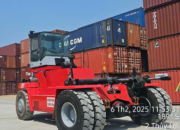
What is a Container Forklift? Detailed Comparison of Reach Stacker vs. Forklift Handler
Are you managing a warehouse, a dry port, or a factory and facing the decision to invest in a container forklift? Choosing the wrong equipment between a Reach Stacker and a Forklift Handler could cost you billions in operational expenses and significantly reduce productivity. Don’t worry! This article, with expert analysis, will serve as your guide to making the most informed and optimal decision for your business.
Overview of Container Forklifts
1. What is a Container Forklift?
A container forklift is a heavy-duty mechanized vehicle specifically designed for lifting, lowering, moving, and stacking ISO-standard containers (20ft, 40ft, 45ft). These are powerful machines with unmistakable characteristics:
Immense lifting capacity: Typically ranging from 10 tons to over 45 tons.
Robust construction: Chassis made from high-strength steel to withstand massive loads and harsh working conditions.
Specialized attachments: Equipped with a spreader that securely clamps onto the top (top-lift) or bottom (bottom-lift) corners of containers.
Container forklifts are indispensable in modern logistics operations.
2. Roles and Practical Applications
Container forklifts are critical assets in:
Seaports/Dry Ports (ICD): Loading and unloading containers from mother ships, organizing container rows, and lifting containers onto trailers for inland transport.
Logistics Centers and Warehouses: Managing and optimizing container storage space.
Large Manufacturing Plants: Moving containers with raw materials or finished products within the facility.
In-Depth Analysis: Reach Stacker vs. Forklift Container Handler
While both serve the same purpose, Reach Stackers and Forklift Container Handlers differ significantly in design and operating principles, leading to distinct advantages and disadvantages.
a. Reach Stacker: The Ultimate Flexible Arm
The Reach Stacker, also known as a reach forklift, is a symbol of flexibility and efficiency in container handling.
Distinctive Features
Boom: The core component, featuring a telescopic structure that allows it to extend (reach) and lift (stack) containers.
Container Spreader: Mounted at the boom’s end, capable of rotating 90 degrees to handle containers vertically or horizontally, with adjustable sizing for 20ft and 40ft containers.
Counterweight: A massive metal block at the rear to balance heavy loads when the boom extends.
Operator Cabin: Typically modern, with panoramic visibility and the ability to slide forward or backward for optimal viewing angles.
Key Advantages
Maximum flexibility: Its standout competitive edge. Reach Stackers can access containers in the second or even third row without moving outer containers, saving time and optimizing yard space significantly.
High handling speed: Deep reach capability reduces vehicle movements, boosting productivity.
Impressive stacking capacity: Easily stacks containers up to 5 or 6 tiers high.
Versatility: Some models can swap attachments to handle other cargo types, such as steel pipes or concrete structures.
Drawbacks to Consider
High initial investment cost.
Complex structure, requiring higher maintenance and repair costs and skilled technicians.
Lifting capacity decreases as the boom extends further.
Requires a relatively large operating space (turning radius).
b. Forklift Container Handler: The Robust and Stable Workhorse
The Forklift Container Handler (often called a container-handling forklift or empty/full container forklift) is a “heavy-duty” version of a standard forklift, renowned for its stability and durable construction.
Distinctive Features
Mast: A robust vertical steel structure responsible for lifting and lowering containers vertically.
Container Spreader: Attached directly to the mast’s carriage, moving up and down with stability.
Counterweight: Like the Reach Stacker, it has a large rear counterweight to ensure safety.
Key Advantages
Lower investment cost: Significantly more affordable than a Reach Stacker.
Simple and familiar design: Easier to operate and maintain, with more readily available spare parts.
Exceptional stability: Vertical lifting and load proximity to the vehicle’s center provide unmatched safety and stability at maximum capacity.
Efficient for long-distance transport: Ideal for moving containers between points within a yard.
Drawbacks
Limited flexibility: The biggest limitation. It can only access containers in the first row, requiring outer containers to be moved to reach those behind, which is time- and labor-intensive.
Restricted stacking height: Typically limited to 3–4 tiers.
Slower overall handling speed: Less efficient in scenarios requiring access to containers in deeper rows.
Guidance: When to Choose Which?
The choice between a Reach Stacker and a Forklift Container Handler depends entirely on your operational needs and model.
Choose a Reach Stacker when:
Space is critical: Your business needs to stack containers in multiple rows (2–3 deep) to maximize storage area.
Speed is a priority: You require the highest handling productivity to clear ships or trucks quickly.
High stacking is frequent: Regular stacking of containers up to 5 or 6 tiers is needed.
Large budget is available: You’re prepared to invest heavily upfront for long-term efficiency and flexibility.
Choose a Forklift Container Handler when:
First-row operations dominate: Your work mainly involves moving containers within the yard, and your yard is spacious enough for single-row arrangements.
Budget optimization is key: Initial and operational costs are a top priority.
Stability and ease of maintenance are valued: You want a durable, reliable machine with minimal downtime and straightforward maintenance.