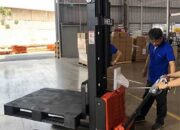
Painting service for new forklifts and cranes

Introduction to Samcovina Joint Stock Company’s crane painting service

Samcovina Joint Stock Company is one of the leading providers of transportation and cargo handling services. With over 10 years of experience in this field, Samcovina has become a reliable partner of many large customers.

Samcovina’s crane painting service is provided by a team of highly specialized technicians with rich experience and in-depth training in the latest crane painting methods. Samcovina uses the most advanced painting technologies, including epoxy paint, polyurethane paint, reflective paint, and heat-resistant paint to ensure durability and maximum protection for the crane.

In addition, Samcovina also has specialized equipment, machinery, and tools to perform crane painting work in the most professional and efficient manner. The company is committed to meeting all customer requirements and providing the best services, ensuring quality and timely construction progress.

With the above benefits, Samcovina Joint Stock Company’s crane painting service is the top choice for businesses or organizations that need to carry out construction, repair, or upgrade of cranes.
 

Dịch vụ sơn mới cẩu bờ
Samco Vina cam kết đảm bảo chất lượng sơn và độ bền màu

Why use Samcovina Joint Stock Company’s crane painting service
There are several reasons why you should use Samcovina Joint Stock Company’s crane painting service, including:

Experience and expertise: Samcovina has over 10 years of experience in the field of crane painting, and the team of technicians is highly trained and specialized.

Advanced technology: Samcovina uses the most advanced painting technologies, including epoxy paint, polyurethane paint, reflective paint, and heat-resistant paint to ensure durability and maximum protection for the crane.

Specialized equipment, machinery, and tools: Samcovina has specialized equipment, machinery, and tools to perform crane painting work in the most professional and efficient manner.

Quality assurance: Samcovina is committed to ensuring the quality of crane painting and timely construction progress.

Good customer service: Samcovina is always dedicated and enthusiastic with customers, ready to meet all requirements and bring absolute satisfaction to customers.

Therefore, if you need crane painting, consider using the services of Samcovina Joint Stock Company to ensure quality and save your time and effort.

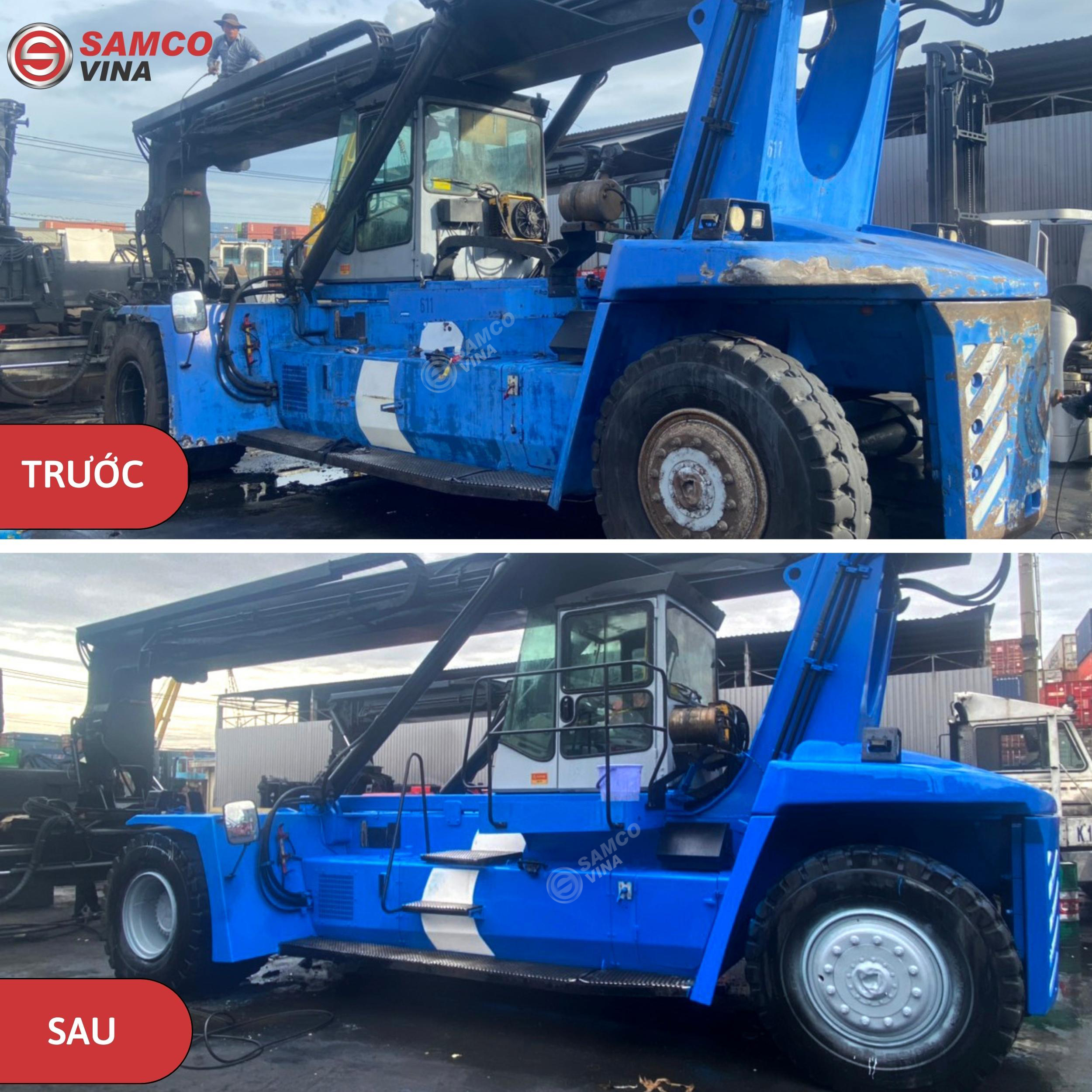
Dịch vụ sơn mới cẩu bờ
Cẩu bờ trước và sau khi sơn mới

Our crane barge painting process
The crane barge painting process of Samcovina Joint Stock Company is carried out through the following specific steps:

Survey and evaluation: Before starting to paint the crane barge, we will conduct a survey and evaluate the condition of the barge, assess the degree of corrosion, and identify the areas that need repair.

Surface preparation: After evaluating the condition of the crane barge, we will clean the surface by washing and polishing to remove dust, grease, rust, and other substances on the surface.

Repair: If there are areas corroded or damaged, we will carry out repairs by replacing the damaged parts or using repair materials to remedy the corroded areas.

Painting: After the surface has been prepared and repaired, we will proceed to paint the surface with epoxy paint, polyurethane paint, reflective paint, or heat-resistant paint to ensure sustainability and maximum protection for the crane barge.

Inspection and completion: After completing the crane barge painting process, we will check again and proceed to complete it by inspecting the durability of the paint layer and ensuring the full completion of the customer’s requirements.

We are committed to carrying out our crane barge painting process in the most professional and efficient manner to ensure sustainability and maximum protection for our customers’ crane barge.”


Contac us: 0931 431 599

4 responses to “Painting service for new forklifts and cranes”

  1. Chào công ty
    Vui lòng cho hỏi bên mình có sơn lại xe nâng tại khu công nghiệp Tân Uyên Bình Dương không?
    Mong nhận được phản hồi sớm.
    Quí: 096216161

    • Chào anh Quí
      Vâng, chúng tôi có dich vụ sơn mới lại xe nâng nhé. Bộ phận chuyên trách của chúng tôi sẽ liên hệ lại để trao đổi thêm nhé
      Thân mến!

  2. Xin cho hỏi, Dịch vụ sơn mới xe nâng của bên mình có hỗ trợ tại nhà máy không? Công ty chúng tôi ở Bình Dương có nhu cầu sơn mới lại xe nâng

Leave a Reply

Your email address will not be published. Required fields are marked *

Related posts

  • hoi-dap-xe-nang-toyota Frequently Asked Questions about Common Issues with Toyota Forklifts

    Frequently Asked Questions about Common Issues with Toyota Forklifts 1. What are the causes and solutions for hydraulic oil leaks in Toyota forklifts? – The causes can be worn or damaged hydraulic oil lines, loose or damaged seals and gaskets, stuck or faulty hydraulic control valves, or leaking lift cylinders. – The solutions include checking and replacing damaged parts, regularly cleaning and maintaining the hydraulic system, and ensuring that the hydraulic oil is clean and at the required level. 2. What are the causes and solutions for difficult or failed engine starting in Toyota forklifts? – Common causes include weak or faulty batteries, malfunctioning starter systems, fuel injection/fuel system issues, or fouled spark plugs. – Solutions involve checking, charging, or replacing the battery; inspecting the starter system; cleaning or replacing fuel injection/fuel system components; and cleaning or replacing spark plugs if necessary. 3. How should you handle an overheating engine in a Toyota forklift? – Causes may include low engine coolant levels, a faulty cooling fan, clogged coolant lines, or a leaking water pump. – Solutions involve immediately stopping the operation of the forklift, checking the cooling system, adding coolant if needed, replacing the cooling fan or water pump if necessary, and cleaning and repairing any clogged coolant lines. 4. What are the causes and solutions for weak or loss of lifting power in Toyota forklifts? – Causes can include decreased hydraulic pressure in the system, inefficient hydraulic pumps, or leaking or damaged lift cylinders. – Solutions involve checking and addressing any factors that reduce hydraulic pressure, replacing the hydraulic pump if needed, and repairing or replacing faulty lift cylinders. 5. What should you do when the steering system of a Toyota forklift becomes stiff or too heavy? Firstly, check the hydraulic fluid level for the steering system and top it up if it’s low. Then inspect the hydraulic lines and control valves for the steering system, replacing them if damaged. If the issue persists, it may be due to worn steering worm gears or a faulty steering shaft that needs replacement. 6. How should you handle ineffective braking in a Toyota forklift? Firstly, check the brake fluid, replacing it if contaminated or low. Then inspect the friction surface of the brake discs, replacing them if worn. If the issue continues, check the brake cylinders, brake lines, and brake pump for any faults, repairing or replacing any damaged components. 7. What are the causes and solutions for non-functioning turn signals and lights in Toyota forklifts? – Causes can include blown fuses, broken wires, burnt-out bulbs, or faulty light switches. – Solutions involve checking and replacing blown fuses, repairing or replacing broken wires, installing new bulbs, and replacing faulty light switches if necessary. 8. How should you handle a malfunctioning battery charger in a Toyota forklift? Firstly, check the battery itself; replace it if corroded or too old. Then inspect the wiring from the charger to the battery; replace any broken wires or shorts. Next, check the charger; replace it if not functioning properly. Finally, adjust the charger settings to match the type of battery being used. 9. What should you do when there is hydraulic system leakage or loss of pressure in a Toyota forklift? Firstly, check the hydraulic fluid level; top it up to the required level if low. Then inspect the entire hydraulic system to identify any leaks or loss of pressure. Causes can include faulty hydraulic cylinders, hoses, valves, or seals/gaskets. Replace any damaged parts to restore pressure and ensure a tight seal in the system. 10. What are the causes and solutions for worn or damaged wheels on Toyota forklifts? – The main causes are overloading, driving on rough terrain, sudden changes in direction leading to increased tire wear. Additionally, wheels can be damaged due to rough handling. – Solutions involve ensuring proper loading during operation, driving cautiously on flat surfaces, and being careful when changing directions. Replace worn or damaged wheels with new ones. 11. How should you address transmission issues in a Toyota forklift? Firstly, check the transmission fluid level; top it up if low. Then inspect the components of the transmission system such as the clutch, drive shaft, couplings, and belts; replace any damaged parts if necessary. Finally, check the gearbox and gearbox oil pump; replace them if faulty. Regularly maintain and clean the entire transmission system. 12. What are the causes and solutions for a stuck parking brake in a Toyota forklift? – Common causes include a jammed or broken parking brake cable, deteriorated rubber grommets causing cable sticking, or a stuck or rusted brake drum. – Solutions involve removing and cleaning the parking brake cable, replacing it if broken, replacing deteriorated rubber grommets, lubricating the brake drum with grease if necessary, and replacing heavily rusted brake drums. 13. How should you handle a malfunctioning stability control system in a Toyota forklift? Firstly, check the hydraulic fluid level for the stability control system; top it up to the required level if low. Then inspect the hydraulic control valve and hydraulic cylinders to ensure there are no leaks. Replace valves or cylinders as needed.

  • xe-nang-toyota-chui-container Container Forklift Sales and Rentals for Loading and Unloading

    Container Forklift Sales and Rentals for Loading and Unloading In the rapidly evolving landscape of logistics and import-export, the demand for container forklifts to load and unload goods has surged. These compact, maneuverable machines play a crucial role in safely and efficiently handling cargo within tight spaces. 1. What is a Container ForkliftA container forklift is a specially designed forklift with narrow dimensions and low height, making it ideal for entering containers to perform loading and unloading tasks. With widths ranging from approximately 800mm to 2000mm, these forklifts can easily navigate standard 20-foot or 40-foot containers. Thanks to their compact size and flexible maneuverability, container forklifts offer several advantages over conventional forklifts when it comes to handling cargo inside containers: – Space Efficiency: Optimized for working in confined environments. – Maximized Container Utilization: Makes the most of available space. – Reduced Risk of Damage: Minimizes the risk of damaging goods during handling. – Increased Productivity: Replaces manual labor, enhancing speed and efficiency. – Enhanced Safety: Provides safer operations for both personnel and cargo. 2. Types of Container Forklifts The market offers various types of container forklifts tailored for different loading and unloading needs. These forklifts are categorized based on fuel type, load capacity, and functionality. By Fuel Type: – Electric Container Forklifts: Powered by batteries, eco-friendly, suitable for indoor use. – Gasoline/Diesel Container Forklifts: Operate on internal combustion engines, ideal for outdoor use with extended range. – Hybrid Container Forklifts: Utilize both electric power and fossil fuels, versatile across multiple environments. By Load Capacity: – Light-Duty Forklifts: Under 1.5 tons, suitable for lighter loads. – Medium-Duty Forklifts: Between 1.5 to 3 tons, versatile for various needs. – Heavy-Duty Forklifts: Over 3 tons, specialized for heavy or large-sized cargo. Each type has its own set of pros and cons regarding fuel costs, operational capabilities, machine lifespan, etc. Therefore, businesses should select the appropriate forklift type based on specific usage requirements to achieve optimal efficiency. 3. Popular Brands of Container Forklifts Several renowned brands dominate the market when it comes to container forklifts: Toyota Container Forklifts: As a leading global brand in material handling equipment, Toyota is well-known for its high-performance engines that offer smooth operation and fuel efficiency. The robust design ensures safety even in challenging environments. However, Toyota forklifts tend to be more expensive than other brands. TCM Container Forklifts: A subsidiary of Japan’s Nissan Group, TCM specializes in compact forklifts perfect for container operations. TCM offers affordable pricing with excellent after-sales service and abundant spare parts availability. However, some models may not match Toyota’s performance levels. Komatsu Container Forklifts: Komatsu is an established Japanese brand known for its powerful performance and durability in tough working conditions. Their machines are also equipped with numerous safety features but come at a higher price point with slightly lower productivity compared to Toyota. Linde Container Forklifts: Originating from Germany, Linde produces high-efficiency electric forklifts designed with environmental friendliness in mind. Linde has made significant advancements in optimizing vehicle weight and battery performance but tends to be more expensive due to import costs while offering modern features that facilitate operation. Hyundai Container Forklifts: This South Korean brand provides competitively priced options that perform well in warehouse settings or industrial facilities. While Hyundai’s quality is generally reliable, some models may lack advanced features or have limited battery life compared to other brands. Other notable brands like Nichiyu (TCM), Yale, Crown also offer high-quality container forklifts worth considering based on specific needs such as usage environment or budget constraints. Trusted Providers of Container Forklift Sales & Rentals In Vietnam, reputable providers like Samcovina JSC stand out as reliable sources for purchasing or renting container forklifts. With years of experience in material handling equipment sales and logistics solutions coupled with a knowledgeable team ready to assist customers’ unique requirements—Samcovina offers a wide range of products from various leading brands ensuring quality service every time you choose them as your partner! For businesses looking into acquiring or leasing efficient container-handling solutions—considering factors such as operational needs environmental conditions investment budget will help make informed decisions among numerous available options ensuring optimal results tailored specifically towards achieving business goals effectively!

  • xe-nang-BT Evaluating Popular Forklift Models

    Navigating the Diverse Forklift Market: How to Make the Right Choice   The forklift market has seen significant growth, offering a wide variety of types, brands, and technologies. From eco-friendly electric forklifts to powerful diesel models, and from versatile reach trucks to compact stand-up forklifts, each type has its own advantages and disadvantages tailored to […]

  • xe-nang-hang-pallet Electric Pallet Trucks

    An electric pallet truck, also known as an Electric Pallet Truck, is a commonly used material handling equipment in warehouses, storage yards, supermarkets, and various industries. Its purpose is to easily and efficiently move, lift, and transport palletized goods. The electric pallet truck operates using electric power sources such as batteries or accumulators. It is […]

  • hoi-dap-xe--nang FAQs about Forklift Battery and Electrical System

    FAQs about Forklift Battery and Electrical System 1. What is the average lifespan of a forklift battery? The average lifespan of a forklift battery is typically between 4-6 years for lead-acid batteries, depending on usage, working conditions, and maintenance. Gel batteries have a shorter lifespan, around 3-5 years. 2. How should I maintain my forklift battery? To maintain your forklift battery, you should regularly check and top up the water level, clean the charging terminals and battery poles, ensure full charging without overcharging, regularly check electrolyte density and cell voltage. 3. How can I maximize the lifespan of my forklift battery? To maximize the lifespan of your forklift battery, you should use the correct capacity battery, follow proper installation procedures, maintain full charging, avoid deep discharging, perform regular maintenance, adjust electrolyte density as needed, and keep it clean. 4. What factors affect the lifespan of a forklift battery? The main factors that affect the lifespan of a forklift battery include initial battery quality, using the correct capacity battery, charging and discharging methods, operating temperature conditions, maintenance and storage practices, and working conditions (vibration, humidity, dust). 5. When should I replace my forklift battery? Typically, you should replace your forklift battery after 4-6 years of use depending on the quality of the battery, usage level, and maintenance conditions. If the battery experiences severe performance degradation before that time frame, it should be replaced earlier. Monitoring electrolyte density can help evaluate remaining battery life. 6. When and how should I charge my forklift battery? You should charge your forklift battery after each work shift. The best method is to use an automatic three-stage controlled charger (bulk-float-equal) with periodic water replenishment for lead-acid batteries. The charger should provide the appropriate current and voltage according to the battery’s requirements. 7. What causes and how to fix a swollen forklift battery? Causes: Excessive heat generated during charging, resulting in hydrogen and oxygen gas buildup. Heat causes expansion of the welding circuit, leading to battery case rupture. Solutions: Check and clean the charger, ventilation system. Replace the damaged battery case. Follow proper charging procedures. Purchase batteries with good quality. 8. How to prevent battery gassing in forklifts? To prevent battery gassing, avoid discharging below 80% of rated capacity, avoid hot charging at high temperatures, maintain proper electrolyte density, perform regular equalizing charges, and use an automatic three-stage controlled charger. 9. Which type of battery is suitable for different types of forklifts? The choice of battery depends on the motor power requirement, lifting capacity, continuous usage time, and working environment conditions. Lead-acid batteries are suitable for high-power forklifts with long working hours. Gel batteries are suitable for small-capacity forklifts used internally. 10. Evaluate the advantages and disadvantages of gel batteries compared to lead-acid batteries. Advantages of gel batteries: No acid spillage, low maintenance, no fumes emission, safer and environmentally friendly. Disadvantages: Shorter lifespan, higher cost, cannot replenish water levels, prone to overheating. Advantages of lead-acid batteries: Lower cost, longer lifespan; however, they require more maintenance and have a risk of acid leakage. 11. How often should I replace distilled water in lead-acid batteries? Distilled water in lead-acid batteries should be replaced every 6-12 months depending on evaporation levels. The replacement frequency may be shorter if the forklift operates in hot and dusty environments. Regularly check water levels to determine when it needs replacement. 12. What are the standards for distilled water used in forklift batteries? Distilled water used in forklift batteries must meet high purity standards (≥99.5%), be free from large impurities, and have a resistivity of ≥5 MΩ.cm. Water that does not meet these standards can corrode battery components, create deposits, and reduce performance. 13. What causes and how to fix a short-circuited forklift battery? Causes: Damaged or corroded wires causing ground contact and short circuits. Dirt and high humidity inside the battery can also cause shorts. Solutions: Check and repair damaged wires. Clean the battery to remove dirt. Maintain proper humidity levels. Replace the battery if it is too old. 14. How should I maintain electrical components on a forklift? Electrical components should be regularly maintained, including checking and cleaning the charger, control circuitry, motor, conductors, and tightening all electrical connections. Ensure effective cooling ventilation systems. Check and replace any faulty components to ensure electrical safety. 15. What are the signs of electrical system issues in a forklift? Signs of electrical system issues in a forklift include slow movement or failure to reach desired speed, underperforming motor power, abnormal battery heat or swelling, smoke smell from electrical devices, unusual noise from motor or drivetrain, malfunctioning warning lights or display screens. 16. What does regular maintenance of the forklift’s electrical system involve? Regular maintenance of the forklift’s electrical system includes checking and cleaning the battery, replenishing distilled water, measuring electrolyte density; checking and cleaning the charger; inspecting control circuits; motors; conductors; tightening all electrical connections; ensuring effective cooling ventilation systems; checking and replacing faulty components to ensure electrical safety.