Guide to Buying Forklifts for Warehouses
Forklifts are indispensable equipment in warehouses, optimizing the process of transporting and handling goods. However, choosing the right forklift that suits your needs and budget is not a simple task.
Why Are Forklifts Important for Warehouses?
Motorized forklifts play a central role in warehouse and production operations:
Increased Productivity: Using motorized forklifts in warehouses shortens the time required for transporting and stacking goods.
Cost Savings: Reduces labor costs and the risk of damage to goods.
Enhanced Safety: Minimizes the risk of workplace accidents when handling heavy loads.
Selecting the right forklift will make warehouse operations more efficient and save costs in the long term. This article will guide you step-by-step to find the most suitable forklift.
Key Factors to Consider When Investing in a Forklift
Before deciding to purchase a forklift, you need to carefully evaluate the following factors to ensure the right choice:
Usage Needs
Type of Goods: Determine the weight, size, and characteristics of the goods (fragile, flammable, etc.). For example, heavy goods require forklifts with high load capacities.
Usage Frequency: Will the forklift operate continuously or only for a few hours daily? This affects the choice of forklift type (electric, diesel, or manual).
Work Environment: Is the warehouse enclosed, outdoors, or a cold storage facility? Electric forklifts are suitable for enclosed spaces, while diesel forklifts are ideal for outdoor environments.
Warehouse Dimensions
Maneuvering Space: Narrow aisles (under 2m) require compact forklifts like reach trucks or stackers.
Ceiling and Rack Height: Ensure the forklift’s lifting height matches the rack height and warehouse ceiling.
Floor Surface: Is the floor smooth concrete or uneven? This determines the type of wheels (rubber, polyurethane, etc.).
Investment Budget
Initial Cost: Manual forklifts are the cheapest, while electric or diesel forklifts are more expensive.
Operating Costs: Include maintenance, repairs, and fuel (electricity, diesel, or gas). Electric forklifts are generally more cost-effective in the long run.
Long-Term Budget: Consider the total cost of ownership (TCO) rather than just the initial purchase price.
Technical Requirements
Maximum Load Capacity: Ranges from 1 to 10 tons depending on the forklift type. Choose a forklift with a capacity 10-20% higher than your actual needs for safety.
Lifting Height: Typically 3-7m for common forklifts. Check the rack height to select the appropriate model.
Wheel Type: Rubber wheels for smooth floors, polyurethane wheels for uneven surfaces.
Common Types of Forklifts for Warehouses
Depending on your needs, you can choose from the following forklift types:
Manual Forklifts
Advantages: Affordable (priced from 5-20 million VND), easy to use, no fuel required. Suitable for light loads (under 2.5 tons).
Disadvantages: Limited lifting height (usually under 2m) and requires manual effort.
Applications: Small warehouses, short-distance goods transport.
Electric Forklifts
Advantages: Environmentally friendly, quiet operation, no emissions. Ideal for enclosed or cold storage warehouses.
Disadvantages: High cost (50-200 million VND), requires charging time (6-8 hours).
Applications: Food, pharmaceutical, or clean-air warehouses.
Diesel/Gas Forklifts
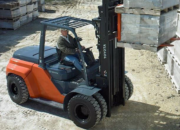
Advantages: High power, suitable for heavy loads (3-10 tons) and outdoor work.
Disadvantages: Noisy, produces emissions, unsuitable for enclosed spaces.
Applications: Large warehouses, outdoor storage yards.
Reach Trucks
Advantages: Optimized for narrow aisles (1.5-2m) and high racks (up to 7m).
Disadvantages: Requires skilled operators, relatively high cost.
Applications: High-density storage warehouses.
Stackers
Advantages: Flexible, easy to maneuver in small spaces, load capacity from 1-2 tons.
Disadvantages: Limited lifting height and load capacity.
Applications: Small warehouses or retail storage.
Comparison of Reputable Forklift Brands
Choosing a reputable forklift brand ensures quality and after-sales service:
Toyota: Renowned for durability, advanced technology, and extensive warranty networks. High price but worth the investment.
Linde: Specializes in electric forklifts, quiet operation, energy-efficient. Suitable for modern warehouses.
Yale: Diverse product range, competitive pricing, ideal for small and medium-sized businesses.
Hyster: Robust, suitable for heavy loads and harsh environments.
Komatsu: Reasonable pricing, easily available spare parts, suitable for Vietnamese warehouses.
Comparison Criteria:
Durability: Toyota and Linde lead in longevity.
Warranty: Toyota and Yale offer long-term warranties (1-2 years).
After-Sales Service: Linde and Komatsu have extensive repair networks in Vietnam.
Price: Yale and Komatsu are generally more affordable than Toyota and Linde.
Advice: Choose a brand that fits your budget and technical requirements. For electric forklifts, Linde is a top choice; for cost savings, consider Komatsu or Yale.
Considerations When Buying Forklifts for Warehouses
Quality Check
Origin: Choose forklifts with clear origins, avoiding unverified products.
Testing: Request a test run to check the engine, lifting system, and stability.
Specifications: Match the specifications to your actual needs (load capacity, lifting height).
Choosing a Reputable Supplier
Research customer reviews and the supplier’s experience.
Request detailed consultation and a transparent contract, including warranty and maintenance terms.
Prioritize companies with strong after-sales service and genuine spare parts.
Samcovina Joint Stock Company – A Trusted Forklift Supplier
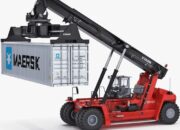
Samcovina Joint Stock Company is one of Vietnam’s leading suppliers, specializing in the sale and rental of high-quality forklifts from renowned brands such as Toyota, Komatsu, Linde, Yale, and Hyster. Samcovina offers a wide range of products, including electric forklifts, diesel forklifts, reach trucks, and container forklifts, with load capacities from 1 to 45 tons, catering to all warehouse needs. Notably, the company provides flexible rental options (short-term and long-term), competitive pricing, and a team of experienced technicians, ensuring regular maintenance and prompt support.