Important knowledge about forklift battery chargers

Share important knowledge about forklift battery chargers

Forklift/Forklift Battery Charger is an industrial charger that is responsible for charging/charging forklift batteries as quickly as possible without shortening the life of the battery by overheating or overloading. Before the advent of modern forklift battery chargers, forklift operators/users were often responsible for setting the desired voltage and voltage difference to charge the battery, due to That is also the reason why the battery is often faulty, even in some unexpected cases, which can be dangerous to people. Today’s industrial chargers contain a complex network of tags and sensors that effectively remove humans from the charge/charge cycle. Nowadays, chargers have preset parameters to protect the battery/device to be charged from overcharging causing damage. The presets will actually stop accepting charge and show an error code if there is a problem with the battery instead of charging the battery to full power until it overcharges/overheats or in the worst case it will catch fire and cause explosion.

There are many options for industrial chargers from small portable chargers that plug into any wall outlet, to large wall-mounted devices that require a large capacity charger with dedicated leads. Current chargers allow users to customize specific charging cycles. This customization allows you to control everything from the amount of voltage, amperage, charging time and even the rate of full charge within a certain period of time. These controls give you more flexibility in battery/battery charging as well as ensure battery/battery life and performance.
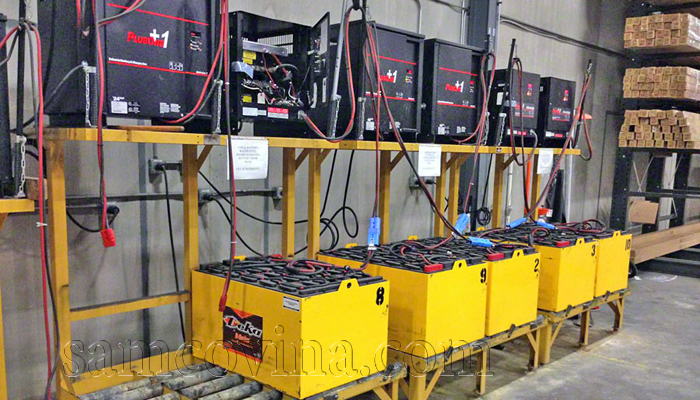
bo xac acqui

Modern industrial forklifts/battery chargers may contain the following components:

The charger which has all the parts inside the charger such as:

– IC cards, large capacitors and very large transformers sometimes weigh 45-50kg. Sometimes up to four transformers can be found in some chargers and diodes. These transformers are responsible for converting AC current to DC current.

– A digital display shows the operator important battery statistics, the selected charge cycle and its status.

– Charging cable and control cable, transferring amp and high voltage to battery/battery.

So, what is a forklift battery charger?

Forklift battery chargers start at $500 for a portable charger plugged into a standard 120V power outlet, to around $3,000 for a charger that must be plugged into your electrical system by a licensed electrician. building. Prices vary depending on the details of the charger.

– Can you buy a used forklift battery charger?

Used forklift battery chargers cost about 40-60% more than new battery chargers. Based on the actual condition of each old charger so you can make an accurate decision.

– Can you rent a forklift and charger?

You can rent batteries and battery chargers together or separately. Price depends on battery weight/quality/life, battery specifications and desired charging parameters. When renting a forklift, find out “what is a forklift battery charger?” in order to avoid being lost in some cases..

When renting, or purchasing, a forklift battery charger, ask the following questions:

What is the voltage of the battery you want to calculate? The voltage of the battery must match the voltage of the charger.
How many phases (1PHS/3PHS)?
What is the AH (amp hour) rating of the battery?
What is the line voltage at the location where the forklift battery charger will be used? Charger and line voltage must match.
Is the battery charger stored in the refrigerator or cold storage? Shouldn’t the battery be charged below 32oF?
 ,

Leave a Reply

Your email address will not be published. Required fields are marked *

Related posts

  • sua chua xe nang bi nuoc bien Common Electrical Faults on Container Forklifts Due to Seawater

    Common Electrical Faults on Container Forklifts Due to Seawater/Salt Corrosion In seaport operations, container handling equipment such as Reachstackers, Empty Container Handlers, and Heavy Duty Forklifts work continuously in particularly harsh environments: high humidity, dense salt mist, and direct seawater splashes during rain or when operating near the wharf.   These factors cause the electrical […]

  • hoi-dap-xe-nang-toyota Frequently Asked Questions about Common Issues with Toyota Forklifts

    Frequently Asked Questions about Common Issues with Toyota Forklifts 1. What are the causes and solutions for hydraulic oil leaks in Toyota forklifts? – The causes can be worn or damaged hydraulic oil lines, loose or damaged seals and gaskets, stuck or faulty hydraulic control valves, or leaking lift cylinders. – The solutions include checking and replacing damaged parts, regularly cleaning and maintaining the hydraulic system, and ensuring that the hydraulic oil is clean and at the required level. 2. What are the causes and solutions for difficult or failed engine starting in Toyota forklifts? – Common causes include weak or faulty batteries, malfunctioning starter systems, fuel injection/fuel system issues, or fouled spark plugs. – Solutions involve checking, charging, or replacing the battery; inspecting the starter system; cleaning or replacing fuel injection/fuel system components; and cleaning or replacing spark plugs if necessary. 3. How should you handle an overheating engine in a Toyota forklift? – Causes may include low engine coolant levels, a faulty cooling fan, clogged coolant lines, or a leaking water pump. – Solutions involve immediately stopping the operation of the forklift, checking the cooling system, adding coolant if needed, replacing the cooling fan or water pump if necessary, and cleaning and repairing any clogged coolant lines. 4. What are the causes and solutions for weak or loss of lifting power in Toyota forklifts? – Causes can include decreased hydraulic pressure in the system, inefficient hydraulic pumps, or leaking or damaged lift cylinders. – Solutions involve checking and addressing any factors that reduce hydraulic pressure, replacing the hydraulic pump if needed, and repairing or replacing faulty lift cylinders. 5. What should you do when the steering system of a Toyota forklift becomes stiff or too heavy? Firstly, check the hydraulic fluid level for the steering system and top it up if it’s low. Then inspect the hydraulic lines and control valves for the steering system, replacing them if damaged. If the issue persists, it may be due to worn steering worm gears or a faulty steering shaft that needs replacement. 6. How should you handle ineffective braking in a Toyota forklift? Firstly, check the brake fluid, replacing it if contaminated or low. Then inspect the friction surface of the brake discs, replacing them if worn. If the issue continues, check the brake cylinders, brake lines, and brake pump for any faults, repairing or replacing any damaged components. 7. What are the causes and solutions for non-functioning turn signals and lights in Toyota forklifts? – Causes can include blown fuses, broken wires, burnt-out bulbs, or faulty light switches. – Solutions involve checking and replacing blown fuses, repairing or replacing broken wires, installing new bulbs, and replacing faulty light switches if necessary. 8. How should you handle a malfunctioning battery charger in a Toyota forklift? Firstly, check the battery itself; replace it if corroded or too old. Then inspect the wiring from the charger to the battery; replace any broken wires or shorts. Next, check the charger; replace it if not functioning properly. Finally, adjust the charger settings to match the type of battery being used. 9. What should you do when there is hydraulic system leakage or loss of pressure in a Toyota forklift? Firstly, check the hydraulic fluid level; top it up to the required level if low. Then inspect the entire hydraulic system to identify any leaks or loss of pressure. Causes can include faulty hydraulic cylinders, hoses, valves, or seals/gaskets. Replace any damaged parts to restore pressure and ensure a tight seal in the system. 10. What are the causes and solutions for worn or damaged wheels on Toyota forklifts? – The main causes are overloading, driving on rough terrain, sudden changes in direction leading to increased tire wear. Additionally, wheels can be damaged due to rough handling. – Solutions involve ensuring proper loading during operation, driving cautiously on flat surfaces, and being careful when changing directions. Replace worn or damaged wheels with new ones. 11. How should you address transmission issues in a Toyota forklift? Firstly, check the transmission fluid level; top it up if low. Then inspect the components of the transmission system such as the clutch, drive shaft, couplings, and belts; replace any damaged parts if necessary. Finally, check the gearbox and gearbox oil pump; replace them if faulty. Regularly maintain and clean the entire transmission system. 12. What are the causes and solutions for a stuck parking brake in a Toyota forklift? – Common causes include a jammed or broken parking brake cable, deteriorated rubber grommets causing cable sticking, or a stuck or rusted brake drum. – Solutions involve removing and cleaning the parking brake cable, replacing it if broken, replacing deteriorated rubber grommets, lubricating the brake drum with grease if necessary, and replacing heavily rusted brake drums. 13. How should you handle a malfunctioning stability control system in a Toyota forklift? Firstly, check the hydraulic fluid level for the stability control system; top it up to the required level if low. Then inspect the hydraulic control valve and hydraulic cylinders to ensure there are no leaks. Replace valves or cylinders as needed.

  • nang-dien-pallet Electric Forklift Pallet

    Electric Forklift Pallet The electric pallet truck is one of the most popular types of electric forklift in the field of transporting and arranging goods. Electric pallet trucks help reduce time and effort in moving and arranging goods, increasing efficiency and safety during work. In this article, we will learn about the characteristics, advantages and […]

  • diesel-forklift Analysis of investment efficiency between electric forklifts and diesel forkls

    Analysis of investment efficiency between electric forklifts and diesel forkls In today’s modern industrial and logistics world, choosing the right lifting equipment plays a crucial role in optimizing performance and operating costs. The two most popular types of forkls on the market today are electric forklifts and diesel forklifts. Each type has its own advantages and limitations, requiring businesses to carefully consider before making investment decisions. This article will analyze in detail the investment efficiency between electric forklifts and diesel forklifts, helping you have a comprehensive view to make informed choices. Overview of electric forklifts and diesel forklifts Electric forklifts use energy from batteries to operate, while diesel forklifts run on internal combustion engines using diesel fuel. Electric forklifts are often preferred in indoor working environments due to their lack of harmful emissions. On the other hand, diesel forklifts are suitable for outdoor tasks, especially in challenging terrain conditions. Key strengths of electric forklifts include: – Smooth operation, low noise levels – No direct emissions, environmentally friendly – Lower operating costs in the long run – Simpler maintenance Key weaknesses of electric forklifts include: – Higher initial investment costs – Long battery charging times – Limited continuous operation due to battery capacity Key advantages of diesel-powered forklifts include: – High power output, suitable for heavy loads – Diesel forklifts can work continuously over long periods – Good adaptation to outdoor conditions and challenging terrains Disadvantages of diesel-powered forklifts include: – Emission of harmful gases – High noise levels – Higher fuel consumption and maintenance costs – Initial investment costs When comparing initial investment costs, diesel-powered forklifts usually have lower prices than electric ones with the same capacity. However, this price difference is gradually narrowing as battery technology and electric motors are being improved. Factors affecting the price of a forklift: – Lifting capacity and load weight – Brand and origin – Features and accompanying technologies For example, a 3-ton diesel-powered forklift may cost between 300-400 million VND, while an electric one with the same load capacity may range from 400-550 million VND. However, it is important to note that the initial price is only part of the total ownership and operating costs of a forklift. Operating costs Operating costs are an important factor in determining long-term investment efficiency. This is an area where electric forklifts often have an advantage. Fuel consumption costs: Electric forklifts have significantly lower energy costs. With an average electricity price of around 2,000 VND/kWh, energy costs can be only 1/3 to 1/4 compared to diesel-powered ones using fuel priced at around 20,000 VND/liter. Maintenance and repair costs: Electric forklifts have simpler construction with fewer moving parts, so maintenance costs are usually lower. However, when replacing batteries (usually after 5-7 years), the cost can be quite high, accounting for about 30-40% of the vehicle’s value. Diesel-powered forklif…

  • bom-thuy-luc The principle of hydraulic system of forklift truck

    Forklift hydraulic system 1. Principle of forklift hydraulic system. The hydraulic system of the forklift is an important part of the forklift. The working equipment accessories and the steering system of the forklift are all driven by the hydraulic system. Therefore, the advantages and disadvantages of the forklift hydraulic system directly affect the forklift’s ability […]

Gọi ngay
Chat Zalo