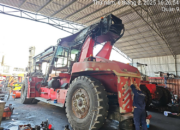
Severe Vibration on Container Handlers When Lifting Loads

5 Root Causes and Quick Troubleshooting Guide

In port operations and logistics, heavy-duty machines such as Reachstackers and Heavy-Duty Forklifts play a critical role. However, one of the most common issues that frustrates operators and technicians is severe vibration or jerking (chatter/judder) during lifting, lowering, or boom extension.


This phenomenon is not only uncomfortable for the operator but also a serious warning sign affecting equipment safety and component lifespan. With extensive experience importing and maintaining premium machinery from Europe and Japan (Kalmar, Konecranes, TCM, Toyota, etc.), Samcovina provides an in-depth technical analysis and the proper procedures to troubleshoot this issue.


  1. How to Identify and Classify Vibration Types

For Google indexing and search optimization, it’s essential to correctly categorize the common vibration symptoms:

– Lifting vibration: When the lift cylinder raises the load, the mast/boom or chassis vibrates in repeated pulses.

– Boom extension vibration (Reachstacker-specific): When extending the telescopic boom to stack containers at the 2nd or 3rd row, the boom jerks and produces loud “screeching” noises due to friction.

– Full-vehicle vibration: The whole machine sways or becomes unstable even when stationary with load—typically related to stabilizers or tires.


  1. The 5 Core Technical Causes of Severe Vibration

Below are detailed professional evaluations from hydraulic to mechanical systems.

2.1. Hydraulic Aeration or Cavitation

Hydraulic systems require a continuous, stable oil flow.

– Air Entrapment: When air enters the hydraulic lines, bubbles compress and decompress rapidly under high pressure, creating unwanted “elasticity” in the circuit. This causes lift cylinders to jerk instead of moving smoothly.

– Low hydraulic oil level: An insufficient tank level causes the pump to draw a mixture of oil and air, resulting in loud noise and vibration transmitted through the hydraulic controls.


2.2. Worn Wear Pads and Lack of Grease

The boom operates on telescopic sections that slide on wear pads (sliding pads).

– Stick-slip phenomenon: When wear pads exceed their wear limit or lack proper EP grease, static friction becomes higher than dynamic friction. The boom “sticks” and then suddenly breaks free, creating continuous sharp jerks during extension.


2.3. Uneven or Stretched Chains (Forklifts)

For mast-type forklifts:

– If the two load chains have different tension (one loose, one tight), the mast becomes off-center when lifting heavy containers.

– This creates torsional stress on the mast channels and forces rollers against one rail, generating severe vibration.


2.4. Deformed Spreader or Mechanical Structure

Constant impacts in port environments can bend the spreader frame.

When twistlocks do not seat properly due to deformation, the container load becomes off-center.

While lifting, the imbalance forces the entire machine to vibrate as it attempts to re-stabilize the center of gravity.


2.5. Unequal Tire Pressure

For heavy machines using pneumatic tires:

Front tires carry the primary load.

If tire pressure is not balanced between the two front wheels, the machine tilts to the softer side under heavy load, leading to whole-vehicle instability and vibration.


  1. Inspection Process & Temporary Troubleshooting

Operators or technicians can perform the following quick checks before requesting advanced service.

Step 1: Check and Stabilize the Hydraulic System

– Check oil level: Ensure the hydraulic oil is at the correct mark; top up if needed.

– Bleed air: Remove air from hydraulic lines.

– Quick method: Fully raise/lower or extend/retract the boom 5–10 times without load. This forces air bubbles back to the tank and releases them.


Step 2: Grease the Boom (Reachstacker)

– If the boom jerks during extension:

– Apply EP high-temperature grease to all sliding surfaces and wear pads.

– Then cycle the boom several times to distribute grease—this resolves ~80% of friction-induced vibration cases.


Step 3: Inspect and Adjust Chains (Forklifts)

– Check chain sag by hand. If one side is looser:

– Use the chain anchor adjustment bolts to equalize chain tension on both sides.


Step 4: Check Tire Pressure

Use a tire pressure gauge and inflate according to the machine’s specification label or catalogue (typically 10 bar / 145 psi depending on model).

Safety warning:

– If the machine still vibrates, or you hear metallic impact noises, STOP OPERATION IMMEDIATELY.

– Continuing to run the machine may cause axle failure, container drop, or permanent hydraulic pump damage.


  1. When to Call Professional Technical Support

The above steps are basic Level-1 maintenance. Contact Samcovina if:

Wear pads are worn beyond their limit → boom must be disassembled for replacement.

Hydraulic pump loses pressure → measured pressure below OEM specification (repair or replacement required).

Electrical/sensor errors → machine displays fault codes related to angle or load sensors.


  1. Samcovina Technical Support Solutions

As a leading importer and service provider of container handlers, Samcovina offers:

OEM Spare Parts: Available wear pads, load chains, hydraulic seals, oil filters, etc., for Kalmar, Konecranes, TCM, Toyota, Doosan, and more.

Mobile repair service: Skilled technicians with deep knowledge of European/American hydraulic and electrical systems are ready to support directly at ports or depots.

Upgrade or replacement consultation: If the machine is outdated and repair costs are too high, we offer high-quality used units or brand-new equipment with optimal investment cost.
Leave a Reply

Your email address will not be published. Required fields are marked *

Related posts

  • cach-chon-xe-nang-cho-nha-may Important Considerations When Choosing Forklifts for Your Warehouse

    Important Considerations When Choosing Forklifts for Your Warehouse   In today’s manufacturing and logistics environment, selecting the right forklift is crucial for optimizing both performance and safety in your facility. This article aims to guide warehouse owners and technical managers through the key factors to consider when making a forklift purchase decision.    Assessing Your […]

  • hoi-dap-xe-nang-toyota Frequently Asked Questions about Common Issues with Toyota Forklifts

    Frequently Asked Questions about Common Issues with Toyota Forklifts 1. What are the causes and solutions for hydraulic oil leaks in Toyota forklifts? – The causes can be worn or damaged hydraulic oil lines, loose or damaged seals and gaskets, stuck or faulty hydraulic control valves, or leaking lift cylinders. – The solutions include checking and replacing damaged parts, regularly cleaning and maintaining the hydraulic system, and ensuring that the hydraulic oil is clean and at the required level. 2. What are the causes and solutions for difficult or failed engine starting in Toyota forklifts? – Common causes include weak or faulty batteries, malfunctioning starter systems, fuel injection/fuel system issues, or fouled spark plugs. – Solutions involve checking, charging, or replacing the battery; inspecting the starter system; cleaning or replacing fuel injection/fuel system components; and cleaning or replacing spark plugs if necessary. 3. How should you handle an overheating engine in a Toyota forklift? – Causes may include low engine coolant levels, a faulty cooling fan, clogged coolant lines, or a leaking water pump. – Solutions involve immediately stopping the operation of the forklift, checking the cooling system, adding coolant if needed, replacing the cooling fan or water pump if necessary, and cleaning and repairing any clogged coolant lines. 4. What are the causes and solutions for weak or loss of lifting power in Toyota forklifts? – Causes can include decreased hydraulic pressure in the system, inefficient hydraulic pumps, or leaking or damaged lift cylinders. – Solutions involve checking and addressing any factors that reduce hydraulic pressure, replacing the hydraulic pump if needed, and repairing or replacing faulty lift cylinders. 5. What should you do when the steering system of a Toyota forklift becomes stiff or too heavy? Firstly, check the hydraulic fluid level for the steering system and top it up if it’s low. Then inspect the hydraulic lines and control valves for the steering system, replacing them if damaged. If the issue persists, it may be due to worn steering worm gears or a faulty steering shaft that needs replacement. 6. How should you handle ineffective braking in a Toyota forklift? Firstly, check the brake fluid, replacing it if contaminated or low. Then inspect the friction surface of the brake discs, replacing them if worn. If the issue continues, check the brake cylinders, brake lines, and brake pump for any faults, repairing or replacing any damaged components. 7. What are the causes and solutions for non-functioning turn signals and lights in Toyota forklifts? – Causes can include blown fuses, broken wires, burnt-out bulbs, or faulty light switches. – Solutions involve checking and replacing blown fuses, repairing or replacing broken wires, installing new bulbs, and replacing faulty light switches if necessary. 8. How should you handle a malfunctioning battery charger in a Toyota forklift? Firstly, check the battery itself; replace it if corroded or too old. Then inspect the wiring from the charger to the battery; replace any broken wires or shorts. Next, check the charger; replace it if not functioning properly. Finally, adjust the charger settings to match the type of battery being used. 9. What should you do when there is hydraulic system leakage or loss of pressure in a Toyota forklift? Firstly, check the hydraulic fluid level; top it up to the required level if low. Then inspect the entire hydraulic system to identify any leaks or loss of pressure. Causes can include faulty hydraulic cylinders, hoses, valves, or seals/gaskets. Replace any damaged parts to restore pressure and ensure a tight seal in the system. 10. What are the causes and solutions for worn or damaged wheels on Toyota forklifts? – The main causes are overloading, driving on rough terrain, sudden changes in direction leading to increased tire wear. Additionally, wheels can be damaged due to rough handling. – Solutions involve ensuring proper loading during operation, driving cautiously on flat surfaces, and being careful when changing directions. Replace worn or damaged wheels with new ones. 11. How should you address transmission issues in a Toyota forklift? Firstly, check the transmission fluid level; top it up if low. Then inspect the components of the transmission system such as the clutch, drive shaft, couplings, and belts; replace any damaged parts if necessary. Finally, check the gearbox and gearbox oil pump; replace them if faulty. Regularly maintain and clean the entire transmission system. 12. What are the causes and solutions for a stuck parking brake in a Toyota forklift? – Common causes include a jammed or broken parking brake cable, deteriorated rubber grommets causing cable sticking, or a stuck or rusted brake drum. – Solutions involve removing and cleaning the parking brake cable, replacing it if broken, replacing deteriorated rubber grommets, lubricating the brake drum with grease if necessary, and replacing heavily rusted brake drums. 13. How should you handle a malfunctioning stability control system in a Toyota forklift? Firstly, check the hydraulic fluid level for the stability control system; top it up to the required level if low. Then inspect the hydraulic control valve and hydraulic cylinders to ensure there are no leaks. Replace valves or cylinders as needed.

  • sua-chua-bao-tri-xe-nang-cont Reach stacker Maintenance Service

    Reach stacker Maintenance Service In today’s modern logistics world, container forklifts play an essential role. They are the backbone of transporting and stacking goods at seaports, depots, and distribution centers. However, to maintain high performance and extend the lifespan of these “machines,” regular maintenance is crucial. Samcovina Corporation is proud to be a leading provider of professional container forklift maintenance services, ensuring continuous and efficient operations for your business. Overview of Container Forklifts Container forklifts are specialized equipment designed to lift, lower, and move containers in seaports, depots, and industrial areas. There are various types of container forklifts such as reach stackers, straddle carriers, and forklift trucks. Each type has its own advantages and is suitable for different working environments. Regular maintenance plays a crucial role in maintaining the performance and safety of container forklifts. A good maintenance program not only helps detect potential issues early but also ensures that the forklift is always in optimal operating condition, thereby increasing productivity and minimizing the risk of workplace accidents. Samcovina’s Container Forklift Maintenance Service Samcovina offers comprehensive maintenance packages including: – Regular maintenance according to manufacturers’ recommendations – Inspection and replacement of excessively worn parts – Maintenance of hydraulic and electrical systems – Calibration and adjustment of control systems Our professional maintenance process includes: – Comprehensive inspection – Data analysis of operations – Maintenance execution based on standard checklists – Post-maintenance checks and detailed reports Our team of technicians at Samcovina is well-trained with certifications from leading forklift manufacturers worldwide. They not only have technical expertise but also practical experience to ensure that all maintenance tasks are carried out accurately and efficiently. Benefits of Using Samcovina’s Maintenance Service Increase lifespan and performance of forklifts: Regular maintenance helps detect and address issues early on, preventing major breakdowns and extending the lifespan while maintaining high performance. Minimize downtime: With carefully planned maintenance schedules, we help you avoid unexpected breakdowns, reducing unnecessary downtime. Long-term cost savings: Investing in regular maintenance helps avoid large repair costs in the future while optimizing fuel efficiency, providing long-term economic benefits. Modern Technology & Equipment Samcovina prides itself on having advanced diagnostic systems that can detect potential issues before they become serious. We use advanced maintenance management software to track maintenance history, predict future maintenance needs, and optimize work processes. Moreover, Samcovina only uses genuine spare parts to ensure quality and perfect compatibility, contributing to maintaining the highest performance and safety standards for your container forklift. Quality Commitment & Customer Service We are committed to providing the highest quality service with clear warranty policies for all maintenance tasks. Our technical support team is available 24/7 to answer any questions or handle emergency situations. Additionally, Samcovina offers training programs for customers’ operators to help them master safe and efficient operation skills while recognizing early signs that require maintenance. Samcovina Corporation – Reliable Partner Providing Genuine Spare Parts In addition to professional maintenance services, Samcovina is a reputable distributor providing genuine spare parts for leading global brands of container forklifts. We are proud to be official partners with many renowned manufacturers guaranteeing high-quality spare parts that meet all customer repair needs. Diverse range of spare parts available for top brands: – Kalmar: We supply a full range of spare parts for Kalmar’s line of forklifts from engine components to complex hydraulic systems. We ensure perfect compatibility and high performance across all Kalmar models. – Konecranes: As a Konecranes partner, we provide genuine spare parts across their product range including reach stackers, straddle carriers, and forklift trucks. Customers can trust the quality and durability of each component. – Fantuzzi: Despite Fantuzzi merging into Terex Port Solutions, we continue to supply reliable spare parts for older Fantuzzi models ensuring effective operation. – Linde: We offer genuine spare parts across Linde’s line known for advanced technology & high performance ensuring every detail meets manufacturer standards. – Hyster: With a diverse range ]

  • xe-nang-may-dau What is a Foklift Forklift?

    What is a Foklift Forklift? A forklift is a type of industrial vehicle used to lift and move heavy items in warehouses, manufacturing plants, and other storage facilities. Forklift trucks are usually equipped with a pair of forks at the front for lifting and lowering units. Forklift trucks come in a variety of sizes and […]

  • cam bien tai trong xe nang New Load Sensor Technology on Container Forklifts

    New Load Sensor Technology on Container Forklifts As Vietnam’s logistics and seaport industries are growing at a rapid pace, pressure on container handling time is increasing significantly. However, speed cannot come at the expense of safety. Potential risks such as vehicle rollover due to overloading, incorrect load center positioning, or inaccurate determination of container weight […]