5 Root Causes and Quick Troubleshooting Guide
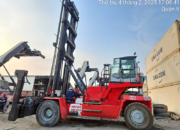
In port operations and logistics, heavy-duty machines such as Reachstackers and Heavy-Duty Forklifts play a critical role. However, one of the most common issues that frustrates operators and technicians is severe vibration or jerking (chatter/judder) during lifting, lowering, or boom extension.
This phenomenon is not only uncomfortable for the operator but also a serious warning sign affecting equipment safety and component lifespan. With extensive experience importing and maintaining premium machinery from Europe and Japan (Kalmar, Konecranes, TCM, Toyota, etc.), Samcovina provides an in-depth technical analysis and the proper procedures to troubleshoot this issue.
- How to Identify and Classify Vibration Types
For Google indexing and search optimization, it’s essential to correctly categorize the common vibration symptoms:
– Lifting vibration: When the lift cylinder raises the load, the mast/boom or chassis vibrates in repeated pulses.
– Boom extension vibration (Reachstacker-specific): When extending the telescopic boom to stack containers at the 2nd or 3rd row, the boom jerks and produces loud “screeching” noises due to friction.
– Full-vehicle vibration: The whole machine sways or becomes unstable even when stationary with load—typically related to stabilizers or tires.
- The 5 Core Technical Causes of Severe Vibration
Below are detailed professional evaluations from hydraulic to mechanical systems.
2.1. Hydraulic Aeration or Cavitation
Hydraulic systems require a continuous, stable oil flow.
– Air Entrapment: When air enters the hydraulic lines, bubbles compress and decompress rapidly under high pressure, creating unwanted “elasticity” in the circuit. This causes lift cylinders to jerk instead of moving smoothly.
– Low hydraulic oil level: An insufficient tank level causes the pump to draw a mixture of oil and air, resulting in loud noise and vibration transmitted through the hydraulic controls.
2.2. Worn Wear Pads and Lack of Grease
The boom operates on telescopic sections that slide on wear pads (sliding pads).
– Stick-slip phenomenon: When wear pads exceed their wear limit or lack proper EP grease, static friction becomes higher than dynamic friction. The boom “sticks” and then suddenly breaks free, creating continuous sharp jerks during extension.
2.3. Uneven or Stretched Chains (Forklifts)
For mast-type forklifts:
– If the two load chains have different tension (one loose, one tight), the mast becomes off-center when lifting heavy containers.
– This creates torsional stress on the mast channels and forces rollers against one rail, generating severe vibration.
2.4. Deformed Spreader or Mechanical Structure
Constant impacts in port environments can bend the spreader frame.
When twistlocks do not seat properly due to deformation, the container load becomes off-center.
While lifting, the imbalance forces the entire machine to vibrate as it attempts to re-stabilize the center of gravity.
2.5. Unequal Tire Pressure
For heavy machines using pneumatic tires:
Front tires carry the primary load.
If tire pressure is not balanced between the two front wheels, the machine tilts to the softer side under heavy load, leading to whole-vehicle instability and vibration.
- Inspection Process & Temporary Troubleshooting
Operators or technicians can perform the following quick checks before requesting advanced service.
Step 1: Check and Stabilize the Hydraulic System
– Check oil level: Ensure the hydraulic oil is at the correct mark; top up if needed.
– Bleed air: Remove air from hydraulic lines.
– Quick method: Fully raise/lower or extend/retract the boom 5–10 times without load. This forces air bubbles back to the tank and releases them.
Step 2: Grease the Boom (Reachstacker)
– If the boom jerks during extension:
– Apply EP high-temperature grease to all sliding surfaces and wear pads.
– Then cycle the boom several times to distribute grease—this resolves ~80% of friction-induced vibration cases.
Step 3: Inspect and Adjust Chains (Forklifts)
– Check chain sag by hand. If one side is looser:
– Use the chain anchor adjustment bolts to equalize chain tension on both sides.
Step 4: Check Tire Pressure
Use a tire pressure gauge and inflate according to the machine’s specification label or catalogue (typically 10 bar / 145 psi depending on model).
Safety warning:
– If the machine still vibrates, or you hear metallic impact noises, STOP OPERATION IMMEDIATELY.
– Continuing to run the machine may cause axle failure, container drop, or permanent hydraulic pump damage.
- When to Call Professional Technical Support
The above steps are basic Level-1 maintenance. Contact Samcovina if:
Wear pads are worn beyond their limit → boom must be disassembled for replacement.
Hydraulic pump loses pressure → measured pressure below OEM specification (repair or replacement required).
Electrical/sensor errors → machine displays fault codes related to angle or load sensors.
- Samcovina Technical Support Solutions
As a leading importer and service provider of container handlers, Samcovina offers:
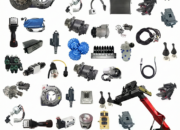
OEM Spare Parts: Available wear pads, load chains, hydraulic seals, oil filters, etc., for Kalmar, Konecranes, TCM, Toyota, Doosan, and more.
Mobile repair service: Skilled technicians with deep knowledge of European/American hydraulic and electrical systems are ready to support directly at ports or depots.
Upgrade or replacement consultation: If the machine is outdated and repair costs are too high, we offer high-quality used units or brand-new equipment with optimal investment cost.