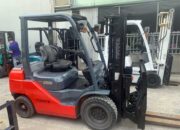
Safety standards when working in the warehouse

Safety standards when working in warehouses need to be paid attention to

In warehouses and ports, keeping workers and pedestrians safe is a very necessary job.

Traffic safety for pedestrians

Forklift operators must always be aware of their workplace, including pedestrian traffic (supervisors or workers working around the aisles). Where possible, it is necessary to separate the forklift traffic from other workers and pedestrians.

Responsibilities of forklift drivers (operators)

Forklift operators in warehouses, wharves, yards… need to be responsible for keeping themselves safe as well as other workers. It is a specific proposal for the benefit and safety of pedestrians.

When a group of people cross the route you plan to drive the forklift through, the best thing the forklift driver does is to stop and wait until the pedestrian has crossed.

Forklift operators should proceed cautiously through any congested areas in warehouses, docks, yards, etc.

The driver should go first through his route will operate the lifting, moving goods before operating a forklift. Think of this as a safety check on your forklift prior to operation.

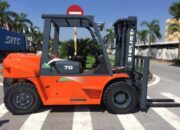
Forklift

Clear, clear all hazards – all obstacles before going with your standard driving route.

Essential reminders for forklift drivers:

Forklift drivers should always drive slowly for safety while also making it easier to handle some unexpected situations – if not stop and look carefully in all directions at intersections, corners, and any other where your vision is obstructed.

Forklift drivers should also use flashing lights, backup sirens or blue lights when going in reverse.

Some high-traffic areas may require a supervisor to help direct drivers through traffic.

Always maintain clear vision and make eye and hand signals when working with pedestrians and other forklift operators.

Signals for pedestrians must be clear.

Check for smooth stopping, walking, steering and braking.

Necessary reminders for pedestrians in warehouses, wharfs, yards…

Potty riders should be aware that forklifts do not stop suddenly. They are designed to stop slowly to minimize load damage and maintain stability.

The best way to avoid tangled forklift operators, pedestrians or warehouse workers is to always stay still while the forklift truck loads and loads through your standing position.

Remember, forklift operations can have limited visibility due to blind spots.

Never board a forklift unless authorized and the forklift is designed for pedestrians.

Always use a designated pedestrian walkway, or on one side of the lifting equipment.

When possible, you should communicate/signalize the forklift operator.

Reminders for warehouse safety managers

Forklift aisles and fixed aisles are required to be free of obstructions and should be appropriately marked when mechanical handling equipment is used.

Consider separating pedestrians from forklift traffic by providing the following:

– Use pedestrian walkways.

Use permanent barriers or other protective barriers.

– If pedestrians must share the aisle with the forklift, they must have adequate walking space on at least one side.

– If fences or barriers are not available, a pedestrian crossing may be used.

Other great safety tips for forklift drivers and pedestrians

– Use convex mirrors at corners and blind intersections

– Post and make signs of traffic control signs

– Signs restricting the operating speed of forklifts in warehouses and yards

Many warehouses require skilled forklift drivers and pedestrians to wear reflective safety vests to increase visibility of both objects when working in the warehouse or yard.
 

Leave a Reply

Your email address will not be published. Required fields are marked *

Related posts

  • mua-xe-nang-qua-ngan-hang Buying and selling forklifts with installment payments through a loan bank

    Buy and sell forklifts with installment payments through the bank You want to buy a forklift through the bank? Not sure what this should include? The article below will help you understand the basics. Some information when buying a forklift through a bank in the form of installment payment Today, with the rapid development of […]

  • Tips to Reduce Warehouse Forklift Spare Parts Costs for Businesses

    Tips to Reduce Warehouse Forklift Spare Parts Costs for Businesses In the context of constantly fluctuating logistics and warehouse operating costs, effective fleet management of forklifts (Reach Trucks, Pallet Trucks, Forklifts, etc.) has become a mission-critical challenge for businesses. In practice, spare parts replacement costs typically account for 15% to 25% of total forklift operating […]

  • hoi-dap-xe-nang-toyota Frequently Asked Questions about Common Issues with Toyota Forklifts

    Frequently Asked Questions about Common Issues with Toyota Forklifts 1. What are the causes and solutions for hydraulic oil leaks in Toyota forklifts? – The causes can be worn or damaged hydraulic oil lines, loose or damaged seals and gaskets, stuck or faulty hydraulic control valves, or leaking lift cylinders. – The solutions include checking and replacing damaged parts, regularly cleaning and maintaining the hydraulic system, and ensuring that the hydraulic oil is clean and at the required level. 2. What are the causes and solutions for difficult or failed engine starting in Toyota forklifts? – Common causes include weak or faulty batteries, malfunctioning starter systems, fuel injection/fuel system issues, or fouled spark plugs. – Solutions involve checking, charging, or replacing the battery; inspecting the starter system; cleaning or replacing fuel injection/fuel system components; and cleaning or replacing spark plugs if necessary. 3. How should you handle an overheating engine in a Toyota forklift? – Causes may include low engine coolant levels, a faulty cooling fan, clogged coolant lines, or a leaking water pump. – Solutions involve immediately stopping the operation of the forklift, checking the cooling system, adding coolant if needed, replacing the cooling fan or water pump if necessary, and cleaning and repairing any clogged coolant lines. 4. What are the causes and solutions for weak or loss of lifting power in Toyota forklifts? – Causes can include decreased hydraulic pressure in the system, inefficient hydraulic pumps, or leaking or damaged lift cylinders. – Solutions involve checking and addressing any factors that reduce hydraulic pressure, replacing the hydraulic pump if needed, and repairing or replacing faulty lift cylinders. 5. What should you do when the steering system of a Toyota forklift becomes stiff or too heavy? Firstly, check the hydraulic fluid level for the steering system and top it up if it’s low. Then inspect the hydraulic lines and control valves for the steering system, replacing them if damaged. If the issue persists, it may be due to worn steering worm gears or a faulty steering shaft that needs replacement. 6. How should you handle ineffective braking in a Toyota forklift? Firstly, check the brake fluid, replacing it if contaminated or low. Then inspect the friction surface of the brake discs, replacing them if worn. If the issue continues, check the brake cylinders, brake lines, and brake pump for any faults, repairing or replacing any damaged components. 7. What are the causes and solutions for non-functioning turn signals and lights in Toyota forklifts? – Causes can include blown fuses, broken wires, burnt-out bulbs, or faulty light switches. – Solutions involve checking and replacing blown fuses, repairing or replacing broken wires, installing new bulbs, and replacing faulty light switches if necessary. 8. How should you handle a malfunctioning battery charger in a Toyota forklift? Firstly, check the battery itself; replace it if corroded or too old. Then inspect the wiring from the charger to the battery; replace any broken wires or shorts. Next, check the charger; replace it if not functioning properly. Finally, adjust the charger settings to match the type of battery being used. 9. What should you do when there is hydraulic system leakage or loss of pressure in a Toyota forklift? Firstly, check the hydraulic fluid level; top it up to the required level if low. Then inspect the entire hydraulic system to identify any leaks or loss of pressure. Causes can include faulty hydraulic cylinders, hoses, valves, or seals/gaskets. Replace any damaged parts to restore pressure and ensure a tight seal in the system. 10. What are the causes and solutions for worn or damaged wheels on Toyota forklifts? – The main causes are overloading, driving on rough terrain, sudden changes in direction leading to increased tire wear. Additionally, wheels can be damaged due to rough handling. – Solutions involve ensuring proper loading during operation, driving cautiously on flat surfaces, and being careful when changing directions. Replace worn or damaged wheels with new ones. 11. How should you address transmission issues in a Toyota forklift? Firstly, check the transmission fluid level; top it up if low. Then inspect the components of the transmission system such as the clutch, drive shaft, couplings, and belts; replace any damaged parts if necessary. Finally, check the gearbox and gearbox oil pump; replace them if faulty. Regularly maintain and clean the entire transmission system. 12. What are the causes and solutions for a stuck parking brake in a Toyota forklift? – Common causes include a jammed or broken parking brake cable, deteriorated rubber grommets causing cable sticking, or a stuck or rusted brake drum. – Solutions involve removing and cleaning the parking brake cable, replacing it if broken, replacing deteriorated rubber grommets, lubricating the brake drum with grease if necessary, and replacing heavily rusted brake drums. 13. How should you handle a malfunctioning stability control system in a Toyota forklift? Firstly, check the hydraulic fluid level for the stability control system; top it up to the required level if low. Then inspect the hydraulic control valve and hydraulic cylinders to ensure there are no leaks. Replace valves or cylinders as needed.

  • thue-xe-nang-o-dau Cheap electric forklift for rent

    Cheap forklift rental Samcovina Joint Stock Company is a company specializing in trading and renting used and new forklifts with more than 14 years of experience. Samcovina.com owns a wide variety of used forklifts imported directly from Korea, Japan, Germany, USA and European countries with high quality for sale and rental. If you need a […]

  • sua chua xe nang bi nuoc bien Common Electrical Faults on Container Forklifts Due to Seawater

    Common Electrical Faults on Container Forklifts Due to Seawater/Salt Corrosion In seaport operations, container handling equipment such as Reachstackers, Empty Container Handlers, and Heavy Duty Forklifts work continuously in particularly harsh environments: high humidity, dense salt mist, and direct seawater splashes during rain or when operating near the wharf.   These factors cause the electrical […]

Gọi ngay
Chat Zalo