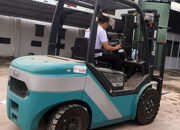
Notes when operating a reach truck

Notes when operating a reach truck

Operating a reach truck requires skill and experience to ensure safety and efficiency in the process. Here are important notes when operating a reach truck:

Get Trained and Certified: Before operating a reach truck, attend training and obtain an operating certificate from a reputable training organization. Master the regulations on occupational safety, operating techniques and emergency procedures.

Before each shift, inspect the reach truck to make sure it is in good working order and safe. Check brakes, lights, sirens, wheels, etc.

Always follow safety rules: Follow safety rules when operating a reach truck, including keeping a safe distance from other objects, not overloading, not going too fast, and always in the right lane.

Handle the vehicle carefully: Control the reach truck slowly, steadily and carefully. Avoid sudden acceleration or deceleration, do not fall too quickly, and always ensure a good viewing angle to avoid collisions.

Use personal protective equipment: Always wear personal protective equipment such as helmets, safety shoes, goggles, and protective vests to protect yourself from danger during forklift operations. truck.

Do not sit on or stand on the fork: Avoid sitting or standing on the fork of a reach truck as this is very dangerous. Use only forklift parts designed for operator use.

Careful handling of cargo: Lift and lower cargo carefully, making sure it is balanced on the forks and does not exceed the vehicle’s load capacity. Always make sure the cargo is fixed and stable on the forks, and do not pull or push the cargo too quickly to avoid the risk of the cargo falling.

Follow emergency procedures: Master emergency procedures such as stopping if necessary, stopping when other vehicles or pedestrians appear on the road, and know how to use the fire extinguishing system or equipment rescue in case of need.

Do not use reach trucks on unsuitable terrain: Reach trucks are designed to operate on flat and hard surfaces and should not be used on uneven terrain, subsidence, soft ground or surfaces. unstable.

Routine Maintenance: Perform routine maintenance on your reach truck according to the manufacturer’s instructions, including inspecting, lubricating, and replacing old, damaged, or damaged parts.

Do not exceed operator capabilities: Do not operate a reach truck when you are not physically, mentally, or physically capable of working safely. This means not operating a vehicle when you are tired, under the influence of drugs or stimulants, or are not skilled enough to operate a vehicle safely.

The dangers of improperly operating reach trucks
If a reach truck is not operated properly, a variety of hazards can arise, including:

Occupational accidents: This is the biggest danger of improperly operating reach trucks. Accidents can occur when the vehicle is not driven correctly, drops goods, collides with structures or other objects, or capsizes the vehicle. This can result in serious injury to the operator, bystanders or even death.

Damage or property damage: If the reach truck is not operated properly, damage or damage to goods, construction, equipment or infrastructure can result. This can cause significant property damage and affect the business’s production or services.

Loss of time and resources: When operating a reach truck improperly, it can lead to inefficient uptime, costing your business time and resources. Facing breakdowns, repairing, or replacing damaged parts can also be financially costly.

Legal and toll: Incidents or accidents related to improper operation of reach trucks can lead to legal problems, including violations of occupational safety regulations, resulting in continued interest. or claim damages. This can lead to significant fees for businesses.

Damage to Reputation and Image: An accident or incident involving an improper reach truck can affect a business’ reputation and image.

To avoid hazards when operating a reach truck, the following precautions should be observed:

Trained and Certified: Reach truck operators need proper training and appropriate certification. This ensures that they understand the safety rules, know how to use the controls and prevent accidents.

Read and follow operating instructions: Before operating a reach truck, an operator should read and understand the manufacturer’s operating instructions. This guide provides important information on how to operate your vehicle safely and efficiently.
Leave a Reply

Your email address will not be published. Required fields are marked *

Related posts

  • cam bien can reach stacker Reach Stacker Sensors Boom Length, Boom Angle, and Twist-Lock Diagnostic

    Reach Stacker Sensors Boom Length, Boom Angle, and Twist-Lock Diagnostics and Replacement On a Reach Stacker, the boom length sensor, boom angle sensor, and twist-lock sensor constitute three critical signal groups determining whether the machine is permitted to lift, extend the boom, or release a container. When one of these sensors outputs an incorrect signal, […]

  • van-hang-xe-nang-dien Safe operation and maintenance procedures for electric forklifts

    Safe operation and maintenance of electric forklifts Related systems and responsibility for maintaining safe operating rules for electric forklifts. Rules and procedures for safe operation. Safe forklift operation procedures Electric forklifts and internal combustion forklifts are nearly identical in shape and construction, respectively. But there is a difference in the exact operation method: Since the […]

  • lai xe nang cho hang Bằng lái và chứng chỉ vận hành xe nâng điều kiện, chi phí, học ở đâu

    Sorry, this entry is only available in Tiếng Việt. For the sake of viewer convenience, the content is shown below in the alternative language. You may click the link to switch the active language. Chứng chỉ vận hành xe nâng điều kiện, chi phí, học ở đâu? Đáp án nhanh: Muốn vận hành xe nâng […]

  • phu tung cho xe nang cont 10 Essential Spare Parts Every Container Handler Warehouse Must Stock

    10 Essential Spare Parts Every Container Handler Warehouse Must Stock A multi-billion–dong container handler standing idle — halting the entire logistics chain and causing massive operational losses — simply because of one unavailable spare part. This painful yet all-too-familiar scenario occurs at many ports and depots. The cost of downtime per hour far exceeds the […]

  • xe-chup-kalma Frequently Asked Questions about Kalmar Container Reach Stackers

    Frequently Asked Questions about Kalmar Container Reach Stackers 1. What is the maximum lifting capacity of a Kalmar Reach stacker? A Kalmar Reach stacker has a maximum lifting capacity ranging from 45 to 50 tons, depending on the specific model. For example, the DRG450-65S5X model can lift up to 45 tons in the first row, while some higher-end models like the DRG500-75S5X can lift up to 50 tons. 2. is the average lifespan of a Kalmar Container Reach stacker? With proper maintenance, a Kalmar Container Reach stacker can operate efficiently for around 15-20 years. However, the exact lifespan depends on various factors such as usage frequency, working conditions, and maintenance quality. Some of our customers have reported that their machines are still running well after more than 25 years of use. 3. How much is the annual maintenance cost for a Kalmar Reach stacker? The annual maintenance cost for a Kalmar Reach stacker typically ranges from 3% to 5% of the initial value of the machine. This means that for a machine priced at around $500,000, the annual maintenance cost could be between $15,000 and $25,000. However, this figure may vary depending on usage intensity and operating conditions. 4. What are some special safety features of Kalmar Reach stackers? Kalmar Reach stackers are equipped with advanced safety features including: – Anti-Tipping System – Load weight sensors and overload warning – 360-degree cameras for comprehensive visibility – Regenerative braking system – ROPS (Roll-Over Protective Structure) compliant cabin design – Obstacle detection and warning system – Safety lockout system when operator is absent 5. What is the average fuel consumption of a Kalmar Reach stacker? The average fuel consumption of a Kalmar Reach stacker typically ranges from 12 to 18 liters of diesel per hour of operation, depending on the model and working conditions. Our latest models come with fuel-saving Eco Drive Mode technology that can reduce consumption to as low as 10-15 liters per hour under normal operating conditions. 6. Which Kalmar Reach stacker models are suitable for small and medium-sized ports? Kalmar offers several Reach stacker models suitable for small and medium-sized ports: – DRG420-60S5: This model can lift 42 tons, suitable for ports with moderate container traffic. – DRG450-65S5: With a lifting capacity of 45 tons, this is a flexible choice for various types of ports. – Gloria DRG100-54S6: This compact model is ideal for ports with limited space. These models have smaller dimensions, lower fuel consumption, but still ensure high performance. 7. How to optimize the performance of a Kalmar Reach stacker in a port environment? To optimize performance, it is important to: – Provide thorough training for operators on efficient driving techniques and stacking operations. – Use Kalmar’s fleet management software to monitor and analyze performance. – Implement preventive maintenance to minimize downtime. – Optimize traffic flow and workspace layout within the port. – Use Eco Drive mode whenever possible to save fuel. – Update software regularly to take advantage of the latest improvements. 8. What are the key advantages of Kalmar Reach stackers compared to other brands? Kalmar Reach stackers stand out with: – Stable operation, high reliability and long lifespan. – Advanced technology such as SmartWheel intelligent control system. – Low fuel consumption thanks to Eco Drive technology. – Ergonomic cabin design with good visibility for operator comfort. – Global support network and service offerings from the brand. – Many integration options with automation systems in warehouses and ports. 9. How long does training for operating a Kalmar Reach stacker typically last? Training usually lasts from 2 to 4 weeks including: – One week theoretical training on safety, operational mechanisms and basic maintenance. – One-two weeks practical training on simulator machines. – One week practical training on real machines under supervision. After training completion, operators need an additional 100–200 hours of practice to become proficient. Kalmar also provides advanced training courses and regular updates. 10. How to troubleshoot common issues on a Kalmar Reach stacker? Common troubleshooting steps for issues on a Kalmar Container reach Stacker include: – Use onboard diagnostic systems to identify faults. – Refer to user manuals for basic troubleshooting procedures. – For engine issues check fuel levels, air filters and electrical connections. – For hydraulic issues check oil levels and leaks. – For electrical issues check fuses and connections. 11. What automation features are available on the latest models of Kalmar Reach Stackers? The latest models of Kalmar reach Stackers come equipped with advanced automation features such as: […]

Gọi ngay
Chat Zalo