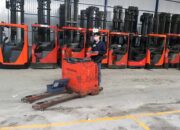
Instructions on how to maintain forklift batteries

Ways to maintain batteries for electric forklifts

Forklift battery maintenance is an extremely important part of keeping forklift operations in warehouses, yards, and docks running smoothly. When a forklift lifts goods up and down with high intensity without care, maintenance or maintenance, it often causes your forklifts to quickly break down and your ability to work is gradually lost. capacity. But instead, if you take the time to care for this type of forklift, and with a few simple steps on how to care for your forklift, you can get the most out of your battery’s lifespan for years to come.

bao tri acqui xe nang

Proper care and watering of the battery can help prolong the life of this industrial battery. Here are 7 simple tips for proper forklift battery maintenance:

Keep the battery clean, dry and free of corrosion.
Maintain the correct water level (about a half inch below the battery cap).
Add water after the battery charge cycle.
Establish a weekly or monthly watering (flush/ flush/ add) watering plan to ensure proper battery water level.
Avoid overcharging the battery (charge during breaks and lunch breaks) because every time you connect the battery to the charger, one of its reduced life cycles is added.
Inspect your battery for/early detect any defects or failures and have them repaired by your service provider if necessary.
Have your forklift batteries cleaned and serviced every six months to control acid and corrosion.
Here are 10 essential factors users need to know to take care of forklift batteries:

– Add approved water – never add acid

– Keep the electrolyte level above the separator

– Keep the battery clean and dry

– Keep fire and metal away from the top of the battery

– Keep the vent cap in place, avoid clogging the vent cap.

– Up to 80% off and no battery operation if specific gravity is less than 1,150 for Powerline, Varta batteries, No water and 1,175 power source for Energy-Plus batteries

– Cool before charging or operating if the battery is above 115 degrees Fahrenheit

– Use only approved chargers with the correct voltage and output.

– Keep the forklift compartment and battery cover open while charging

– When in any doubt, call your service representative for assistance

Instructions for filling the battery water:

– Approved water: Only distilled and deionized water should be added to the battery, check your specifications.

– Proper electrolyte level: The dielectric level must be kept between the “high water level” and the separation guard. Only refill the battery at the end of the charge cycle.

Attention: Do not overfill. Moisture on the top of the battery means the battery is overcharged.


Leave a Reply

Your email address will not be published. Required fields are marked *

Related posts

  • phu tung kalmar reachstacker Reputable Kalmar Reachstacker Spare Parts Supplier

    Reputable Kalmar Reachstacker Spare Parts Supplier – Direct Distribution and Global Delivery   In the maritime port, logistics, and heavy transport industries, Kalmar Reachstackers are considered the backbone of all cargo handling operations. Operating continuously in harsh environments with massive payloads, component wear and tear is inevitable. When a machine breaks down, every minute of […]

  • reachtruck What is Reach truck? Address to rent and buy cheap

    What is Reach truck? Address to rent and buy cheap prestigious Reachtruck forklifts Reach trucks are forklifts used in warehouses and factories to move goods from one place to another. The name “Reach truck” comes from its ability to “reach” to high and narrow locations to pick up or place goods. It is considered one […]

  • xe nang kho pallet dien A Comprehensive Guide to Selecting Electric Pallet Trucks for Small Warehouses Introduction

    For small-scale warehouses, supermarkets, or production workshops, optimizing space and operational efficiency presents a significant challenge. The reliance on traditional manual hand pallet jacks not only curtails labor productivity but also introduces potential safety risks. Conversely, investing in a full-sized counterbalance forklift is often not feasible due to spatial and financial constraints. In this context, […]

  • forklift-cat FAQs about Forklift

    Frequently Asked Questions about Forklifts 1. What is a forklift? Answer: A forklift is a specialized vehicle designed to lift, lower, and move goods and materials in warehouses and factories easily and safely. It is equipped with front lifting forks and an engine for movement. 2. What are the most common types of forklifts? Answer: Some common types of forklifts include counterbalance forklifts, electric forklifts, pneumatic forklifts, and manual pallet jacks. Among them, electric forklifts are the most popular due to their flexibility, ease of use, and environmental friendliness. 3. What is the typical lifting range of a forklift? Answer: The standard lifting range of a forklift is usually between 2m – 5.5m depending on the type and capacity. For high-rise warehouses, taller lifting ranges up to 7-12 meters can be used. 4. What is the maximum safe load capacity of regular forklifts? Answer: The safe load capacity of regular forklifts ranges from 1 – 5 tons depending on the capacity and size of the vehicle. For heavy-duty forklifts, the load capacity can go up to 10-15 tons. Always follow the manufacturer’s recommended load limits to ensure safety. 5. What are the common fuel options for forklifts? Answer: Forklifts commonly run on electricity (battery) or diesel/gasoline fuel. Electric forklifts are preferred in indoor warehouses due to their clean operation, quietness, and ease of use. 6. How should a forklift be regularly maintained? Answer: To ensure proper operation and safety, a forklift should undergo regular maintenance every month or after a certain number of operating hours. Maintenance tasks typically include checking oil levels, replacing oil/fuel filters, inspecting brakes/tires, charging/replacing batteries (for electric forklifts), etc. 7. How much does it cost to operate and maintain a forklift annually? Answer: The annual operating and maintenance cost for a regular forklift is around 15 – 30 million VND, including fuel costs (diesel, gasoline, electricity), regular maintenance, and small component replacements. For higher-end forklifts, the cost can go up to 50-70 million VND per year. 8. How to safely lift and lower palletized loads with a forklift? Answer: When lifting loads, tilt the forks forward by 15 degrees to ensure stability, move slowly, and maintain a safe distance from the surroundings. Lift the load slowly according to the driver’s visibility. Lower the load slowly in a tilted direction. Avoid sudden lifting or lowering that may cause load spills. 9. What qualifications or certifications are required to operate a forklift? Answer: Forklift operators need to have certification in safe operation and handling of forklifts. They also need to possess a Forklift Driver’s License issued by the authorized agency to legally operate the vehicle. 10. What are the standard dimensions of different types of forklifts? Answer: The dimensions of forklifts vary depending on their load capacity and type. Typically, length ranges from 1.5 – 3m; width ranges from 0.5 – 1m; height ranges from 1.5 – 4m. Some models have smaller dimensions to fit narrow aisles. 11. On what types of terrains can forklifts operate? Answer: Forklifts can operate well on most flat surfaces such as concrete, asphalt, tiled floors, etc. However, they should not be used on rough or uneven terrains or muddy areas. 12. What is the safe traveling speed of a forklift when carrying loads? Answer: The recommended safe traveling speed for a forklift carrying loads is 8-12 km/h. Speed should be reduced when going around corners or narrow paths. 13. How to stack loads on a forklift to ensure safety? Answer: Loads should be stacked evenly and within the allowed load capacity. Do not stack higher than the fork height. Maintain stability while moving. Stack in a way that does not obstruct the driver’s visibility. 14. What safety features do forklifts have? Answer: Forklifts are equipped with reverse alarms, turn signals, warning horns, anti-tip frames, and guardrails to protect the driver and cargo. 15. How long does it take to fully charge an electric forklift battery? Answer: The average charging time for an electric forklift battery is 6-8 hours. It should be fully charged before each shift. Some models can have fast charging options within 2-3 hours. 16. Which countries are the most common sources of imported forklifts? Answer: Forklifts are mostly imported from Japan, South Korea, China, and Taiwan. These countries are known for their quality and popular brands in Vietnam. 17. What are some popular forklift brands? Answer: Some popular forklift brands include Toyota, Mitsubishi, Komatsu, Nissan, TCM, Hangcha, Lonking… 18. Is it better to buy a new or used forklift? Why? Answer: It is recommended to buy a new forklift to ensure quality and longevity of the vehicle. New forklifts have high durability, fewer breakdowns, and lower maintenance costs. Used forklifts may be cheaper but come with higher risks of issues. 19. How much does it cost to insure a forklift annually? Answer: The insurance cost for a forklift is around 4-8% of the vehicle’s value. For example, for a 500 million VND forklift, the insurance fee would be approximately 20-40 million VND per year depending on the coverage. 20. What is the process for inspection and registration of a forklift? Answer: Forklifts need to undergo inspection and registration procedures according to local regulations. This typically involves submitting necessary documents, paying fees, and obtaining registration plates or stickers.

  • diesel-forklift Analysis of investment efficiency between electric forklifts and diesel forkls

    Analysis of investment efficiency between electric forklifts and diesel forkls In today’s modern industrial and logistics world, choosing the right lifting equipment plays a crucial role in optimizing performance and operating costs. The two most popular types of forkls on the market today are electric forklifts and diesel forklifts. Each type has its own advantages and limitations, requiring businesses to carefully consider before making investment decisions. This article will analyze in detail the investment efficiency between electric forklifts and diesel forklifts, helping you have a comprehensive view to make informed choices. Overview of electric forklifts and diesel forklifts Electric forklifts use energy from batteries to operate, while diesel forklifts run on internal combustion engines using diesel fuel. Electric forklifts are often preferred in indoor working environments due to their lack of harmful emissions. On the other hand, diesel forklifts are suitable for outdoor tasks, especially in challenging terrain conditions. Key strengths of electric forklifts include: – Smooth operation, low noise levels – No direct emissions, environmentally friendly – Lower operating costs in the long run – Simpler maintenance Key weaknesses of electric forklifts include: – Higher initial investment costs – Long battery charging times – Limited continuous operation due to battery capacity Key advantages of diesel-powered forklifts include: – High power output, suitable for heavy loads – Diesel forklifts can work continuously over long periods – Good adaptation to outdoor conditions and challenging terrains Disadvantages of diesel-powered forklifts include: – Emission of harmful gases – High noise levels – Higher fuel consumption and maintenance costs – Initial investment costs When comparing initial investment costs, diesel-powered forklifts usually have lower prices than electric ones with the same capacity. However, this price difference is gradually narrowing as battery technology and electric motors are being improved. Factors affecting the price of a forklift: – Lifting capacity and load weight – Brand and origin – Features and accompanying technologies For example, a 3-ton diesel-powered forklift may cost between 300-400 million VND, while an electric one with the same load capacity may range from 400-550 million VND. However, it is important to note that the initial price is only part of the total ownership and operating costs of a forklift. Operating costs Operating costs are an important factor in determining long-term investment efficiency. This is an area where electric forklifts often have an advantage. Fuel consumption costs: Electric forklifts have significantly lower energy costs. With an average electricity price of around 2,000 VND/kWh, energy costs can be only 1/3 to 1/4 compared to diesel-powered ones using fuel priced at around 20,000 VND/liter. Maintenance and repair costs: Electric forklifts have simpler construction with fewer moving parts, so maintenance costs are usually lower. However, when replacing batteries (usually after 5-7 years), the cost can be quite high, accounting for about 30-40% of the vehicle’s value. Diesel-powered forklif…

Gọi ngay
Chat Zalo